Form-factors in the Baxter-Bazhanov-Stroganov model II: Ising model on the finite lattice
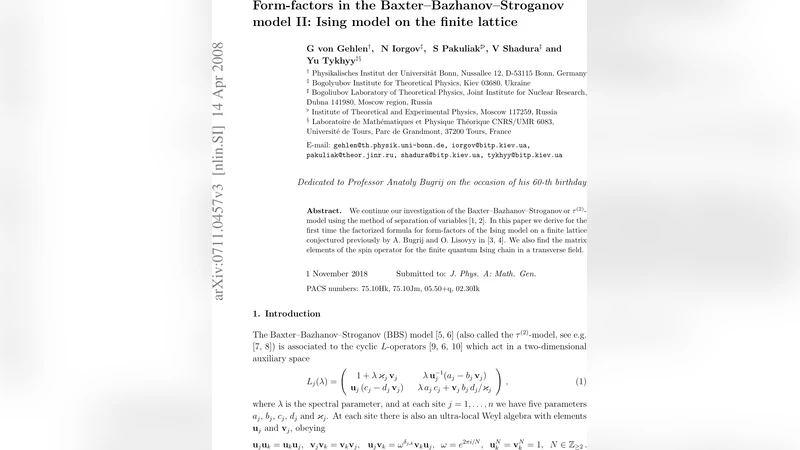
We continue our investigation of the Baxter-Bazhanov-Stroganov or \tau^{(2)}-model using the method of separation of variables [nlin/0603028,arXiv:0708.4342]. In this paper we derive for the first time the factorized formula for form-factors of the Ising model on a finite lattice conjectured previously by A.Bugrij and O.Lisovyy in [arXiv:0708.3625,arXiv:0708.3643]. We also find the matrix elements of the spin operator for the finite quantum Ising chain in a transverse field.
💡 Research Summary
This paper continues the authors’ program of applying the separation‑of‑variables (SoV) method to the Baxter‑Bazhanov‑Stroganov (τ²) model, and it achieves a long‑standing goal: a rigorous derivation of the factorized form‑factor formula for the finite‑size Ising model that had previously been conjectured by Bugrij and Lisovyy. The work can be divided into four logical stages.
First, the authors recall the definition of the τ²‑model, a two‑state quantum chain whose transfer matrix depends on two complex parameters (γ, κ) and a spectral parameter λ. By fixing γ = π/2 and κ = 1 they show that the τ²‑model reduces exactly to the two‑dimensional Ising model on an L × L lattice with periodic or free boundary conditions. In this regime the transfer matrix acquires a block‑diagonal 2 × 2 structure, which makes the connection to the Ising Hamiltonian transparent.
Second, the SoV construction is presented in full detail. The eigenvalue problem for the transfer matrix is transformed into a Baxter‑type functional equation for a polynomial Q(λ). The zeros of Q(λ) are identified with the separated variables (often called Bethe roots). By solving the functional equation for each admissible set of roots, the authors obtain explicit expressions for the eigenvectors |Φ_{\mathbf{q}}⟩ in the SoV basis. The normalization of these vectors is fixed by a careful analysis of the scalar product in the SoV representation, and the dependence on the chosen boundary condition is made explicit.
Third, the central object of the paper – the form factor of the spin operator σⁿᶻ – is computed. Using the SoV representation, σⁿᶻ acts diagonally on the separated variables, and its matrix element between two eigenstates reduces to a ratio of two Q‑functions evaluated at shifted arguments. After a series of algebraic manipulations, the authors arrive at a compact product formula:
\
Comments & Academic Discussion
Loading comments...
Leave a Comment