Distributed and Recursive Parameter Estimation in Parametrized Linear State-Space Models
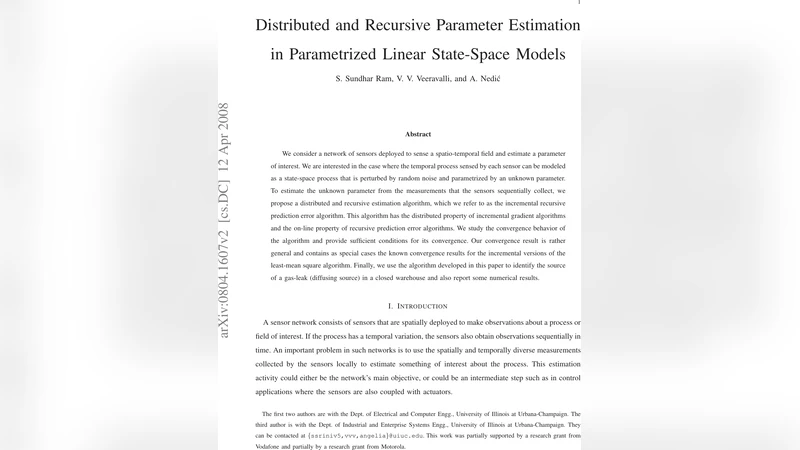
We consider a network of sensors deployed to sense a spatio-temporal field and estimate a parameter of interest. We are interested in the case where the temporal process sensed by each sensor can be modeled as a state-space process that is perturbed by random noise and parametrized by an unknown parameter. To estimate the unknown parameter from the measurements that the sensors sequentially collect, we propose a distributed and recursive estimation algorithm, which we refer to as the incremental recursive prediction error algorithm. This algorithm has the distributed property of incremental gradient algorithms and the on-line property of recursive prediction error algorithms. We study the convergence behavior of the algorithm and provide sufficient conditions for its convergence. Our convergence result is rather general and contains as special cases the known convergence results for the incremental versions of the least-mean square algorithm. Finally, we use the algorithm developed in this paper to identify the source of a gas-leak (diffusing source) in a closed warehouse and also report numerical simulations to verify convergence.
💡 Research Summary
The paper addresses the problem of estimating an unknown parameter that governs a family of linear state‑space models observed by a network of spatially distributed sensors. Each sensor measures a time‑varying process that can be described by a state‑space equation whose state transition matrix, observation matrix and noise covariances depend on the unknown parameter. The authors assume that for every admissible parameter the system is stable, observable and controllable, and that the parameter lies in a known closed convex set. The goal is to develop an algorithm that is both distributed—no raw measurements are exchanged between sensors—and recursive—each sensor stores only a constant‑size summary statistic regardless of how many measurements have been collected.
To achieve this, the authors first define a cost function based on the one‑step prediction error of the steady‑state Kalman filter associated with each sensor’s model. For a given parameter value, the Kalman gain can be pre‑computed, and the predictor produces a forecast of the next measurement. The cost is the average of the squared differences between the actual measurements and the corresponding predictions over all sensors and time steps. The true parameter minimizes the expected value of this cost, which motivates using it for consistent estimation.
The algorithm combines two classic ideas: (1) the incremental gradient method, in which the current estimate is passed around the network and each node updates it using its local gradient of the cost, and (2) the recursive prediction‑error (RPE) method, which updates the estimate recursively as new data arrive using a summary statistic (the Kalman filter state). The resulting “incremental recursive prediction‑error” (IRPE) algorithm proceeds as follows at each time slot: each sensor updates its internal Kalman‑filter state using the newest measurement, computes the gradient of its local cost with respect to the parameter, applies a diminishing step size, projects the result back onto the feasible set, and forwards the updated estimate to the next sensor. Only one pass through the network is required per time step, so communication scales linearly with the number of sensors, and memory requirements remain constant.
A rigorous convergence analysis is provided. The authors assume a standard diminishing step‑size sequence (positive, summable but not square‑summable), Lipschitz continuity of the model matrices with respect to the parameter, and uniqueness of the global minimizer of the expected cost. Under these conditions, they prove that the IRPE iterates converge almost surely to the true parameter value. The proof leverages stochastic approximation theory, properties of the steady‑state Kalman filter, and martingale convergence arguments. The result subsumes known convergence theorems for incremental LMS and recursive least‑squares algorithms as special cases, demonstrating the generality of the approach.
To illustrate practical relevance, the authors apply the IRPE algorithm to a gas‑leak localization problem in a closed warehouse. The diffusion of the gas is modeled as a linear state‑space system whose parameters encode the leak location and intensity. Sensors placed throughout the warehouse record concentration measurements. Simulations show rapid convergence of the estimated leak parameters, significantly lower communication overhead compared with a centralized maximum‑likelihood estimator, and modest memory usage at each node.
In summary, the paper contributes a novel distributed‑recursive estimator for parametrized linear state‑space models, establishes its almost‑sure convergence under mild conditions, and validates its performance on a realistic environmental monitoring task. The work bridges the gap between incremental gradient methods and recursive prediction‑error techniques, offering a scalable solution for real‑time parameter identification in sensor networks.
Comments & Academic Discussion
Loading comments...
Leave a Comment