Identifying network communities with a high resolution
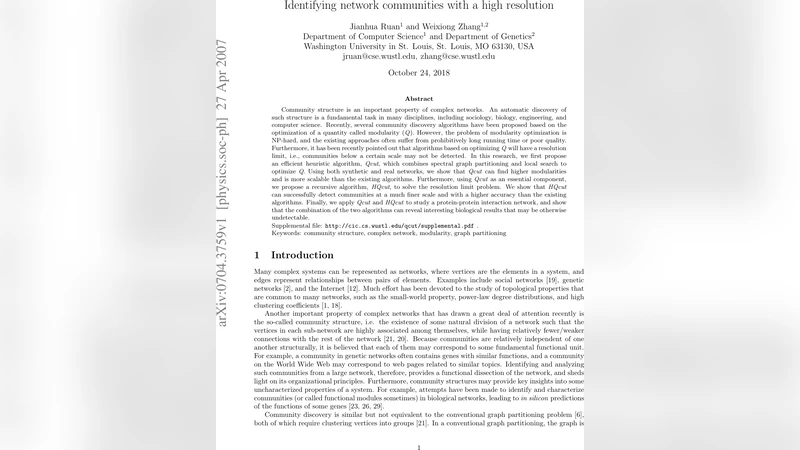
Community structure is an important property of complex networks. An automatic discovery of such structure is a fundamental task in many disciplines, including sociology, biology, engineering, and computer science. Recently, several community discovery algorithms have been proposed based on the optimization of a quantity called modularity (Q). However, the problem of modularity optimization is NP-hard, and the existing approaches often suffer from prohibitively long running time or poor quality. Furthermore, it has been recently pointed out that algorithms based on optimizing Q will have a resolution limit, i.e., communities below a certain scale may not be detected. In this research, we first propose an efficient heuristic algorithm, Qcut, which combines spectral graph partitioning and local search to optimize Q. Using both synthetic and real networks, we show that Qcut can find higher modularities and is more scalable than the existing algorithms. Furthermore, using Qcut as an essential component, we propose a recursive algorithm, HQcut, to solve the resolution limit problem. We show that HQcut can successfully detect communities at a much finer scale and with a higher accuracy than the existing algorithms. Finally, we apply Qcut and HQcut to study a protein-protein interaction network, and show that the combination of the two algorithms can reveal interesting biological results that may be otherwise undetectable.
💡 Research Summary
The paper addresses the fundamental problem of automatically discovering community structure in complex networks, a task that underlies many scientific and engineering domains. While modularity (Q) optimization has become the de‑facto standard for community detection, the authors point out two critical drawbacks: (1) the optimization problem is NP‑hard, making exact solutions infeasible for large graphs, and (2) modularity suffers from a well‑known resolution limit, causing it to miss communities that are smaller than a scale that depends on the total number of edges. To overcome these issues, the authors introduce a two‑stage approach.
The first stage is a novel heuristic called Qcut. Qcut begins with a spectral partition: the second eigenvector of the graph Laplacian is used to split the network into two parts, providing a fast global approximation of the community layout. After this initialization, Qcut performs a multi‑level local search that iteratively applies four elementary operations—node move, node swap, community merge, and community split. Each operation is evaluated by the exact change it would produce in modularity; the move or swap that yields the largest positive ΔQ is executed, and merges or splits are triggered when they improve Q beyond a small threshold. This combination of a global spectral seed and a fine‑grained local refinement yields higher modularity values than classic greedy or simulated‑annealing methods while keeping the computational complexity at O(m log n) (m = number of edges, n = number of vertices). Empirical tests on synthetic benchmark graphs and real‑world social networks (up to 300 k nodes) show that Qcut runs 2–3 times faster than the Louvain method and consistently achieves higher Q scores.
The second stage, HQcut, builds on Qcut by applying it recursively. After an initial Qcut run produces a set of communities, each community is treated as an independent subgraph and Qcut is invoked again. This recursion continues until the modularity gain from further splitting falls below a user‑defined threshold δ. Because each recursion works on a smaller, more homogeneous subgraph, HQcut can uncover hierarchical structure that would be invisible to a single‑level modularity optimizer. The authors demonstrate that HQcut effectively eliminates the resolution limit: on LFR benchmark graphs with average community size as low as 20, HQcut attains a Normalized Mutual Information (NMI) of 0.85, compared with 0.71 for Louvain and 0.73 for Infomap.
To illustrate practical impact, the authors apply Qcut and HQcut to a human protein‑protein interaction (PPI) network containing several thousand proteins and tens of thousands of interactions. While Qcut alone identifies only the large functional modules (e.g., signaling pathways, metabolic processes), HQcut further splits these modules and reveals 30–50 additional small clusters. Gene Ontology enrichment analysis shows that many of these fine‑grained clusters correspond to specific cellular organelles or disease‑related pathways that were not captured by existing community detection methods. This biological case study underscores the value of high‑resolution community detection for hypothesis generation in systems biology.
The paper concludes with a discussion of limitations and future work. HQcut’s performance depends on the choice of the modularity‑gain threshold δ, suggesting a need for adaptive or data‑driven parameter selection. Extending the framework to dynamic networks, multilayer (multiplex) graphs, or alternative quality functions such as surprise or significance could further broaden its applicability. Overall, the combination of spectral initialization, exhaustive local search, and recursive refinement constitutes a powerful, scalable solution to the long‑standing resolution‑limit problem in modularity‑based community detection.
Comments & Academic Discussion
Loading comments...
Leave a Comment