Distributed Space Time Codes for the Amplify-and-Forward Multiple-Access Relay Channel
In this work, we present a construction of a family of space-time block codes for a Multi-Access Amplify-and- Forward Relay channel with two users and a single half-duplex relay. It is assumed that there is no Channel Side Information at the transmit…
Authors: Maya Badr, Jean-Claude Belfiore
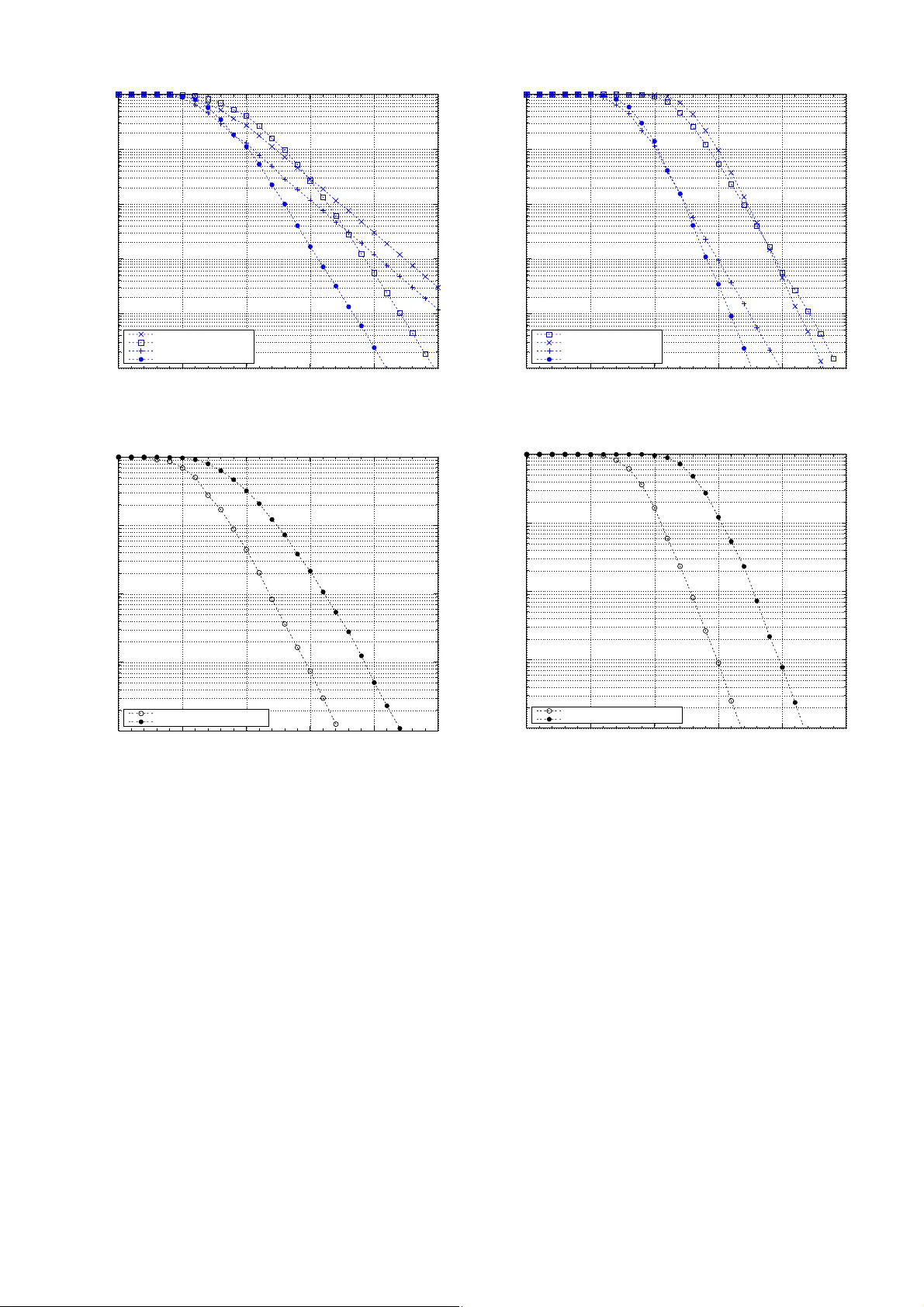
Distrib uted Space T i me Codes for the Amplify-and-F orward Multiple -Access Relay Channel Maya Badr E.N.S.T . 46, rue Barrault 75013 Paris, France Email: mbadr@enst.fr Jean-Claud e Belfiore E.N.S.T . 46, rue Barrault 75013 Paris, France Email: belfiore@e nst.fr Abstract — In this wor k, we present a construction of a family of space-time block codes for a Multi-Access Amplify-and- For ward Relay channel with two users and a single half-duplex relay . It is assumed that th ere is no Channel Side Inform ation at the transmitters and that they are not allowed to cooperate together . Using the Diversity Mult iplexing T radeoff as a tool to ev alu ate the perf ormance, we prov e that the proposed scheme is optimal in some sense. Moreo ver , we pro vide numerical results which show that the new scheme outperforms the orthogonal transmission sch eme, e. g. time sharing and offers a significant gain. I . I N T R O D U C T I O N In a Multiple Access Relay (MAR) channe l, first intr oduced in [5 ], multiple users co mmunica te with a sing le destina tion with the help of some relays. Many coopera tion protocols were applied to the MAR chan nel, su ch as the well-known Dy- namic Deco de-Forward (DDF) protocol [4] an d the Com press- Forward (CF) proto col [10]. As a perfor mance analysis tool, the Di versity Multiplexing Tradeoff (DMT), first introduced by Z heng an d Tse in [7], is u sed. Na mely , the upper b ound on the achiev able DMT for the MAR chann el derived in [4] is used to compar e different strategies. In the DDF strategy , both users tran smit their informa tion symbols th rough out an entire b lock, the r elay de codes the in - formation it rec eiv es only when it has a su fficient in formatio n for a correct de tection. Then the relay re- encodes the message and transmits it to the destination. It is shown in [ 4] that th e DDF protocol a chieves the optim al DMT fo r low mu ltiplexing gains while being suboptimal for high mu ltiplexing gains. In the CF pr otocol, the relay uses source coding to compre ss its received signal a nd f orward it to the destination. I t is shown in [ 10] that this com munication strategy achieves th e o ptimal DMT f or high mu ltiplexing gains, but suffers from a diversity loss for a lo w multiplexing gain . In this work, we consider the Multi-A ccess Amplify - Forward (MAF) recently pro posed by Chen et al. in [1] assuming a half-d uplex relay . In th is paper, the author s fo- cused on the special ca se of two users, one relay channel and high lighted the significan t gain s provided by the M AF protoco l and the comp lexity reduc tion it of fers com pared to previously proposed p rotoco ls. The two-user MAF r elay channel is equiv alen t to a virtual m ulti-anten na MA C (in fact MIMO-MAC, two transmit antenn as pe r u ser in this case). In [2], [3], Gärtne r and Bölc skei presented a d etailed analysis of the MAC based o n the different err or ty pes that can be encounter ed in this cha nnel and deriv ed th e spa ce-time code design criter ia for mu ltiantenna MA Cs. Moreover , th ey showed tha t their code de sign criteria are optimal with respect to the DMT of the cha nnel, [8], and proved that, for a MIMO- MA C, o utage analysis allows a rigorous characterization of the do minant error event region s. I n other words, o utage and error probabilities h av e the same behaviors. Based on th is fundam ental r esult, we presented in a pr evious work [9] an optimal space-time coding scheme for the M IMO-MAC . Our main contr ibution, her e, is a n ew con struction of a family of o ptimal space- time block co des for th e two-user, single relay MAF relay chan nel inspired by the code designed for the MIMO-MAC and based on the DMT of this channel derived in [1]. Recall that the u sers can ’t cooperate tog ether, hence, without any confusion , in the sequel, the terminology “cooper ativ e” and “non -coop erative” simply r epresent chan- nels with and with out relay , respectiv ely . I I . S Y S T E M M O D E L W e use boldface cap ital letter s M to denote matrices. C N represents the co mplex G aussian random v ar iable. [.] ⊤ ( r esp. [.] † ) den otes the matr ix transposition ( r esp. con jugated transposition) operation . A 2 x × y matrix M 2 , resulting fro m the concatenatio n of the first x rows of the initial 2 x × y matrix, M 1 and the remaining x rows is d enoted (Ma tlab R notation) M 2 , [ M 1 (1 : x, 1 : y ) M 1 ( x + 1 : 2 x, 1 : y )] A. The Multiple Access Relay Channel The MAR channel is a MAC with one or m ore re lays helping the users to c ommun icate with the destination while the cooper ation between the users is n ot allowed. In this work, we con sider the case of tw o users single-relay MAR channel. Let n t , n r and n d be the num ber of anten nas at the transmitters, the relay and the d estination, respecti vely . The d 2 1 r H 1 , d H 2 , d H 1 , r H 2 , r H r , d Fig. 1. A 2-user mult iple access relay channel. channel mo del is illu strated in fig ure 1 where H i,d , H i,r and H r,d are n d × n t , n r × n t and n d × n r indepen dent matrices deno ting user i -destination, user i -relay and relay- destination, r espectively , with zero -mean unit variance i. i.d. Gaussian entries, i.e. , h i,j ∼ C N (0 , 1) . Let T denotes the len gth of a cooper ation fram e. All the fading coefficients remain co nstant within this coop eration frame but chang e indep enden tly from one frame to the o ther . Moreover , we assume that the Channel State I nform ation (CSI) can be tracked at the receiv er , thoug h it is n ot av ailab le at the tran smitters. Note tha t it is assumed th at the receiver has knowledge o f all CSIs, includ ing those o f the user-relay link s. B. Diversity-Multiplexing tradeoff The div ersity-multip lexing tradeo ff (D MT) was introd uced and fully char acterized in [7] in the context of a poin t to point commun ication. In this no tion, a coding scheme C ( SNR ) is said to achieve multiplexing gain r and diversity ga in d if lim SNR →∞ R ( SNR ) log SNR = r and lim SNR →∞ P e ( SNR ) log SNR = − d where R ( SNR ) is the data rate me asured by bits per cha nnel use ( BPCU) an d P e ( SNR ) is th e average error probability using the maximu m likelihood ( ML) dec oder . The optimal achiev ab le tradeoff d ( r ) can be fou nd as the exponent of the outage p robab ility in the high SNR regime. Consider th e following examples that will ha ve a major im portance in the development of this p aper . The DMT of an n r × n t Rayleigh MIMO poin t-to-po int channel is a piecewise-linear functio n joinin g po ints [ 7] d n t ,n r ( k ) = ( n r − k )( n t − k ) , k = 0 , 1 , . . . , min( n t , n r ) (1) The DMT o f the sym metric 1 MA C was in troduced and fully characterized in [8] d M AC ( r ) = d n t ,n r ( r ) , r ≤ min( n t , n r K +1 ) d K n t ,n r ( K r ) , r ≥ min( n t , n r K +1 ) (2) I I I . T H E M U LT I - A C C E S S A M P L I F Y - F O RW A R D P RO T O C O L In the Multi-Access Amplif y-Forward (MAF) p resented in [1], both users transmit th eir informations th rough out an entire coop eration fra me (two slots). Due to the h alf-dup lex constraint, the relay listens to both users dur ing the first slot, then, in the second slo t, it simp ly amplifies and forward the signal it received. The simplicity of this proto col is its m ain 1 Di versi ty orders and multiple xing gains per use r are identi cal ( r and d ) advantage, in contr ast to o ther protoco ls, such as the DDF and CF defined previously , tha t add a sign ificant complexity to the relaying terminal. In addition to the simp licity of the MAF , authors showed that the propo sed protocol outpe rforms both the D DF in the hig h multiplexing regime an d th e CF pro tocol in the low multiplexing r egime. A. Sign al mod el The MAF coope ration strategy can be simply illustrated as in the following figu re where plain lin e slots represent trans- mission mode, wh ereas d ashed slo ts represent th e listening mode. user 2 user 1 relay destination BY r Y 1 Y 2 X 21 Y r X 22 X 11 X 12 Fig. 2. A 2-user mult iple access relay channel. X ij are n t × T 2 matrices with i.i.d. unit variance en tries, representin g the space-time signa l fr om u ser i a t the j th slot. Y j ’ s represen t the received signal at the d estination Y 1 = P 2 i =1 √ P i 1 H i,d X i 1 + V 1 Y r = P 2 i =1 √ P i 1 H i,r X i 1 + W Y 2 = √ P r H r,d B Y r + P 2 i =1 √ P i 2 H i,d X i 2 + V 2 (4) where V 1 , V 2 and W are in depend ent A WGN ma trices with norma lized i.i.d. entries. p P ij and √ P r denote user i ’ s transmission power at the j th slot and the relay’ s transmission power , respectively . Each power is a fraction ( π ij and π r ) of the average r eceived SNR at th e destination. 2 B is an n d × n d normalizatio n matrix subject to th e p ower constra int E || B Y r || 2 F ≤ T 2 n r [6]. T akin g the same footsteps as th ose in [6], we obtain the f ollowing equiv alent cha nnel m odel ˜ Y j = 2 X i =1 ˜ H i ˜ X ij + z j , j = 1 , . . . , T / 2 (5) where ˜ X ij , X i 1 [ j ] T , X i 2 [ j ] T T and ˜ Y j , Y 1 [ j ] T , Y 2 [ j ] T T are the vectorized transmitted and received signals with M [ i ] d enoting the i th column of th e matrix M . z i ∼ C N (0 , I ) is the eq uiv alen t A WGN, the equiv a lent chan nel matr ix of u ser i is ˜ H i , √ P i 1 H i,d 0 √ P r √ P i 1 Ω H r,d B H i,r √ P i 2 H i,d (6) 2 The total transmit power in both time slots is ( n t P π ij + n r π r ) SNR . Since the channel coef ficients and the A WG N are normaliz ed, ( n t P π ij + n r π r ) SNR represen ts the av erage recei ved SNR for both time slots. W e choose the v alues of π ’ s satisfying n t P π ij + n r π r = 2 . d M AR ( r ) ≤ min n d 3 × n r ( r ) , d 2 × ( n r +1) ( r ) , d 2 × n r ( r 2 ) , d 1 × ( n r +1) ( r 2 ) o (3) Ω being the whitening m atrix satisfying ( Ω † Ω ) − 1 = ( ΩΩ † ) − 1 = I + P r ( H r,d B )( H r,d B ) † . I V . C O N S T RU C T I O N O F D I S T R I B U T E D S PAC E - T I M E C O D E S F O R T H E M A F R E L AY C H A N N E L In this section, we presen t our new construction o f space- time codes f or th e MAF relay channel f ollowing the same footsteps as the construction o f optimal space-time c odes for the MIMO Amplify -Forward c oopera ti ve chan nel in [6] combined w ith the construction of codes for the MI MO-MAC [9]. A. Structu r e of the codewor ds W e assume that the modulation u sed by both users is either a q uadratur e amplitude mo dulation (QAM) o r an hexagonal (HEX) m odulation . W e denote P the field Q ( i ) ( resp. Q ( j ) ), representin g the modu lated symbols. W e denote F a Galois extension of degree K over P with Galois gro up Ga l( F / P ) = { τ 1 , τ 2 , . . . , τ K } . K is a cyclic extension of degree n t on F and σ the generator of its Galo is group. Let X be an optimal sp ace-time code for the MIMO-M A C [9]. W e d efine the mother codeword of user k , M k , as a single-user compo nent of a codeword of X given by M k = Γ τ 1 ( Ξ k ) Γ τ 2 ( Ξ k ) . . . τ K ( Ξ k ) where Ξ k is an 2 n t × 2 n t matrix and Γ is a multiplication matrix factor fo r th e k − 1 first matrices o f M k . Now consider an eq uiv alen t co de C whose codewords ( per user) are in th e form C k , [ X k (1 : n t , 1 : 2 K n t ) X k ( n t + 1 : 2 n t , 1 : 2 K n t )] Then C achieves the optimal DMT of the K -user MAF channel with n t transmit anten nas per u ser , by transmittin g C k by user k , k = 1 , . . . , K in each cooperation frame. Th e code C is of length T = 4 K n t . The key idea of the proof o f this r esult is th at, by scalin g the size o f the und erlying QAM constellations by a factor o f SNR r , the exponent of SNR in the asympto tic expression of the error probab ility varies as the op timal DMT . For convenience of pr esentation, we consider as an example the two-user MAR chann el where one single-antenn a relay node is assigned to assist the two multip le-access u sers. B. T wo sing le-antenn a-user MAF Relay channel Optimal DMT : An up per bound on the o ptimal di versity gain fo r the symm etric two single-an tenna users MAR cha nnel with n r received antenna s is giv e n in (3) using a simple min- cut max- flow examination of the scheme in fig ure 1 as in [4]. Co nsider as an example the two-user MAR with a single r d 2 1 1 MAR MAF MAC TS 1 2 Fig. 3. DMT of the m ulti-a ccess relay channel (MAR), multi-acce ss amplify- forward (MAF) rel ay channel and multiple -access channe l (MAC ). receive antenna. The op timal DMT of this ch annel is upp er bound ed by d M AR ( r ) ≤ 2 − r, f or , 0 ≤ r ≤ 1 2 3 (1 − r ) , fo r , 1 2 ≤ r ≤ 1 (7) The DMT of the MAF re lay channel was der iv ed in [1] d M AF ( r ) = 2 − 3 2 r , f or , 0 ≤ r ≤ 2 3 3 (1 − r ) , fo r , 2 3 ≤ r ≤ 1 (8) Figure 3 illustrates these two DMTs, the DMT achieved by the MA C o btained using ( 2) for K = 2 , n T = n r = 1 , as well as the DMT achieved by a tim e-sharing scheme. This comparison rev e als the significant advantage that multiple users can p otentially gain fr om a single M AF relay an d shows that the MAF p rotoco l achieves the o ptimal DM T for 2 / 3 ≤ r ≤ 1 , [1]. It a lso shows the suboptimality of the time-sharing strategy . Note th at, if time-sharing is c onsidered , the system without coope ration is equiv alent to a point-to- point sch eme. Howe ver , with coopera tion, the MAF protoc ol is equiv alen t to the Non- orthog onal Amplify-Forward (N AF) protoco l [11]. Our goa l is to constru ct a space-time co de tha t achieves the optimal DMT of the two-user MAF relay channel. Code con struction: For the tw o-user MAF r elay channe l, we propose th e f ollowing code. W e fir st design each user’ s mother codeword. T his design aims to construct the Golden code on th e b ase field Q ( ζ 8 ) [6] in stead of th e b ase field Q ( i ) . Then, using results in [9], the equ i valent mother codew ord is designed. Let F = Q ( ζ 8 ) be an extension of Q ( i ) of degree K = 2 , with ζ 8 = e iπ 4 and K = F ( √ 5) = Q ( ζ 8 , √ 5) . Let σ : θ = 1+ √ 5 2 7→ ¯ θ = 1 − √ 5 2 , α = 1 + i − iθ an d ¯ α = 1 + i − i ¯ θ . User’ s k mother codew ord X k is M k = Ξ k τ ( Ξ k ) (10) Ξ k = 1 √ 5 α. ( s k, 1 + s k, 2 ζ 8 + s k, 3 θ + s k, 4 ζ 8 θ ) α. ( s k, 5 + s k, 6 ζ 8 + s k, 7 θ + s k, 8 ζ 8 θ ) ζ 8 ¯ α. ( s k, 5 + s k, 6 ζ 8 + s k, 7 ¯ θ + s k, 8 ζ 8 ¯ θ ) ¯ α. ( s k, 1 + s k, 2 ζ 8 + s k, 3 ¯ θ + s k, 4 ζ 8 ¯ θ ) (9) with Ξ k defined by (9) and τ changes ζ 8 into − ζ 8 . s kj denotes the j th informa tion s ymbol of user k . This code uses 8 QAM symbols per user . Finally , we get the eq uiv alen t mother codeword matrix M = M 1 M 2 = Ξ 1 τ ( Ξ 1 ) ΓΞ 2 τ ( Ξ 2 ) (11) with Γ = 0 1 i 0 . The equivalent code C h as codewords (per user) in the fo rm C k , [ M k (1 : 1 , 1 : 4) M k (2 : 2 , 1 : 4)] (12) The pr oposed co de, o f length T = 4 K n t = 8 , ach iev e s the optimal DMT o f the ( K = 2 , n t = 1 , n d ) MAF relay channel by tra nsmitting (fo r each u ser k ) , in each cooper ation frame, codewords as in (12). Pr oof: ( sketch) If one of th e users (say user 2 ) is n ot in error, then the receiv er can cancel th e signal it receives from this user and th e system is equivalent to a sin gle-user single-relay co operative system. The MAF protocol is, in th is case, equiv alent to the Non -ortho gonal Amplify-an d-Forward (N AF) , [11]. User 1 ’ s codeword C 1 is given in (12) and is simply equivalent to the distributed Golden Code of [ 6] which is known to be an DM T achieving space-time block code for the single-relay single-anten na N A F channel. If both users are in error, the mother codewords are those of [9]. Thus, the p ropo sed code is DMT achieving. V . N U M E R I C A L R E S U LT S In this section, we pre sent the numerical results obtained by Mon te-Carlo simulation s. W e assume that the p ower is allocated eq ually so that no a- priori advantage is given to any link over another o ne. W e first compare the ou tage perfor mance of the MAF r elay chann el to the time-sharing strategy where the channel is shared among the users in an orthog onal m ultiple-access mann er . W e also consider the non- cooper ativ e scenario in b oth multiple- access and time-sharin g cases to hig hlight th e b enefit of the relay . The perform ance o f the proposed scheme is the n measur ed by th e word error rate (WER) vs received SNR and compare d to the time sharin g scheme. At the receiver side, we use (when need ed) an MMSE- DFE p repro cessing combined with lattice d ecoding as a way to tackle the problem of the rank deficiency r esulting from n d being smaller than K × n t . In [12] it is shown that an approp riate combina tion of left, right p reprocessing an d lattice decodin g, yields significan t saving in co mplexity with very small degredation with re spect to the ML p erform ance. Outage perf ormance of the two-user ch annel is illustrated in fig ures 4 (with n d = 1 ) and 5 (with n d = 2 ) for different spectr al efficiencies, 2 − and 4 − BPCU, respec ti vely . Both no n-coop erative and cooperative systems are conside red for two different access strategies: simu ltaneous transmission (multi-access MA) and orth ogon al ac cess (tim e-sharing TS). This study gives the theo retical limit of th e channel in each scenario and will be used as an analysis tool to ev alu ate th e perfor mance of codin g scheme s. T wo imp ortant observations can be made: In the high SNR regime, as in the single user case, th e existence of a relay h elp- ing the u sers to r each the destination offers a significant gain in bo th multi-access a nd time-shar ing schemes. Compared to the time- sharing scenario, the m ulti-access scenario ach ieves the same div e rsity order but offers a significant gain , in bo th cooper ativ e and no n-coo perative channels, that increases with the spectral efficiency . Now , we consider the ne w coding scheme wh ose perfor- mance is shown in figures 6 and 7. In th e first one, the number of receive antennas is set to 1 , whereas in the secon d one it is set to 2 in orde r to simp lify the decoding . Compa red to the time-sharing scheme, the prop osed code ach iev es the sam e div ersity order (2 f or n d = 1 and 3 for n d = 2 ) but offers a significant per forman ce gain that dep ends on the spectral efficiency of the system. In o rder to h ighligh t th is dep endenc e on R , u sers informatio n symbols are carved from different QAM constellations, e.g. 4-QA M and a 16-QAM for the coded scheme (16 -QAM and 256-QAM, repectively , f or the time- sharing scheme). At WER = 10 − 3 , a gain o f 8 dB is ob served when a 4 -QAM c onstellation is co nsidered . When we in crease the spectr al efficiency (1 6-QAM), this g ain increases to 10 dB. Inter estingly , if we co mpare the per forman ce of the cod ed scheme to the ou tage p erform ance of the ch annel, the same behavior can be obser ved. V I . C O N C L U S I O N In this p aper, the multiple a ccess relay chann el with no channel side in formatio n at the tr ansmitters is studied . W e considered the multi-ac cess a mplify-f orward relaying protocol which exp eriences low com plexity at the re lay and achieves the op timal diversity-multiplexing tradeoff for 2 3 ≤ r ≤ 1 . In order to get advantage of the gain offered by th e existence of the relay c ompared to a sy stem without r elaying and by m ulti- access technique compared to the time-sharing, we pro pose a new construction of distributed space-time bloc k codes. In addition to its practical encoding an d decoding in terest, th e new coding scheme achieves the op timal DMT of the 2 -user MAF relay cha nnel. Simu lation results show th at the new codes offer a significant performanc e gain compared to the time sharing scheme. 10 -5 10 -4 10 -3 10 -2 10 -1 10 0 0 10 20 30 40 50 Pout SNR(dB) Non-cooperative TS Cooperative TS Non-cooperative MA Cooperative MAF Fig. 4. Outage performa nce of two-user MAR channe l, n r = 1 , MAF protocol vs time sharing , R = 2 B P C U . 10 -4 10 -3 10 -2 10 -1 10 0 0 10 20 30 40 50 WER SNR(dB) DSTC (4-QAM) Time-Sharing (16-QAM) Fig. 5. Performance of the Space-T ime Code designed for the two-user MAF relay channe l, n r = 1 , 4-QAM. R E F E R E N C E S [1] D. Chen, K. Azarian and J. N. Laneman, “A case for Amplify- Forward relayi ng in the block-f ading multi-access channel, ” Online on arXi v:cs/0701053 . [2] M. Gärtner and H. Bölcskei, “Multiuser s pace-t ime/frequ ency code de- sign, ” in P r oceedings of ISIT 2006, Seattl e , July 2006. [3] M. Gärtner and H. Bölcsk ei, “Multiuser space-time code design, ” to be submitted. [4] D. Chen, K. Azarian and J. N. Laneman, “On the optimali ty of the ARQ- DDF Protocol, ” IEEE T rans. Inform. Theory accepte d subject to re visions, 2006. [5] G. Kramer and A.J. V an Wijng aarden, “On the white gaussian multiple- access relay channel, ” in Pr oceedings of ISIT 2000 , Sorrento, italy , June 2000. [6] S. Y ang and J.C. Belfiore, “Optimal space-time codes for the MIMO amplify-a nd-forwa rd coope rati ve channel, ” IEEE T rans. Inform. Theory , vol. 53, No.2, Feb . 2007. [7] L. Zheng and D. Tse, “Di versit y and Multiple xing: A fundament al tradeof f in multiple-a ntenna channels, ” IEEE T rans. Inform. Theory , vol. 49, pp. 1073–1096, May 2003. 10 -5 10 -4 10 -3 10 -2 10 -1 10 0 0 10 20 30 40 50 Pout SNR(dB) Non-cooperative TS Cooperative TS Non-cooperative MA Cooperative MAF Fig. 6. Outage performa nce of two-user MAR channel, n r = 2 , MAF protocol vs time sharing , R = 4 B P C U . 10 -4 10 -3 10 -2 10 -1 10 0 0 10 20 30 40 50 WER SNR(dB) DSTC (16-QAM) Time-Sharing (256-QAM) Fig. 7. Performance of the Space-T ime Code designed for the two-user MAF relay channe l, n r = 2 , 16-QAM. [8] D. N. Ts e, P . V iswanat h, and L. Zheng, “Div ersity and multiple xing trade- of f in multiple-a ccess channe ls, ” IEE E Tr ans. Inform. Theory , vo l. 50, pp. 1859–1874, September 2004. [9] M. Badr and J.-C. Belfiore, “Distr ibut ed space-ti me block codes for the MIMO multiple access channel, ” accept ed to ISIT 2008, Online on arXi v:0804.1490 v1 [cs.IT]. [10] M. Y uksel and E. Erkip, “Cooperat i ve wirele ss systems: A div ersity- multiple xing tradeof f perspec ti ve, ” IEEE T rans. Inform. Theory , 2006, to appear . [11] K. Azaria n, H. El Gamal and P . Schnite r , “On the achie va ble di versity- multiple xing tradeo ff in half-duple x cooperat i ve channels, ” IEEE T rans. Inform. Theory , vol. 51, pp. 4152–4172, Dec. 2005. [12] A.D. Murugan, H. El Gamal, M. O. Damen, and G. Caire, “ A uni- fied framew ork for tree search decoding: redisco vering the sequent ial decode r , ” IEEE T rans. Inform. Theory , vol. 52, pp. 933–953, March 2006. [13] J.-C. Belfiore , G. Rekaya, and E. V iterbo, “The Golden code: A 2 × 2 full-rat e space-ti me code with non-v anishing dete rminants, ” IE EE T rans. Inform. Theory , vol. 51, pp. 1432–1436, April 2005.
Original Paper
Loading high-quality paper...
Comments & Academic Discussion
Loading comments...
Leave a Comment