The Geometry of Interaction of Differential Interaction Nets
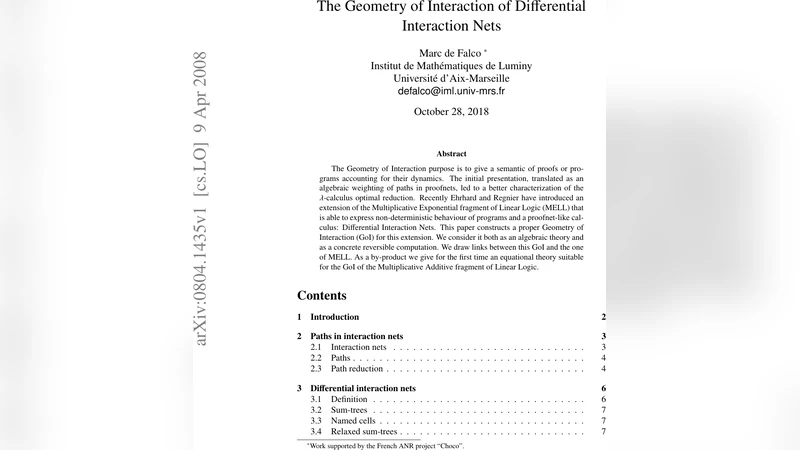
The Geometry of Interaction purpose is to give a semantic of proofs or programs accounting for their dynamics. The initial presentation, translated as an algebraic weighting of paths in proofnets, led to a better characterization of the lambda-calculus optimal reduction. Recently Ehrhard and Regnier have introduced an extension of the Multiplicative Exponential fragment of Linear Logic (MELL) that is able to express non-deterministic behaviour of programs and a proofnet-like calculus: Differential Interaction Nets. This paper constructs a proper Geometry of Interaction (GoI) for this extension. We consider it both as an algebraic theory and as a concrete reversible computation. We draw links between this GoI and the one of MELL. As a by-product we give for the first time an equational theory suitable for the GoI of the Multiplicative Additive fragment of Linear Logic.
💡 Research Summary
The paper “The Geometry of Interaction of Differential Interaction Nets” extends the Geometry of Interaction (GoI) – a semantics originally devised for the Multiplicative‑Exponential fragment of Linear Logic (MELL) – to a non‑deterministic computational model called Differential Interaction Nets (DIN). DINs enrich ordinary interaction nets with a syntactic sum operator, co‑dereliction, co‑contraction and co‑weakening cells, and a labeling scheme that uniquely identifies each non‑deterministic choice. This richer syntax enables the expression of non‑deterministic reductions as formal sums of possible outcomes, but it also breaks the straightforward path‑weighting techniques used in the classic GoI for MELL.
The authors first recall the notion of paths in interaction nets: a path is a finite alternating sequence of wire edges and cell edges, subject to a “long‑enough” condition that prevents a path from starting or ending on the principal ports of a redex. They define a path‑reduction function δ_R that maps a path in a net R to a set of paths in the reduct R′, handling the replacement of sub‑paths crossing a redex by corresponding paths inside the rule’s right‑hand side. Strong confluence of the underlying net reduction ensures that δ_R is independent of the reduction order.
To accommodate the sum operator, the paper introduces “sum‑trees”: binary trees whose leaves are simple DINs and whose internal nodes are labeled by natural numbers (the choice identifiers). A path in a sum‑tree is represented as a branch label (e.g., +α,1) concatenated with a path inside the leaf net. The authors also define a relaxed equivalence on sum‑trees that implements the middle‑four interchange law, allowing the reordering of independent choices.
The central technical contribution is the definition of an algebraic structure called ∂L?, an inverse monoid with zero (imz) generated by:
- multiplicative generators p, q,
- exponential generators r?, r!, s?, s!,
- for each label α: dα?, dα!, uα, vα, eα, subject to orthogonality, commutation, and reduction relations (e.g., dα? r? = uα, dα! s! = vα, dα? dβ! = eα eβ). The monoid captures the interaction of linear logic connectives, exponential modalities, and the labeled non‑deterministic choices. Orthogonality (a⊥b) ensures that distinct choices do not interfere; full orthogonality (a⊥⊥b) guarantees that the star operation yields the unit.
A weight‑mapping w: P(R) → ∂L? assigns to each path a monoid element built by concatenating the appropriate generators according to the cells traversed and the labels encountered. The key property proved is that a path is “weakly‑persistent” (i.e., survives all weak reductions that exclude the co‑weakening rule) if and only if its weight is non‑zero in ∂L?. Thus the GoI provides an algebraic test for path persistence, exactly mirroring the original GoI’s invariant‑path property but now in a non‑deterministic setting.
The paper establishes several important results:
- Soundness: The weight mapping respects reduction; applying δ_R to a path and then weighting yields the same result as weighting first and then applying the monoid’s multiplication.
- Structure of Weights: Persistent paths correspond to elements of the positive sub‑monoid ∂L?⁺, while non‑persistent paths map to the zero element.
- Normalization: Every DIN reduces in finitely many weak steps to a normal form; the weight of a net’s set of persistent paths is invariant under reduction.
- Embedding of MELL GoI: Restricting DIN to MELL (i.e., removing sums and co‑cells) recovers the classic GoI for MELL, showing that the new construction is a conservative extension.
- Equational Theory for MALL: By handling additive connectives via the sum‑tree machinery, the authors provide the first equational presentation of a GoI for the Multiplicative‑Additive fragment (MALL), filling a gap in the literature.
- Weak‑Weakening and Shaded Execution: The authors discuss how to treat branches that are never selected (“shaded” execution) without collapsing the algebraic structure, preserving the distinction between “chosen” and “un‑chosen” paths.
Finally, the paper outlines future work, including the implementation of reversible computation models based on the presented GoI, exploration of optimization techniques for non‑deterministic programs, and deeper categorical analysis of the ∂L? monoid (e.g., its possible enrichment to a dagger compact closed category).
In summary, the authors successfully generalize the Geometry of Interaction to a non‑deterministic setting by introducing a sophisticated algebraic monoid that accounts for both linear‑logic structure and labeled non‑deterministic choices. This work not only bridges a theoretical gap between GoI and differential interaction nets but also opens avenues for practical reversible and parallel computation models grounded in linear logic semantics.
Comments & Academic Discussion
Loading comments...
Leave a Comment