A Lower Bound on the Area of a 3-Coloured Disk Packing
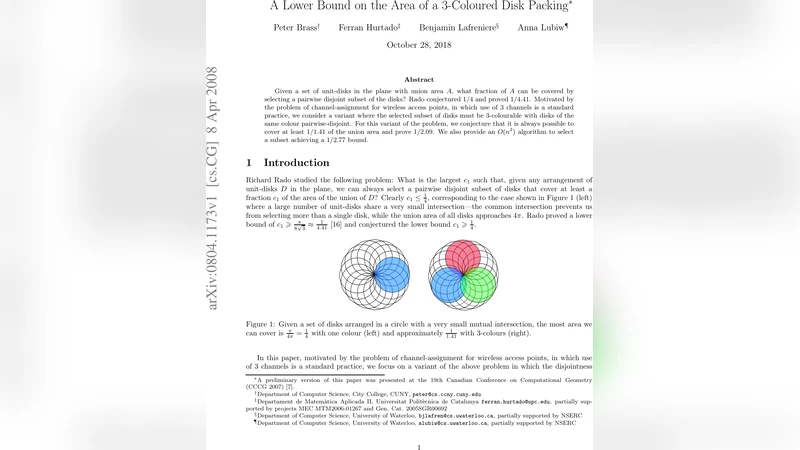
Given a set of unit-disks in the plane with union area $A$, what fraction of $A$ can be covered by selecting a pairwise disjoint subset of the disks? Rado conjectured 1/4 and proved $1/4.41$. Motivated by the problem of channel-assignment for wireless access points, in which use of 3 channels is a standard practice, we consider a variant where the selected subset of disks must be 3-colourable with disks of the same colour pairwise-disjoint. For this variant of the problem, we conjecture that it is always possible to cover at least $1/1.41$ of the union area and prove $1/2.09$. We also provide an $O(n^2)$ algorithm to select a subset achieving a $1/2.77$ bound.
💡 Research Summary
The paper studies a geometric packing problem motivated by Wi‑Fi channel assignment. Given an arbitrary set D of unit‑radius disks in the plane with total union area A, we ask how much of A can be covered by a subset C of the disks that can be coloured with three colours such that disks of the same colour are pairwise disjoint. This is a natural extension of the classic Rado problem, which asks the same question for a single colour (i.e., a pairwise‑disjoint subset). Rado proved a lower bound of π/(8√3)≈0.226 and conjectured the optimal constant to be 1/4≈0.25.
The authors first adapt Rado’s lattice‑based argument. They overlay a regular triangular lattice of side length 4√3 and colour its points with three colours in a way that no two points of the same colour are adjacent. For any placement of the lattice, each lattice point that falls inside the union of the disks selects a disk containing it and inherits the point’s colour. Because the lattice spacing guarantees that a single disk cannot contain two lattice points, the selection is well defined, and disks receiving the same colour are automatically disjoint. By a lemma due to Rado, the lattice can be translated so that at least A·√3/8 lattice points lie inside the union, giving a lower bound on the number of selected disks |C|.
To turn a bound on |C| into an area bound, the authors examine the Voronoi cell of each lattice point, which is a regular hexagon of side length 4/3. Lemma 4 computes the minimum possible intersection area Δ between a unit disk and its associated hexagon; the worst case occurs when the disk’s centre lies on the hexagon’s boundary and yields Δ≈1.6645. Consequently, the total covered area satisfies
A_C ≥ |C|·Δ > (A·√3/8)·Δ ≈ A/2.77.
This proves Theorem 2: a 3‑coloured packing always covers at least 1/2.77 of the total union area.
The second, stronger result (Theorem 1) improves the analysis by optimising a weighted version of the lattice placement. For a lattice point p, let H(p) be its hexagonal Voronoi cell and let d(p) be the disk containing p that maximises the intersection area with H(p). Define a weight w(p)=area(H(p)∩d(p)). The goal is to translate the lattice so that the sum of weights over all lattice points, W(L)=∑_{p∈L} w(p), is maximised. By translating portions of the union onto a fundamental cell, the authors show that the total weight that can be accumulated in the fundamental cell is at least B, where B is the integral of w over the whole union. Although B cannot be computed exactly, they replace the hexagon by a circumscribing circle of radius 2/√3, obtaining a lower‑bound weight function w_l(p) that depends only on the distance r from p to the nearest disk centre. The function w_l(r) is continuous, decreasing, and can be expressed analytically. Integrating w_l over the union yields a lower bound on B, which in turn guarantees the existence of a lattice translation with total weight at least √3/8·B. This translates into a covered area of at least A·0.48, i.e. c₃ ≥ 1/2.09.
The authors also present an O(n²) algorithm that enumerates candidate lattice translations (based on disk centres and intersection points) and evaluates the weighted sum for each colour class, selecting the best translation. They prove that the lattice‑positioning step is 3‑SUM‑hard, implying that the quadratic bound is essentially optimal for this approach.
Finally, the paper discusses extensions to k‑colours (k ≠ 3). While the same lattice‑based framework can be adapted, the achievable fraction of the union area drops quickly as k grows, reflecting the weaker disjointness constraints.
In summary, the paper establishes that for any arrangement of unit disks, a 3‑colourable, pairwise‑disjoint‑by‑colour subset can always be found that covers at least 48 % of the total area (c₃ ≥ 1/2.09). A simpler lattice‑only argument yields a 36 % guarantee (c₃ ≥ 1/2.77) and can be implemented in quadratic time. The authors conjecture that the true constant is 1/1.41≈0.71, leaving a substantial gap for future work. The results have direct relevance to Wi‑Fi access‑point deployment, where three non‑interfering channels are standard, and they provide a geometric foundation for algorithms that jointly optimise placement and channel assignment.
Comments & Academic Discussion
Loading comments...
Leave a Comment