Fractal and Multifractal Time Series
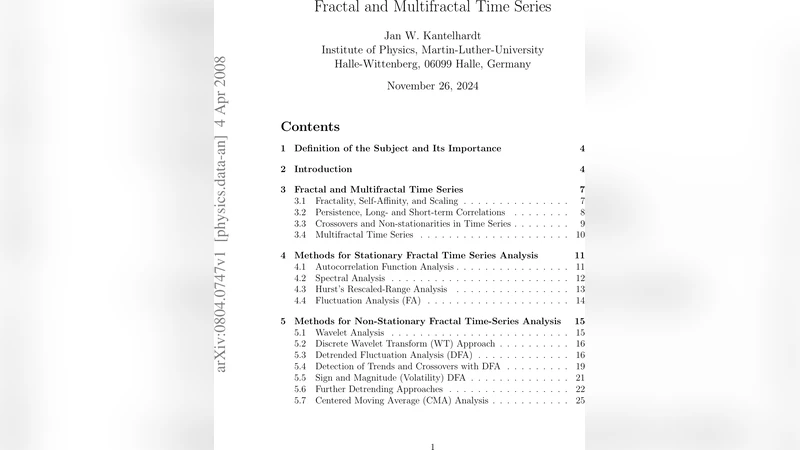
Data series generated by complex systems exhibit fluctuations on many time scales and/or broad distributions of the values. In both equilibrium and non-equilibrium situations, the natural fluctuations are often found to follow a scaling relation over several orders of magnitude, allowing for a characterisation of the data and the generating complex system by fractal (or multifractal) scaling exponents. In addition, fractal and multifractal approaches can be used for modelling time series and deriving predictions regarding extreme events. This review article describes and exemplifies several methods originating from Statistical Physics and Applied Mathematics, which have been used for fractal and multifractal time series analysis.
💡 Research Summary
The paper provides a comprehensive review of fractal and multifractal analysis techniques for time‑series data generated by complex systems. It begins by emphasizing that many natural and engineered systems produce long, one‑dimensional records whose fluctuations span a wide range of temporal scales and exhibit broad value distributions. In such cases, scaling laws of the form F(s) ∼ s^α (or the Hurst exponent H) often hold over several orders of magnitude, allowing the characterization of the underlying dynamics through a small set of scaling exponents.
Section 3 defines the basic concepts: fractality (self‑similarity with a non‑integer scaling exponent), self‑affinity (different scaling factors for time and amplitude, described by H), persistence versus anti‑persistence, and the distinction between short‑range (exponential decay) and long‑range (power‑law decay) correlations. It also introduces the notion of cross‑overs, where one scaling regime gives way to another at a characteristic scale s×, and discusses non‑stationarities such as trends, periodicities, and abrupt shifts that can masquerade as spurious scaling.
Sections 4 and 5 review analysis methods for stationary and non‑stationary data, respectively. Traditional tools for stationary series include autocorrelation function analysis, spectral (Fourier) analysis, Hurst’s rescaled‑range (R/S) method, and basic fluctuation analysis. For non‑stationary series, the authors focus on wavelet‑based techniques (continuous and discrete wavelet transforms), Detrended Fluctuation Analysis (DFA) and its variants (trend detection, magnitude/volatility DFA, centered moving‑average analysis), and related detrending schemes that remove polynomial trends while preserving intrinsic scaling.
Section 6 is devoted to multifractal methods. The structure‑function approach computes q‑order moments S_q(s)=⟨|Δx|^q⟩ ∼ s^{ζ(q)} and obtains the singularity spectrum f(α) via Legendre transformation. The Wavelet Transform Modulus Maxima (WTMM) method tracks the evolution of wavelet maxima across scales, offering high resolution for sparse or noisy data. Multifractal Detrended Fluctuation Analysis (MF‑DFA) extends DFA to arbitrary q, providing a unified framework to estimate the full multifractal spectrum in a single pass. The paper compares WTMM and MF‑DFA, highlighting their complementary strengths: WTMM excels in handling non‑uniform sampling and strong non‑stationarities, while MF‑DFA is computationally simpler and widely adopted.
Section 7 discusses the implications of fractal scaling for extreme‑event statistics. Return‑interval distributions and the tail behavior of extreme values are directly linked to the Hurst or multifractal exponents, enabling probabilistic forecasts for rare events in climate, finance, seismology, and other domains.
Section 8 presents synthetic models that reproduce prescribed fractal or multifractal properties: Fourier‑filtering to impose a target power spectrum, the Schmitz‑Schreiber surrogate method preserving both rank order and spectrum, the extended binomial multifractal cascade, and the bi‑fractal model that captures a single cross‑over between two scaling regimes. These models serve both as testbeds for algorithm validation and as generators for Monte‑Carlo studies.
Finally, Section 9 outlines future directions. With ever‑increasing data lengths and higher sampling rates, the need for robust non‑stationarity removal, automated scaling‑exponent detection, and real‑time monitoring becomes critical. Emerging research avenues include integrating machine‑learning classifiers with fractal diagnostics, extending analysis to multivariate (vector‑valued) time series, and developing adaptive wavelet‑based frameworks that can track evolving scaling behavior in non‑ergodic systems.
Overall, the review synthesizes a rich toolbox—from classical autocorrelation and spectral methods to modern wavelet‑based detrending and multifractal spectrum estimators—providing researchers across physics, geoscience, physiology, finance, and engineering with practical guidance for uncovering and exploiting fractal dynamics in complex time‑series data.
Comments & Academic Discussion
Loading comments...
Leave a Comment