Evolutionary Computation in High Energy Physics
Evolutionary Computation is a branch of computer science with which, traditionally, High Energy Physics has fewer connections. Its methods were investigated in this field, mainly for data analysis tasks. These methods and studies are, however, less known in the high energy physics community and this motivated us to prepare this lecture. The lecture presents a general overview of the main types of algorithms based on Evolutionary Computation, as well as a review of their applications in High Energy Physics.
💡 Research Summary
The paper provides a comprehensive overview of Evolutionary Computation (EC) and its applications within High Energy Physics (HEP). It begins by defining EC as a set of meta‑heuristic algorithms inspired by natural evolution, categorizing the main families as Genetic Algorithms (GA), Genetic Programming (GP), Evolutionary Strategies (ES), and Evolutionary Programming (EP), with newer hybrids such as Gene Expression Programming (GEP) also mentioned.
Section 2 details the generic structure of an evolutionary algorithm: random initialization of a population, evaluation of a problem‑specific fitness function, selection of individuals (via random, proportional/roulette‑wheel, or rank‑based methods), application of genetic operators (crossover, mutation, elitism), and generation of a new population. The loop repeats until a termination criterion—either a target fitness or a maximum number of generations—is satisfied. The authors stress that the most critical steps are problem definition, solution encoding, and fitness design, as these directly affect convergence speed and solution quality.
Section 3 focuses on Genetic Algorithms. GA traditionally uses fixed‑length binary strings, but extensions to integer, real‑valued, order‑based, and variable‑length encodings are discussed. Standard operators include one‑point and two‑point crossover and low‑probability mutation. In HEP, GA has been employed for large‑scale parameter optimisation and fitting tasks, both in experimental analyses (cut‑value optimisation for event selection, trigger optimisation, neural‑network parameter tuning) and phenomenological studies (optimising parameters of isobar models, SUSY model discrimination, lattice calculations). A notable example is the SUSY‑breaking model discrimination study, where a “relative distance” fitness function quantified the separation between mass spectra, indicating that sub‑percent measurement precision would be required to distinguish competing models.
Section 4 describes Evolutionary Strategies. ES augments each individual with a strategy parameter σ, typically the standard deviation of a Gaussian mutation distribution, allowing the algorithm to self‑adapt mutation step sizes. Early ES used only mutation; later variants incorporated crossover (both discrete and intermediate recombination). The paper cites a single HEP study where ES was applied to optimise event‑selection cuts and Dalitz‑plot parameters in BaBar analyses. Using the squared signal significance S²/(S+2B) as the fitness function, ES improved the significance by 19.4 % (Dₛ→φπ), 45 % (Dₛ→K*⁰K⁺), and 16 % (Dₛ→K⁰K) relative to manually tuned cuts. In a Dalitz‑plot fit of the reaction pγ→π⁰η (CB/ELSA data), ES optimised 16 MC weight parameters, achieving good agreement with experimental distributions.
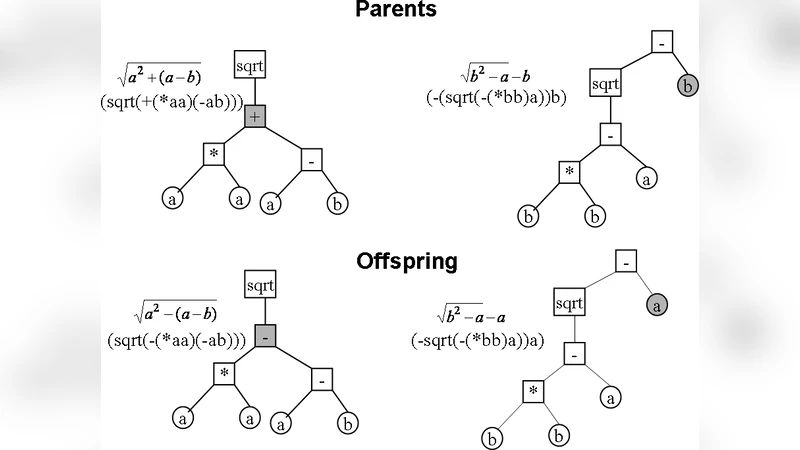
Section 5 introduces Genetic Programming. GP evolves computer programs represented as tree‑structured S‑expressions (often in Lisp). The chromosome is a variable‑length tree composed of terminals (variables or constants) and functions (arithmetic, logical operators). Genetic operators are adapted to the tree representation: subtree crossover swaps sub‑trees between parents, while mutation replaces a node or subtree with a new randomly generated one, respecting syntactic constraints. The authors note that GP can generate many syntactically invalid trees, incurring computational waste, and that grammar‑aware variants have been developed to mitigate this.
In HEP, GP has been tested only recently. The FOCUS collaboration used GP to evolve event‑selection cuts for decays such as D⁺→K⁺π⁺π⁻, Λc→pK⁺π⁻, and Dₛ⁺→K⁺K⁺π⁻, constructing trees from physics variables, mathematical functions, and constants in prescribed ranges. A similar GP‑based study was performed for Higgs searches in ATLAS using simulated data. In both cases, the GP‑derived selection criteria achieved comparable or superior signal‑background discrimination relative to manually designed cuts.
The concluding discussion acknowledges that while EC techniques have demonstrated promising results in specific HEP problems, their adoption remains limited due to high computational demands and the need for careful problem‑specific tailoring. The authors argue that advances in computing power, improved fitness‑function design, and hybridisation with traditional optimisation methods will likely increase the relevance of EC in future HEP analyses. They also suggest that systematic benchmarking against conventional techniques and exploration of newer meta‑heuristics (e.g., Differential Evolution, Particle Swarm Optimisation) constitute important directions for further research.
Comments & Academic Discussion
Loading comments...
Leave a Comment