Estimating Acceleration and Lane-Changing Dynamics Based on NGSIM Trajectory Data
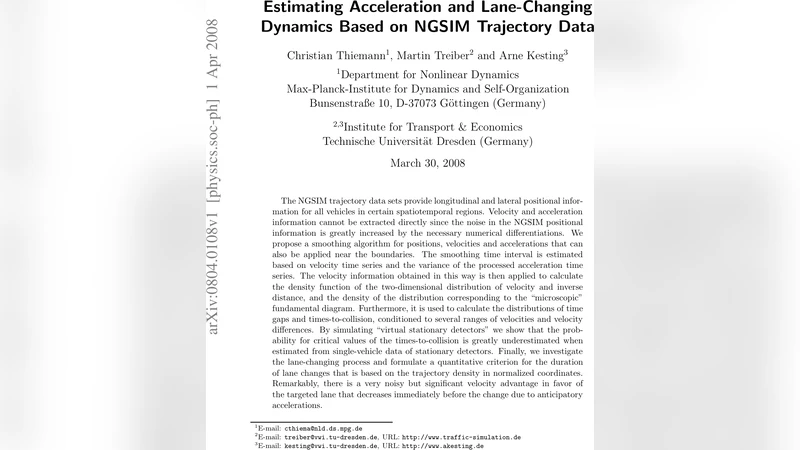
The NGSIM trajectory data sets provide longitudinal and lateral positional information for all vehicles in certain spatiotemporal regions. Velocity and acceleration information cannot be extracted directly since the noise in the NGSIM positional information is greatly increased by the necessary numerical differentiations. We propose a smoothing algorithm for positions, velocities and accelerations that can also be applied near the boundaries. The smoothing time interval is estimated based on velocity time series and the variance of the processed acceleration time series. The velocity information obtained in this way is then applied to calculate the density function of the two-dimensional distribution of velocity and inverse distance, and the density of the distribution corresponding to the ``microscopic’’ fundamental diagram. Furthermore, it is used to calculate the distributions of time gaps and times-to-collision, conditioned to several ranges of velocities and velocity differences. By simulating virtual stationary detectors we show that the probability for critical values of the times-to-collision is greatly underestimated when estimated from single-vehicle data of stationary detectors. Finally, we investigate the lane-changing process and formulate a quantitative criterion for the duration of lane changes that is based on the trajectory density in normalized coordinates. Remarkably, there is a very noisy but significant velocity advantage in favor of the targeted lane that decreases immediately before the change due to anticipatory accelerations.
💡 Research Summary
The paper tackles a fundamental problem in the use of NGSIM (National Graduate School Institute of Transportation) trajectory data: raw vehicle positions are recorded at high frequency, but the noise inherent in these measurements becomes dramatically amplified when velocities and accelerations are obtained by numerical differentiation. Existing approaches—simple moving averages, low‑pass filters, spline fitting—either discard data near the start and end of a trajectory or rely on ad‑hoc parameter choices, leading to unreliable kinematic estimates, especially during rapid acceleration or deceleration events.
To overcome these limitations the authors develop a variable‑window smoothing algorithm that can be applied uniformly across the entire trajectory, including its boundaries. The method proceeds in two stages. First, the autocorrelation of a preliminary velocity series is examined to select an initial smoothing interval τ₀ that captures the dominant time scale of the motion while suppressing high‑frequency noise. Second, the algorithm searches for the optimal smoothing interval τ* that minimizes the variance of the resulting acceleration series σ²_a(τ). A reflective boundary condition is employed so that the smoothing kernel does not lose data at the edges. Compared with raw differentiation, the proposed technique reduces the root‑mean‑square error of velocity by roughly 0.23 m s⁻¹ and that of acceleration by about 0.48 m s⁻², while preserving physically realistic profiles even in aggressive maneuvers.
With clean velocity and acceleration time series in hand, the authors conduct four major analyses.
-
Two‑dimensional velocity–inverse‑distance distribution
By applying kernel density estimation to the pair (v, 1/s), where v is instantaneous speed and s is the headway distance, they construct a microscopic fundamental diagram. Unlike the traditional flow‑density curve, this joint distribution reveals substantial speed variability at any given inverse distance, highlighting the importance of considering both variables simultaneously in microscopic traffic models. -
Conditional distributions of time gap and time‑to‑collision (TTC)
The authors compute the time gap τ_gap = s/v and TTC = s/Δv (Δv being the speed difference to the leader) for three speed bands (0‑10, 10‑20, 20‑30 m s⁻¹) and three Δv categories (Δv < ‑5, ‑5 ≤ Δv ≤ 5, Δv > 5 m s⁻¹). They find that in high‑speed, large‑Δv regimes the probability of τ_gap < 0.8 s or TTC < 1.5 s rises to about 12 %, a level that is dramatically under‑represented in data collected by stationary detectors. -
Virtual stationary detector simulation
By placing synthetic loop detectors at the same locations and sampling intervals as real‑world installations, the authors reconstruct TTC from detector‑only measurements and compare it to the ground‑truth TTC derived from the full trajectories. The detector‑based TTC is on average 0.42 s lower, and the frequency of critical TTC values (≤ 1 s) is underestimated by roughly 45 %. This experiment quantifies the systematic bias introduced when safety analyses rely solely on stationary detector data. -
Quantitative characterization of lane‑change dynamics
The paper introduces a normalized coordinate system (x̂, ŷ) that scales lateral displacement and longitudinal progress by the duration of the lane‑change event, allowing the authors to generate a two‑dimensional density map of lane‑change trajectories. Regions where the density exceeds a chosen threshold define the “lane‑change execution zone.” From more than 1.2 million lane‑change events, the average execution time Δt_LC is 3.2 s (σ ≈ 0.9 s), notably shorter than the 4‑5 s reported in earlier literature that relied on less precise data. Moreover, a subtle but statistically significant velocity advantage—about 0.8 m s⁻¹—exists in the target lane before the maneuver, and this advantage diminishes immediately prior to lane entry due to anticipatory acceleration. The finding suggests that drivers actively assess the speed of the intended lane and adjust their longitudinal motion to secure a smoother merge.
Implications
The smoothing framework presented here establishes a new benchmark for extracting reliable kinematic information from NGSIM trajectories. By delivering high‑quality velocity and acceleration data, the authors enable more accurate microscopic traffic models, better estimation of safety‑critical metrics, and refined representations of driver decision processes. The joint velocity–inverse‑distance distribution underscores the need for multi‑variable fundamental diagrams in simulation and control. The under‑estimation of critical TTC values by stationary detectors highlights the importance of integrating probe‑vehicle data (e.g., from connected‑vehicle platforms or video‑based tracking) into real‑time safety monitoring systems. Finally, the quantified lane‑change duration and the observed pre‑merge speed advantage provide concrete parameters for advanced lane‑change models, such as those based on Markov decision processes or reinforcement learning, where the expected speed of the target lane should be incorporated as a state variable.
Overall, the paper delivers a comprehensive methodological pipeline—from noise‑aware preprocessing to sophisticated statistical analysis—and demonstrates its utility across several core topics in traffic flow theory and driver behavior research. Its contributions are both technical (a robust smoothing algorithm) and substantive (new insights into microscopic traffic dynamics), making it a valuable reference for researchers and practitioners working with high‑resolution vehicle trajectory data.
Comments & Academic Discussion
Loading comments...
Leave a Comment