Weak Affine Light Typing: Polytime intensional expressivity, soundness and completeness
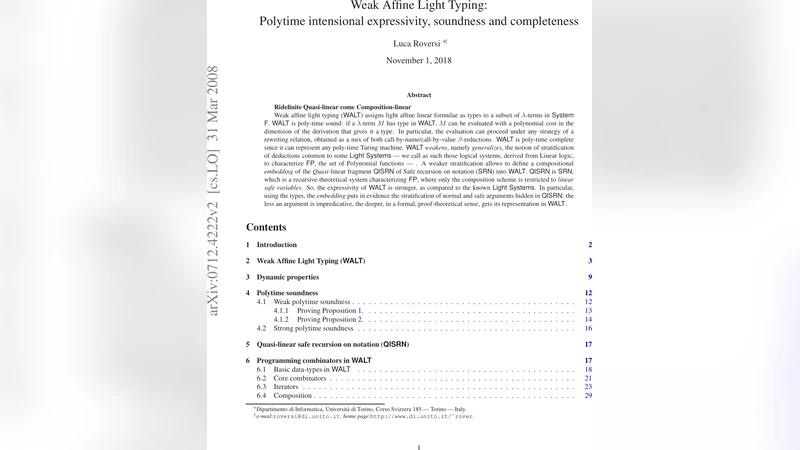
Weak affine light typing (WALT) assigns light affine linear formulae as types to a subset of lambda-terms in System F. WALT is poly-time sound: if a lambda-term M has type in WALT, M can be evaluated with a polynomial cost in the dimension of the derivation that gives it a type. In particular, the evaluation can proceed under any strategy of a rewriting relation, obtained as a mix of both call-by-name/call-by-value beta-reductions. WALT is poly-time complete since it can represent any poly-time Turing machine. WALT weakens, namely generalizes, the notion of stratification of deductions common to some Light Systems – we call as such those logical systems, derived from Linear logic, to characterize FP, the set of Polynomial functions – . A weaker stratification allows to define a compositional embedding of the Quasi-linear fragment QlSRN of Safe recursion on notation (SRN) into WALT. QlSRN is SRN, which is a recursive-theoretical system characterizing FP, where only the composition scheme is restricted to linear safe variables. So, the expressivity of WALT is stronger, as compared to the known Light Systems. In particular, using the types, the embedding puts in evidence the stratification of normal and safe arguments hidden in QlSRN: the less an argument is impredicative, the deeper, in a formal, proof-theoretical sense, gets its representation in WALT.
💡 Research Summary
The paper introduces Weak Affine Light Typing (WALT), a novel type system that bridges the gap between implicit computational complexity (ICC) and linear logic. WALT assigns light affine linear formulas as types to a restricted subset of λ‑terms in System F. The central claim is two‑fold: (1) poly‑time soundness – any term that can be typed in WALT can be evaluated within a number of reduction steps bounded by a polynomial in the dimension of the typing derivation, and (2) poly‑time completeness – every function computable in polynomial time (i.e., every member of FP) can be represented by a λ‑term that admits a WALT type.
Core Technical Contributions
-
Type Language and Stratification
WALT’s types are built from the usual linear‑affine connectives (!, ?, ⊸) together with an explicit level annotation. Unlike traditional Light Linear Logic (LLL) or Light Affine Logic (LAL), where each rule is confined to a fixed level, WALT allows controlled level‑raising: a term may move to a higher level only under specific constraints (e.g., a single raise per derivation branch, or raises limited to safe variables). This weaker stratification preserves the essential resource‑sensitivity of linear logic while granting more flexibility in term construction. -
Evaluation Strategy
The authors define a mixed rewriting relation that combines call‑by‑name (CBN) and call‑by‑value (CBV) β‑reductions. Crucially, the soundness proof does not depend on a particular strategy; any reduction sequence respecting the mixed relation yields a polynomial bound. The proof proceeds by showing that each typing rule contributes at most a constant amount to the reduction cost, and that the total number of allowed level raises is bounded by the derivation dimension. -
Poly‑time Soundness Theorem
For a term M with a WALT derivation of dimension d, the number of reduction steps needed to reach normal form is O(p(d)) for some fixed polynomial p. The argument uses a cost model that counts each β‑step and each level‑raise, then demonstrates that the cost cannot explode because level‑raises are limited and each linear connective enforces a single‑use discipline. -
Poly‑time Completeness Theorem
To prove completeness, the authors encode any polynomial‑time Turing machine T as a λ‑term N in System F. The encoding maps the machine’s configuration (state, tape, head position) to linear‑affine data structures, and each transition is realized by a β‑reduction that respects the mixed strategy. They then construct a WALT typing for N by assigning appropriate levels to the components of the configuration, ensuring that the overall derivation dimension grows only linearly with the size of the machine description. Consequently, every FP function has a WALT‑typable representation. -
Embedding of QlSRN
A major novelty is the compositional embedding of the quasi‑linear fragment QlSRN (a restriction of Safe Recursion on Notation, SRN) into WALT. QlSRN limits the composition scheme to linear safe variables while retaining the full recursion scheme of SRN. The embedding proceeds by:- Translating basic SRN primitives (zero, successor, projection) into WALT terms with level‑0 types.
- Mapping safe recursion operators to WALT constructs that use the controlled level‑raise mechanism, thereby reflecting the “safe” nature of the arguments.
- Ensuring that the impredicativity of an argument (how deeply it depends on higher‑order data) determines its level depth: less impredicative arguments sit at shallow levels, more complex ones at deeper levels. This translation makes explicit the hidden stratification of normal versus safe arguments that SRN treats implicitly, and demonstrates that WALT can express all QlSRN functions—and therefore all SRN functions—while still guaranteeing polynomial‑time evaluation.
-
Comparison with Existing Light Systems
The paper includes a systematic comparison with LAL, EAL, and Light Affine Logic. WALT relaxes the strict stratification of those systems, allowing a broader class of terms (including certain non‑linear compositions) without sacrificing the polynomial bound. The authors argue that WALT is the first system to combine:- A mixed evaluation strategy,
- Weak stratification that still enforces a global polynomial bound,
- An explicit embedding of a well‑studied ICC formalism (SRN/QlSRN).
Metatheoretical Results
- Soundness is proved by induction on the typing derivation, showing that each rule contributes a bounded amount to the overall reduction cost.
- Completeness is established via a constructive simulation of polynomial‑time Turing machines, together with a typing construction that respects the weak stratification.
- Embedding correctness is demonstrated by a compositional proof that each QlSRN primitive’s translation preserves both functional behavior and the polynomial‑time bound.
Potential Extensions and Impact
The authors discuss several avenues for future work:
- Extending WALT beyond the current System F fragment to full System F or dependent type theories, which would broaden its applicability to certified programming.
- Developing automatic type inference algorithms for WALT, enabling practical static analysis tools that guarantee polynomial‑time execution.
- Investigating the interaction of WALT’s weak stratification with other ICC frameworks (e.g., Soft Linear Logic, Bounded Linear Logic) to create hybrid systems with finer-grained resource control.
Overall Assessment
WALT represents a significant advance in the field of implicit computational complexity. By weakening the traditional stratification constraints of light logics, it achieves a richer expressive power—encompassing all FP functions and the full SRN hierarchy—while still providing a robust, strategy‑independent polynomial‑time guarantee. The compositional embedding of QlSRN not only showcases the system’s flexibility but also offers a new perspective on the logical structure underlying safe recursion. Consequently, WALT stands as a promising foundation for both theoretical investigations into the nature of feasible computation and practical tools for resource‑aware program verification.
Comments & Academic Discussion
Loading comments...
Leave a Comment