Kolmogorov Complexity Theory over the Reals
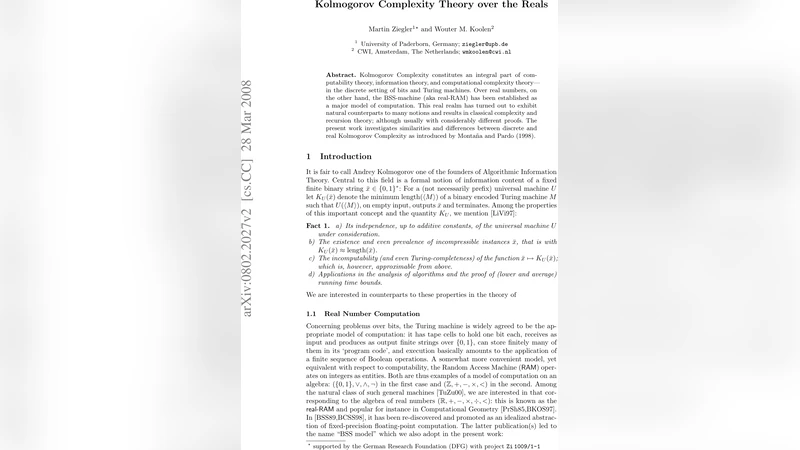
Kolmogorov Complexity constitutes an integral part of computability theory, information theory, and computational complexity theory – in the discrete setting of bits and Turing machines. Over real numbers, on the other hand, the BSS-machine (aka real-RAM) has been established as a major model of computation. This real realm has turned out to exhibit natural counterparts to many notions and results in classical complexity and recursion theory; although usually with considerably different proofs. The present work investigates similarities and differences between discrete and real Kolmogorov Complexity as introduced by Montana and Pardo (1998).
💡 Research Summary
The paper investigates Kolmogorov complexity in the setting of real‑number computation, where the underlying model is the Blum‑Shub‑Smale (BSS) machine, also known as a real‑RAM. After recalling the classical four fundamental properties of discrete Kolmogorov complexity—machine‑independence, existence of incompressible strings, incomputability of the complexity function, and its use in algorithmic lower bounds—the authors seek precise analogues for real inputs.
A BSS machine is defined as a multi‑tape device with cells that can store arbitrary real numbers, a finite control, a finite list of real constants, and elementary arithmetic operations. Input strings are finite sequences of reals, and the size of a program (or “code”) is measured by the length of the real sequence that encodes it. For a universal BSS machine U, the real Kolmogorov complexity K_U( x ) of a real vector x∈ℝ⁎ is the minimal size of a real program p such that U(p) on empty input outputs x and halts.
The central result, originally due to Montana and Pardo (1998) and sharpened in this work, is that for the constant‑free universal machine U₀ the complexity is tightly bounded by the transcendence degree of the input over ℚ:
trdeg_ℚ( x ) ≤ K_U₀( x ) ≤ trdeg_ℚ( x )+c,
where c is an absolute constant. The authors prove that c can be taken to be 1 and that this bound is optimal. Consequently, the Kolmogorov complexity of a real vector coincides (up to an additive 1) with the number of algebraically independent coordinates it possesses. Random real vectors of dimension n almost surely have transcendence degree n, so they are incompressible: K_U₀( x )=n with probability 1.
To refine the notion of complexity, three variants are introduced: K⁰ (output‑only programs), Kˢ (semi‑deciding the singleton language {x}), and Kᵈ (deciding it). Theorem 12 establishes exact relationships:
- Kˢ_z( x )=Kᵈ_z( x )=max{1, trdeg_ℚ(z)( x )}.
- max{1, trdeg_ℚ(z)( x )} ≤ K⁰_z( x ) ≤ trdeg_ℚ(z)( x )+1.
- If ℚ(z, x) is purely transcendental over ℚ(z) then K⁰_z( x )=trdeg_ℚ(z)( x ).
These results give a clean algebraic characterisation of the three complexity measures and demonstrate that incompressible strings are not only existent but prevalent.
The classical diagonalisation proof of incomputability does not transfer directly to the continuous setting. Instead, the authors use a result of Michaux (1990) stating that any language semi‑decided by a BSS machine is a countable union of basic semi‑algebraic sets over a rational field extension generated by the machine’s constants. Applying this to the singleton language {x} shows that any program that outputs x must contain at least trdeg_ℚ(z)( x ) independent real constants, establishing the lower bound for Kˢ and Kᵈ. Consequently, the function K⁰ is not BSS‑computable (incomputable), mirroring the discrete case.
Nevertheless, K⁰ can be approximated from above: given any ε>0 one can enumerate programs of size up to trdeg_ℚ(z)( x )+1 and thus obtain an upper bound within a constant additive error. The paper also proves that K⁰ is not BSS‑complete; there is no BSS reduction from arbitrary decision problems to computing K⁰, which aligns with the intuition that Kolmogorov complexity is a “measure” rather than a decision problem.
A novel “compact BSS model” is introduced to minimise program size further. By fixing a finite tuple of real constants z and encoding all discrete control information into the first real constant of the program, the authors obtain a universal machine U_z whose control is purely discrete. This eliminates the need for a separate prefix‑complexity notion and yields the inequality K_z( x, y ) ≤ K_z( x )+K_z( y ). Moreover, they show that no BSS‑computable function ℝ→ℝ² can be surjective, using Kolmogorov complexity arguments (Observation 28).
Concrete examples illustrate the theory:
- For the vector (e^{√2}, e^{√3}, …, e^{√p_n}) the complexity equals n, because the exponentials of distinct square‑free roots are algebraically independent (Lindemann–Weierstrass).
- For (t, √2) the complexity is 1 if t is algebraic and 2 if t is transcendental, reflecting the algebraic dependence of √2 on t.
These examples demonstrate that the bounds are tight and that the transcendence degree provides an exact measure of information content in the real setting.
In summary, the paper establishes a robust real‑Kolmogorov complexity theory parallel to the classical discrete one. It shows that the complexity of a real vector is essentially its transcendence degree, proves incompressibility, incomputability, approximability, and non‑completeness, and introduces a compact encoding scheme that streamlines the theory. The work bridges algorithmic information theory, real algebraic geometry, and BSS computation, opening avenues for further exploration of information measures in continuous computational models.
Comments & Academic Discussion
Loading comments...
Leave a Comment