When is Group Cohomology Finitary?
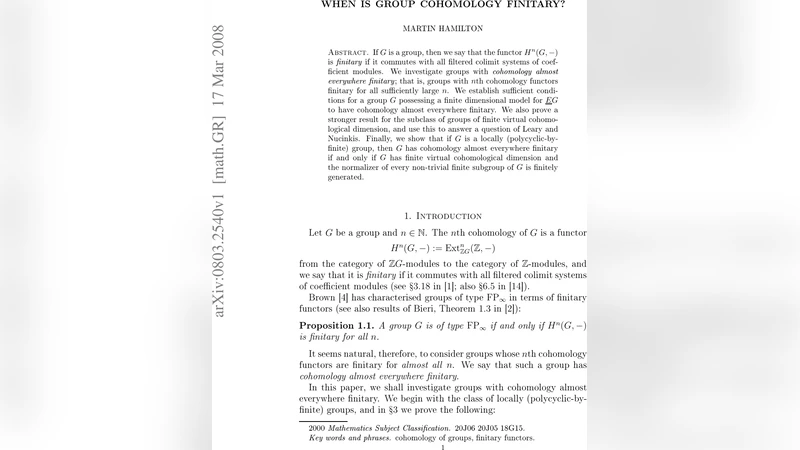
If $G$ is a group, then we say that the functor $H^n(G,-)$ is finitary if it commutes with all filtered colimit systems of coefficient modules. We investigate groups with cohomology almost everywhere finitary; that is, groups with $n$th cohomology functors finitary for all sufficiently large $n$. We establish sufficient conditions for a group $G$ possessing a finite dimensional model for $e.g.$ to have cohomology almost everywhere finitary. We also prove a stronger result for the subclass of groups of finite virtual cohomological dimension, and use this to answer a question of Leary and Nucinkis. Finally, we show that if $G$ is a locally (polycyclic-by-finite) group, then $G$ has cohomology almost everywhere finitary if and only if $G$ has finite virtual cohomological dimension and the normalizer of every non-trivial finite subgroup of $G$ is finitely generated.
💡 Research Summary
The paper investigates the finitary property of group cohomology functors. For a group (G) and integer (n\ge0) the cohomology functor is defined as (H^{n}(G,-)=\operatorname{Ext}^{n}{\mathbb Z G}(\mathbb Z,-)). A functor is called finitary if it commutes with all filtered colimit systems of modules. Brown showed that a group is of type FP(\infty) precisely when every (H^{n}(G,-)) is finitary. Motivated by this, the author introduces the notion “cohomology almost everywhere finitary”: there exists an integer (N) such that (H^{n}(G,-)) is finitary for all (n\ge N).
The main results focus on locally (poly‑cyclic‑by‑finite) groups. Theorem A gives a complete characterisation: a locally (poly‑cyclic‑by‑finite) group (G) has cohomology almost everywhere finitary if and only if (i) (G) has finite virtual cohomological dimension (vcd) and (ii) the normaliser of every non‑trivial finite subgroup of (G) is finitely generated. The proof proceeds by first reducing to groups of finite vcd, then using the existence of a finite‑dimensional model for the classifying space (E G) (Conner–Kropholler). By analysing the action of (G) on the poset of non‑trivial finite subgroups, the author shows that finitariness of the cohomology forces the normalisers to be finitely generated; conversely, if the normalisers are finitely generated, a series of spectral sequence arguments and Shapiro’s Lemma yield finitariness for large (n).
Corollary B shows that within this class the property is inherited by all subgroups, a feature that fails for arbitrary groups (see Proposition 4.1). Proposition C treats elementary amenable groups: if such a group has cohomology almost everywhere finitary then it possesses only finitely many conjugacy classes of finite subgroups and the centraliser of any finite (p)-subgroup is finitely generated.
The paper then works over a ring (R) of prime characteristic (p). Theorem D proves that for groups of finite vcd the following are equivalent: (i) cohomology is almost everywhere finitary over (R); (ii) there are finitely many conjugacy classes of elementary abelian (p)-subgroups and each normaliser is of type FP(_\infty) over (R); (iii) the same finiteness of conjugacy classes together with the normalisers themselves having cohomology almost everywhere finitary over (R). The proof adapts the earlier arguments to the (R)-module setting, using Lemma 2.3 to split Ext‑functors and Lemma 2.2 to change coefficients.
Using Theorem D the author answers a question of Leary and Nucinkis (Question 1 in
Comments & Academic Discussion
Loading comments...
Leave a Comment