On the need for a global academic internet platform
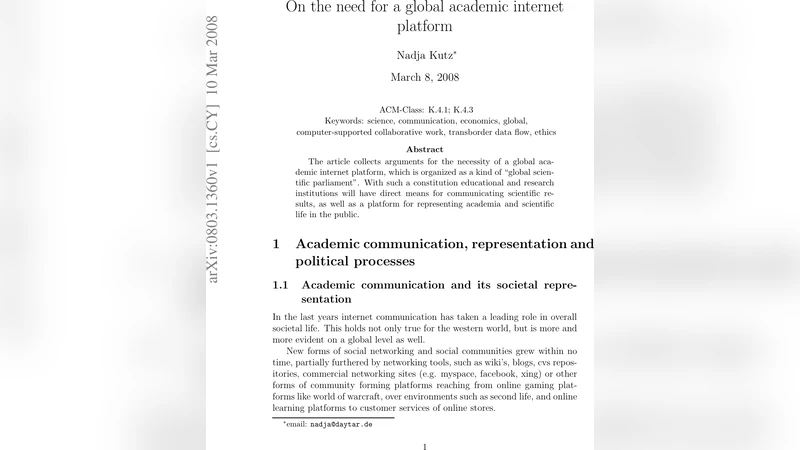
The article collects arguments for the necessity of a global academic internet platform, which is organized as a kind of ``global scientific parliament’’. With such a constitution educational and research institutions will have direct means for communicating scientific results, as well as a platform for representing academia and scientific life in the public.
💡 Research Summary
The paper argues for the creation of a worldwide academic internet platform that would function as a “global scientific parliament.” It begins by observing how the internet has become a central medium for political and social communication worldwide, yet academic communication remains fragmented across individual university websites, wikis, blogs, and pre‑print repositories such as arXiv. Although scholars already contribute to policy‑relevant bodies like the IPCC, their influence is often reduced to vague labels such as “leading climate scientist,” and the collective voice of academia is not systematically integrated into political decision‑making. Existing international mediators (e.g., UNESCO, scientific unions) are limited by small staff sizes and predefined agendas, leaving a representational gap that a dedicated platform could fill.
The proposed platform would be jointly operated by universities worldwide, providing a trusted authentication system, standardized metadata, and transparent communication channels. It would enable real‑time peer review, open pre‑publication, and possibly blockchain‑based immutable records to guard against data tampering and ensure reproducibility. By aggregating scholarly output in a single, searchable repository, the platform would reduce information asymmetry and allow policymakers to access vetted scientific evidence directly, thereby improving the quality of evidence‑based policy.
From a political perspective, the paper critiques the current reliance on consultants and lobbyists—often representing economic interests—to advise elected officials. It suggests that a neutral, globally accessible scientific parliament could serve as an independent advisory body, offering objective data and analyses to governments and international organizations. This could also democratize participation by giving scholars from developing nations an equal voice, helping to mitigate the geographic and economic biases that currently shape global scientific discourse.
The discussion of scientific methodology focuses on fields with well‑defined validation procedures, such as mathematics, physics, and computer science. The authors note that these disciplines already benefit from clear logical consistency checks and reproducible experiments, which can be automated and standardized within the platform. They also highlight the problem of “publication bias,” where negative results are rarely published, and propose that an open‑review system would capture such data, enriching the knowledge base.
Funding and integrity are identified as critical vulnerabilities. The paper points out that research funding often steers question selection toward “safe” topics with a higher chance of positive outcomes, potentially sidelining high‑risk, high‑reward investigations. To avoid similar distortions, the platform’s operational costs should be covered by participating universities or an international fund, rather than being tied to specific research grants. Moreover, a diverse, distributed review process would dilute the influence of any single funding source or lobby, enhancing scientific integrity.
In conclusion, the authors contend that a globally coordinated academic internet platform could (1) streamline scholarly communication, (2) strengthen the societal representation of academia, and (3) act as an impartial scientific advisor to policymakers. Realizing this vision will require careful design of governance structures, sustainable financing, technical standards for data sharing, and mechanisms to balance openness with privacy and intellectual‑property concerns. The paper acknowledges these challenges but maintains that the potential benefits for knowledge accumulation, democratic legitimacy, and global problem‑solving justify the effort.
Comments & Academic Discussion
Loading comments...
Leave a Comment