Pre-Hausdorff Spaces
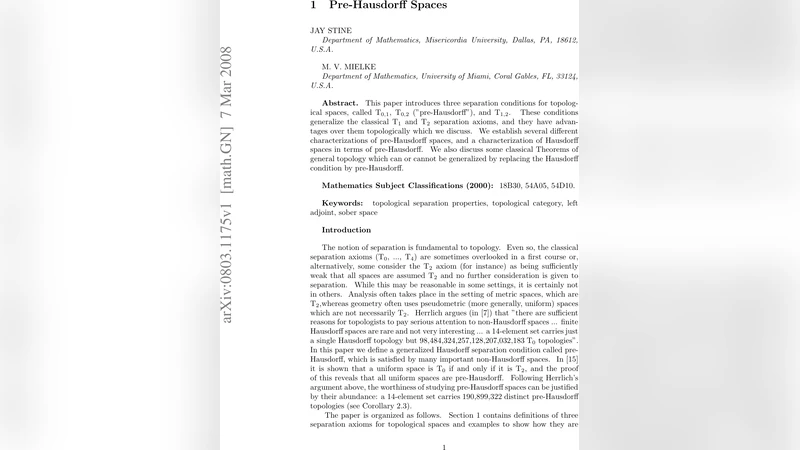
This paper introduces three separation conditions for topological spaces, called T_{0,1}, T_{0,2} (“pre-Hausdorff”), and T_{1,2}. These conditions generalize the classical T_(1) and T_(2) separation axioms, and they have advantages over them topologically which we discuss. We establish several different characterizations of pre-Hausdorff spaces, and a characterization of Hausdorff spaces in terms of pre-Hausdorff. We also discuss some classical Theorems of general topology which can or cannot be generalized by replacing the Hausdorff condition by pre-Hausdorff.
💡 Research Summary
The paper introduces a new family of separation axioms for topological spaces, denoted T_{i,j} with 0 ≤ i < j ≤ 2. A space is called T_{i,j} if whenever two points can be separated by a T_i‑open neighbourhood, they can also be separated by a T_j‑open neighbourhood. This definition simultaneously generalises the classical T_i and T_j axioms while allowing many intermediate cases that are not covered by the traditional hierarchy. The authors give a series of examples: the Sierpiński space is T₀ but fails both T_{0,1} and T_{0,2}; an indiscrete space with more than one point satisfies every T_{i,j} condition yet is not T₀.
Section 1 establishes that each full subcategory T_{i,j}‑TOP of TOP (the category of all topological spaces and continuous maps) is a concrete topological category over SET. In particular, the inclusion functors preserve initial lifts and all limits, making the subcategories reflective subcategories of TOP. Consequently each inclusion has a left adjoint L_{i,j}, which “reflects’’ an arbitrary space into the smallest T_{i,j}‑space containing it. The paper gives an explicit description of L_{0,2}, the reflector onto pre‑Hausdorff spaces, in terms of a quotient by an equivalence relation (later called R₀).
Section 2 focuses on the case i = 0, j = 2, which the authors name “pre‑Hausdorff’’ spaces. They first consider principal spaces (those whose open sets are closed under arbitrary intersections) and prove Theorem 2.1, showing that for such spaces the following are equivalent: (i) pre‑Hausdorff, (ii) regular, (iii) zero‑dimensional (i.e., possessing a clopen basis), and (iv) the Boolean algebra of open sets satisfies double‑negation ¬¬ = id. This chain of equivalences places pre‑Hausdorff spaces strictly between regular and zero‑dimensional spaces.
The authors then connect pre‑Hausdorff topologies on a finite set X with Borel fields (σ‑algebras) on X. They prove that a family τ of subsets of a finite set X is a Borel field iff (X,τ) is pre‑Hausdorff (Corollary 2.6). Since Borel fields on a finite set correspond bijectively to equivalence relations, and equivalence relations correspond to set partitions, the number of distinct pre‑Hausdorff topologies on an n‑element set equals the Bell number B(n). For n = 14 this yields 190,899,322 distinct topologies, illustrating the abundance of such spaces.
A key structural result is Theorem 2.9, which shows that a space is Hausdorff if and only if it is both pre‑Hausdorff and sober (every irreducible closed set has a unique generic point). Thus pre‑Hausdorffness captures the “separation” part of Hausdorffness, while sobriety supplies the “uniqueness of limits” part.
The paper introduces the relation R₀ = {(x,y) | x and y have no T₀‑separation}. Theorem 2.10 proves that the following are equivalent: (i) X is pre‑Hausdorff, (ii) R₀ is closed in X × X, (iii) R₀ equals the diagonal Δ_X, and (iv) the quotient space X/R₀ is Hausdorff. Consequently, every space admits a universal arrow from its pre‑Hausdorff reflection to a Hausdorff space via the quotient by R₀. Lemma 2.11 shows that any continuous map from X to a T₀‑space factors uniquely through the quotient map q : X → X/R₀, establishing the universal property of the quotient.
Using these observations, the authors define left adjoints L_{2,2} (reflector from T_{0,2}‑TOP to T₂‑TOP) and L₂ (reflector from TOP to Hausdorff spaces) as successive applications of the quotient construction. Both are retracts, i.e., the inclusion functors have sections given by the canonical embeddings of Hausdorff spaces back into the larger categories.
Finally, the paper discusses which classical theorems of general topology survive when Hausdorff is replaced by pre‑Hausdorff. Some results (e.g., those relying on closed diagonals) extend via the R₀‑quotient, while others fail because pre‑Hausdorff spaces need not be T₁ or regular. The overall contribution is a systematic framework that interpolates between the familiar separation axioms, provides categorical reflections, links to combinatorial enumeration via Bell numbers, and clarifies the precise additional condition (sobriety) required to recover full Hausdorffness.
Comments & Academic Discussion
Loading comments...
Leave a Comment