A short proof of nonhomogeneity of the pseudo-circle
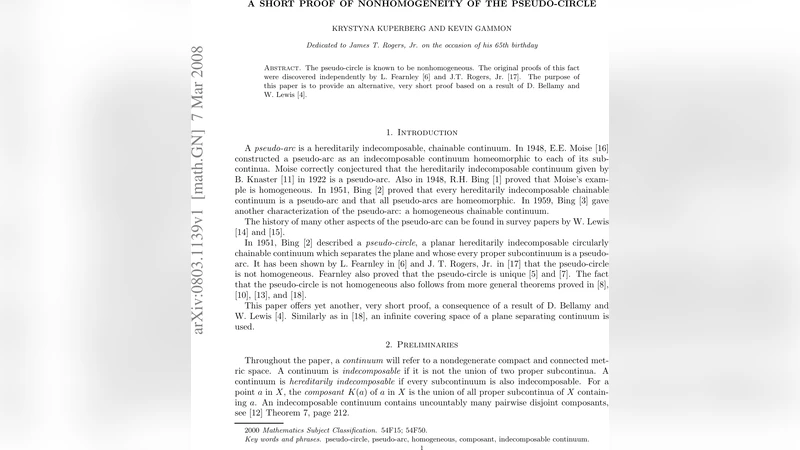
The pseudo-circle is known to be nonhomogeneous. The original proofs of this fact were discovered independently by L. Fearnley and J.T. Rogers, Jr. The purpose of this paper is to provide an alternative, very short proof based on a result of D. Bellamy and W. Lewis.
💡 Research Summary
The paper presents a concise proof that the pseudo‑circle is not a homogeneous continuum, relying on a result of Bellamy and Lewis concerning pseudo‑arcs. After recalling the historical context—Moise’s construction of the pseudo‑arc, Bing’s homogeneity theorem for pseudo‑arcs, and the earlier independent proofs by Fearnley and Rogers that the pseudo‑circle fails to be homogeneous—the authors set up a new argument that avoids the technical machinery of those earlier works.
They embed the pseudo‑circle (C) in a planar annulus (A) so that each circular chain defining (C) has winding number one. Any self‑homeomorphism (h:C\to C) extends to a continuous map (f:A\to A) of degree (\pm1). By passing to the universal covering space (\widetilde A) of the annulus and then compactifying it with two added points (a) and (b), they obtain a compact space (bA). The pre‑image (\widetilde C = p^{-1}(C)) together with the points (a) and (b) forms a set (P = \widetilde C\cup{a,b}). Bellamy and Lewis proved that (P) is a pseudo‑arc.
Crucially, the points (a) and (b) lie in distinct components (K(a)) and (K(b)) of the pseudo‑arc (P). The lifted map (\widetilde f) respects the covering projection, and it extends uniquely to a homeomorphism (F:bA\to bA). Restricting (F) to (P) yields a homeomorphism (H:P\to P) that either fixes (a) and (b) or swaps them, while preserving each component.
Assuming, for contradiction, that (C) were homogeneous, one could pick points (x\in C) and (y\in C) whose lifts (\tilde x) and (\tilde y) lie respectively inside (K(a)\cup K(b)) (but not at the endpoints) and outside that union. A homeomorphism (h:C\to C) sending (x) to (y) would lift to a homeomorphism (H) sending (\tilde x) to (\tilde y). This is impossible because (H) must map each component of (P) onto a component, and the chosen points lie in different component types. Hence no such (h) exists, proving that the pseudo‑circle is not homogeneous.
Theorem 2 further analyses the structure of the components (K(a)) and (K(b)). It shows that if a fiber (p^{-1}(x)) meets (K(a)), then the entire fiber is contained in (K(a)). Consequently the images (p(K(a)\setminus{a})) and (p(K(b)\setminus{b})) are disjoint subsets of (C). The authors suggest that these disjoint subsets might serve as invariants to classify the components of the pseudo‑circle.
Overall, the paper delivers a short, elegant argument that replaces earlier, more involved proofs. By exploiting the covering space of the annulus and the known pseudo‑arc structure of the lifted set, the authors demonstrate that the pseudo‑circle’s inherent asymmetry prevents it from being homogeneous. This method not only clarifies the non‑homogeneity of the pseudo‑circle but also illustrates a technique that could be adapted to other problems concerning the homogeneity of complex planar continua.
Comments & Academic Discussion
Loading comments...
Leave a Comment