Full-scale simulation study of a generalized Zakharov model for the generation of topside ionospheric turbulence
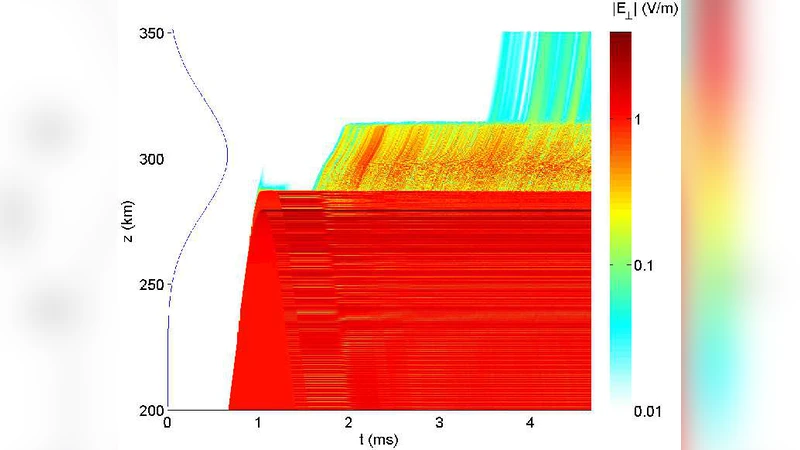
We present a full-scale simulation study of a generalized Zakharov model for the generation of the topside electrostatic turbulence due to the parametric instability during ionospheric heating experiments near the F region peak. The nonlinear tunneling of electromagnetic waves through the ionospheric layer is attributed to multiple-stage parametric decay and mode-conversion processes. At the bottomside of the F region, electrostatic turbulence excited by the parametric instability results in the conversion of the ordinary (O mode) wave into a large amplitude extraordinary (Z mode) wave tunneling through the F peak. At the topside interaction region, the Z mode undergoes parametric decay cascade process that results in the generation of the topside electrostatic turbulence and then conversion process yielding O waves that escape the plasma. This study may explain the observed topside ionospheric turbulence during ground based ionospheric heating experiments.
💡 Research Summary
This paper presents a comprehensive full‑scale numerical investigation of topside ionospheric turbulence generated during high‑frequency (HF) heating experiments, using a generalized Zakharov model that couples fast electromagnetic waves with slow ion‑acoustic dynamics. The authors adopt a one‑dimensional geometry aligned with the vertical (z) direction and separate the plasma response into a high‑frequency component (the injected O‑mode HF pump) and a low‑frequency component (density and ion‑acoustic fluctuations). The high‑frequency fields are described by envelope equations for the transverse vector potential A⊥ and electric field E⊥, while the slow dynamics obey continuity and momentum equations for electrons (treated as inertialess on the slow scale) and ions (unmagnetized). The coupling is mediated by the ponderomotive force proportional to |E|², which drives density perturbations that in turn modify the refractive index for the HF wave.
The simulation domain spans 200–400 km altitude, with a realistic Gaussian electron density profile peaking at 5 × 10¹¹ m⁻³ near 300 km (the F‑layer peak). A background magnetic field of 4.8 × 10⁻⁵ T is tilted by ~13° to mimic the EISCAT site in Tromsø. The HF pump frequency is set to ω₀ = 3.66 × 10⁷ s⁻¹, slightly below the maximum plasma frequency (ω_pe,max ≈ 3.99 × 10⁷ s⁻¹) but above the Z‑mode cutoff, ensuring that the O‑mode is reflected while the Z‑mode can propagate if generated. The grid employs a nested scheme: a coarse 2 m resolution throughout the domain and a fine 4 cm resolution in the critical bottom‑side (≈286 km) and top‑side (≈313 km) interaction layers, allowing the capture of sub‑meter Langmuir and ion‑acoustic structures.
Key dynamical stages observed in the simulation are:
-
Bottom‑side parametric instability – As the O‑mode reaches the lower F‑layer, density fluctuations seeded by random noise grow rapidly under the action of the ponderomotive force. The O‑mode undergoes a three‑wave decay into a backward‑propagating Langmuir wave (L) and a forward‑propagating ion‑acoustic (IA) wave, satisfying ω_O = ω_L + ω_IA and k_O = k_L + k_IA. The resulting Langmuir and IA wavelengths are of order 1 m.
-
O‑to‑Z mode conversion – The same density perturbations create a localized “critical layer” where the O‑mode can mode‑convert to the extraordinary Z‑mode. The Z‑mode, having a much larger group velocity in the presence of the magnetic field, tunnels through the overdense region and reaches the top‑side interaction zone.
-
Top‑side parametric cascade – Upon arrival, the Z‑mode experiences a second parametric decay, again producing Langmuir and IA waves. The Langmuir component collapses nonlinearly, forming intense electric field spikes and ion cavitons with spatial scales of a few tens of centimeters and separations of ≲1 m.
-
Re‑generation of O‑mode radiation – The caviton‑filled region acts as a secondary source: the density depressions allow the O‑mode to be regenerated and to escape upward, producing the observed topside plasma and ion lines. This process reproduces the “HF‑induced outshifted line” (HF‑OL) reported in EISCAT and Arecibo experiments.
The authors emphasize that the nonlinear tunneling of electromagnetic energy is fundamentally enabled by the multi‑stage parametric decay and mode‑conversion chain. The simulation reproduces the observed spectral broadening (up to ~200 kHz) and frequency shifts (200–300 kHz) of the topside emissions, linking them to the cascade of wave‑wave interactions and the formation of small‑scale turbulence. Moreover, the study demonstrates that the same mechanism should operate at other high‑latitude heating facilities such as HAARP and HIPAS, where similar plasma parameters are encountered.
In conclusion, the work validates a self‑consistent, physics‑based picture of topside ionospheric turbulence: an O‑mode pump is first converted to a Z‑mode via a bottom‑side parametric instability, the Z‑mode then undergoes a second parametric cascade that creates Langmuir turbulence and ion cavitons, and finally the O‑mode is regenerated and radiated outward. This multi‑stage nonlinear process explains longstanding observational puzzles and provides a robust framework for interpreting and planning future ionospheric heating experiments.
Comments & Academic Discussion
Loading comments...
Leave a Comment