Asymptotic analysis of $k$-noncrossing matchings
In this paper we study $k$-noncrossing matchings. A $k$-noncrossing matching is a labeled graph with vertex set $\{1,...,2n\}$ arranged in increasing order in a horizontal line and vertex-degree 1. The $n$ arcs are drawn in the upper halfplane subjec…
Authors: Emma Y. Jin, Christian M. Reidys, Rita R. Wang
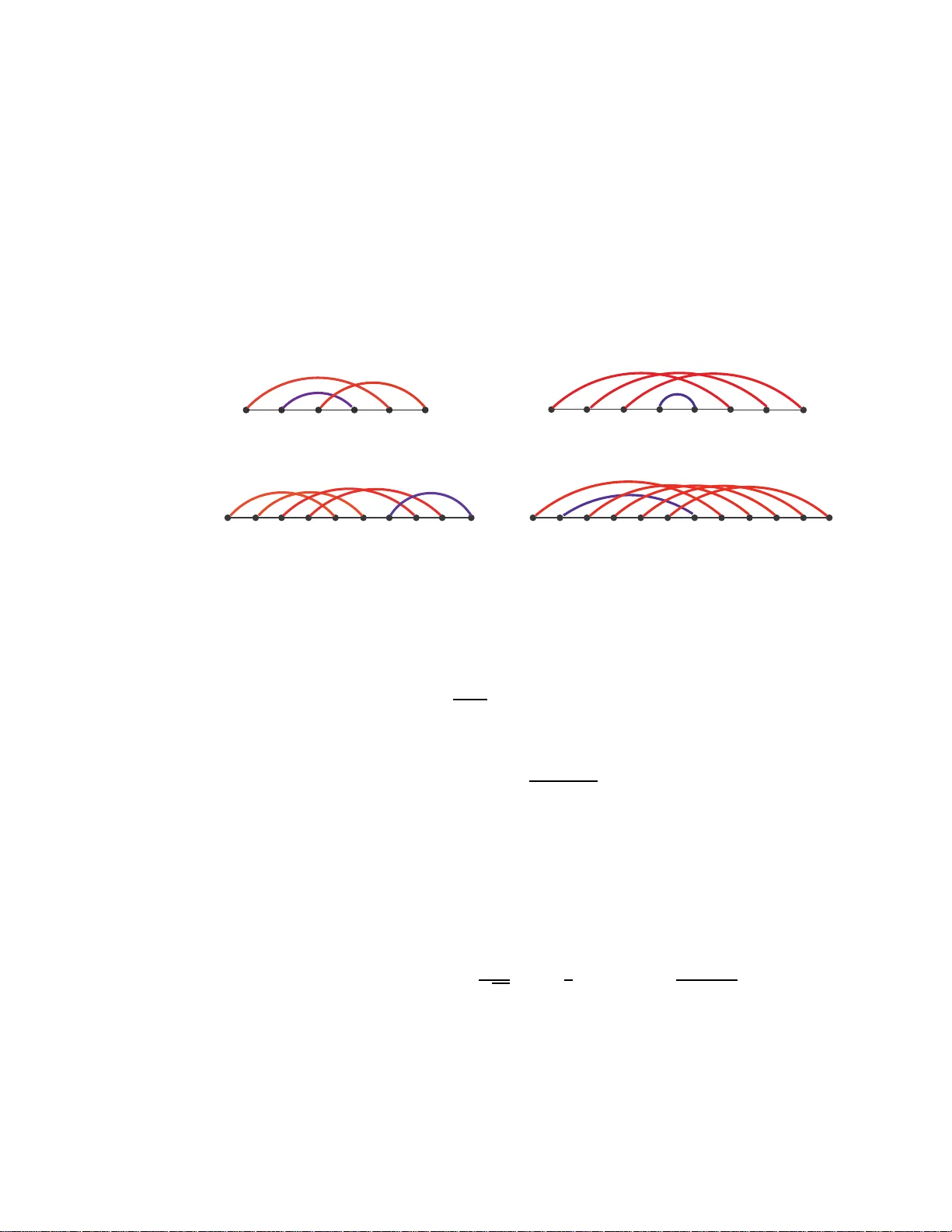
ASYMPTOTIC ANAL YSIS OF k -NONCROSSING MA TCHINGS EMMA Y. JIN , CHRISTIAN M. REIDYS ⋆ AND RIT A R. W ANG Abstract. In this paper we study k -noncrossing matc hings. A k -noncrossing matc hing is a labeled graph w ith ve rtex set { 1 , . . . , 2 n } arranged i n increasing or der in a horizon tal li ne and v ertex-degree 1. The n arcs are dra wn in the upper halfplane sub j ect t o the condition that there exist no k ar cs that mutually int ersect. W e deriv e: (a) for arbitrary k , an asymptotic approxima- tion of the exponent ial generating f unction of k -noncrossing matc hings F k ( z ). (b) the asymptotic formula f or the num b er of k -noncrossing matc hings f k ( n ) ∼ c k n − (( k − 1) 2 +( k − 1) / 2) (2( k − 1)) 2 n for some c k > 0. 1. St a tement of resul ts and back ground Let F k ( z ) denote the expo nen tial gener ating function of k -noncros sing ma tc hings, i.e. (1.1) F k ( z ) = X n ≥ 0 f k ( n ) z 2 n (2 n )! . In this pap er we prov e the following tw o theor ems: Theorem 1. Then we have for arbitr ary k ∈ N , k ≥ 2 , ar g( z ) 6 = ± π 2 F k ( z ) = " k − 1 Y i =1 Γ( i + 1 − 1 2 ) k − 2 Y r =1 r ! # e 2 z π k − 1 z − ( k − 1) 2 − k − 1 2 (1 + O ( | z | − 1 )) . (1.2) Theorem 2. F or arbitr ary k ∈ N , k ≥ 2 we have (1.3) f k ( n ) ∼ c k n − (( k − 1) 2 +( k − 1) / 2) (2( k − 1)) 2 n , for s ome c k > 0 . Date : M arc h, 2008. Key wor ds and phr ases. determinan t, Bessel-function, subtraction of si ngularit y pri nciple, oscil lating tableaux. 1 2 EMMA Y. JIN , CHRISTIAN M. REIDYS ⋆ AND RIT A R. W ANG Here we use the no tation f ( z ) = O ( g ( z )) and f ( z ) = o ( g ( z )) for | f ( z ) | / | g ( z ) | b eing b ounded and tending to zer o, for | z | → ∞ , resp ectively . A k -noncr ossing matching is a lab eled g raph ov er the vertices 1 , . . . , 2 n , of degr ee exactly 1 and drawn in increa s ing or der in a horizontal line. The a r cs ar e drawn in the upp er halfplane sub ject to the condition that there a re no k arcs that m utually intersect. Grabiner and Magyar proved a n 1 2 3 4 5 6 1 2 3 4 5 6 7 8 1 2 3 4 5 6 7 8 9 10 1 2 3 4 5 6 7 8 9 10 11 12 (a) (b) (c) (d) Figure 1. k -noncrossing matc hings: 3-, 4-, 5- and 6-noncrossi ng matc hings respec- tively . One of the k − 1 mutually crossing arcs are d ra wn in red. explicit determinant formula, [7] (see als o [2], eq. (9)) whic h e xpresses the expo nen tial gener ating function of f k ( n ), for fixed k , as a ( k − 1) × ( k − 1) determinant F k ( z ) = X n ≥ 0 f k ( n ) · z 2 n (2 n )! = det[ I i − j (2 z ) − I i + j (2 z )] | k − 1 i,j =1 , (1.4) where I m (2 z ) is the h yp erbo lic Besse l function: (1.5) I m (2 z ) = ∞ X j =0 z m +2 j j !( m + j )! . Chen et.al. proved in [2] a b eautiful cor resp ondence b et w een k - noncrossing matchings and osc illa t- ing tableaux. The particular RSK-ins e rtion used in [2] is based o n an idea of Stanley . Our second result is related to a theorem of Regev [10] for the c o efficient u k ( n ) of Gessel’s generating function [5] U k ( x ) = det ( I i − j (2 z )) k i,j =1 . Regev shows (1.6) u k ( n ) ∼ 1!2! . . . ( k − 1)! 1 √ 2 π k − 1 1 2 ( k − 1) 2 / 2 k k 2 / 2 k 2 n n ( k 2 − 1) / 2 . ASYMPTOTIC ANAL YSIS OF k -NONCR OSSING MA TCHINGS 3 The proo f is obtained employing the RSK-a lg orithm a nd using the ho ok-leng th formula. One arrives, taking the limit n → ∞ , at a k -dimensio nal Selb er g -integral, which can be explicitely computed. W e shall use a different strategy . One key ele ment in our approa c h is the following approximation o f the Bess el-function, v alid for − π 2 < arg(z) < π 2 [1] (1.7) I m ( z ) = e z √ 2 π z H X h =0 ( − 1) h h !8 h h Y t =1 (4 m 2 − (2 t − 1) 2 ) z − h + O( | z | − H − 1 ) ! . In this pap er we will s how that, using the approximation of eq . (1.7), the determinant of Bessel- functions of eq . (1.4) ca n b e computed as ymptotically for ar bitrary k . The computation o f the determinant via the alg orithm given in Section 2 is the key ingredient for all our results. 2. Proof of Theorem 1 Suppo se we are given a po lynomial (2.1) g n ( x, y ) = X 0 ≤ a + b ≤ n C ( a, b ) x 2 a y 2 b , where for a + b = n , C ( a, b ) > 0 holds. In the following a , b alwa y s denote in tegers gr eater o r equal to zer o. W e set (2.2) z △ z ′ = ( z − z ′ )( z + z ′ ) . Lemma 1. Supp ose n ≥ 0 , then we have (2.3) g n ( x, y ) − g n ( x, z ) = ( y △ z ) P a + b ≤ n − 1 E ( a, b, z ) x 2 a y 2 b n ≥ 1 0 n = 0 wher e E ( a, b, z ) = C ( a, b + 1) for a + b = n − 1 . F urthermor e (2.4) g n ( x, y ) − g n ( x, y 1 ) − g n ( x 1 , y )+ g n ( x 1 , y 1 ) = ( x △ x 1 )( y △ y 1 ) P a + b ≤ n − 2 D ( a, b, x 1 , y 1 ) x 2 a y 2 b n ≥ 2 0 n = 0 , 1 wher e D ( a, b, x 1 , y 1 ) = C ( a + 1 , b + 1) for a + b = n − 2 . 4 EMMA Y. JIN , CHRISTIAN M. REIDYS ⋆ AND RIT A R. W ANG Pr o of. F o r n = 0, we immediately obtain g 0 ( x, y ) − g 0 ( x, z ) = 0. In ca se of n ≥ 1 we co mpute g n ( x, y ) − g n ( x, z ) = ( y △ z ) X a + b ≤ n, b> 0 C ( a, b ) x 2 a " b − 1 X m =0 y 2 m z 2 b − 2 − 2 m # = ( y △ z ) X a + b ≤ n − 1 E ( a, b, z ) x 2 a y 2 b . In pa r ticular, for a + b = n − 1, we observe E ( a, b , z ) = C ( a, b + 1 ). As for eq. (2.4) we compute in cas e of n = 0 o r 1, ϑ n ( x, x 1 , y , y 1 ) = g n ( x, y ) − g n ( x, y 1 ) − g n ( x 1 , y ) + g n ( x 1 , y 1 ) = 0. F or n ≥ 2 we c ompute ϑ n ( x, x 1 , y , y 1 ) = ( x △ x 1 )( y △ y 1 ) X a + b ≤ n, ab> 0 C h ( a, b ) " a − 1 X m =0 x 2 m x 2 a − 2 − 2 m 1 # " b − 1 X m =0 y 2 m y 2 b − 2 − 2 m 1 # = ( x △ x 1 )( y △ y 1 ) X a + b ≤ n − 2 D ( a, b, x 1 , y 1 ) x 2 a y 2 b . In par ticular, for a + b = n − 2 , D ( a, b, x 1 , y 1 ) = C ( a + 1 , b + 1) holds. Let e i,j ( z ) = X h ≥ 0 m h ( i, j ) ( − 1) h 16 h h ! z − h (2.5) m h ( i, j ) = h Y t =1 (4( i − j ) 2 − (2 t − 1) 2 ) − h Y t =1 (4( i + j ) 2 − (2 t − 1) 2 ) . (2.6) W e consider the alg orithm A , sp ecified in Figure 2, which manipulates the matrix of Laurent series M = ( e i,j ( z )) 1 ≤ i,j ≤ k − 1 . Let e t i,j ( z ) denote the matrix co efficient after running A exa ctly t steps. W e set (2.7) e t i,j ( z ) = X h ≥ 0 m t h ( i, j ) ( − 1) h 16 h h ! z − h and pr o cee d by analyzing the terms m t h ( i, j ) for 1 ≤ t < k − 1. Lemma 2. F or any p ositive int e ger t strictly smal ler than k − 1 and we have m t h ( i, j ) = m t h ( j, i ) the fol lowing t wo assertions hold. ASYMPTOTIC ANAL YSIS OF k -NONCR OSSING MA TCHINGS 5 The algorithm A: b egin M := [ e i,j ( z )] k − 1 i,j =1 ; for t from 1 to k − 1 do for i from t + 1 to k − 1 do for j from 1 to k − 1 do e ′ i,j ( z ) := − i Q t − 1 r =1 ( i △ r ) (2 t − 1)! e t,j ( z ) + e i,j ( z ); e i,j ( z ) := e ′ i,j ( z ); end ; end ; for j from t + 1 to k − 1 do for i from 1 to k − 1 do e ′′ i,j ( z ) := − j Q t − 1 r =1 ( j △ r ) (2 t − 1)! e i,t ( z ) + e i,j ( z ); e i,j ( z ) := e ′′ i,j ( z ); end ; end ; end ; output M ; end ; Figure 2. (a) for i ≤ t < j , we have m t h ( i, j ) = − (2 i − 1)! j t Y r =1 ( j △ r ) X a + b ≤ h − ( t + i ) E t h ( a, b , i ) i 2 a j 2 b (2.8) h < t + i = ⇒ m t h ( i, j ) = 0 (2.9) a + b = h − ( t + i ) = ⇒ E t h ( a, b , i ) = C h ( a + i − 1 , b + t ) > 0 . (2.10) F urt hermor e (a) implies the c ase j ≤ t < i . 6 EMMA Y. JIN , CHRISTIAN M. REIDYS ⋆ AND RIT A R. W ANG (b) for i, j > t , we have m t h ( i, j ) = − i j t Y r =1 ( i △ r ) t Y r =1 ( j △ r ) X a + b ≤ h − (2 t +1) D t h ( a, b ) i 2 a j 2 b (2.11) h < 2 t + 1 = ⇒ m t h ( i, j ) = 0 (2.12) a + b = h − (2 t + 1) = ⇒ D t h ( a, b ) = C h ( a + t, b + t ) > 0 . (2.13) Pr o of. W e shall prove (a) and (b) by inductio n on 1 ≤ t < k − 1. W e first obs e r ve that, in view of eq. (2.6) m h ( i, j ) = − 2 ⌊ h − 1 2 ⌋ X s =0 X p + q + r +2 s +1= h h − r p h − p − r q (4 i 2 ) p (4 j 2 ) q a 1 · · · a r (8 ij ) 2 s +1 = − ij X a + b ≤ h − 1 C h ( a, b ) i 2 a j 2 b , (2.14) where a i ∈ { − 1 2 , . . . , − (2 h − 1) 2 } , i 6 = j, a i 6 = a j and C h ( a, b ) > 0 for a + b = h − 1 . F urthermore by de finitio n m h ( i, j ) = m h ( j, i ). F or i = 1 , j > 1, only the j - loo p is executed, whence (2.15) m 1 h ( i, j ) = m h ( i, j ) − j m h ( i, 1) and for m h ( j, i ) only the i -lo op contributes m 1 h ( j, i ) = m h ( j, i ) − j m h (1 , i ) = m h ( i, j ) − j m h ( i, 1) = m 1 h ( i, j ) . Consequently m 1 h ( i, j ) = − ij X a + b ≤ h − 1 C h ( a, b ) i 2 a j 2 b − X a + b ≤ h − 1 C h ( a, b ) i 2 a Employing Lemma 1 we obtain m 1 h ( i, j ) = − i j ( j △ 1 ) X a + b ≤ h − 2 E 1 h ( a, b , 1 ) i 2 a j 2 b . F urthermor e a + b = h − 2 = ⇒ E 1 h ( a, b , 1 ) = C h ( a, b + 1) > 0 h = 1 = ⇒ m 1 h ( i, j ) = 0 . Thu s for t = 1, the induction bas is for (a) holds. W e pr o c e ed by proving that for t = 1 (b) holds . F or i > 1 , j > 1 b oth i - and j -lo op a re exec uted m 1 h ( i, j ) = m h ( i, j ) − i m h (1 , j ) − j m h ( i, 1) + ij m h (1 , 1) (2.16) ASYMPTOTIC ANAL YSIS OF k -NONCR OSSING MA TCHINGS 7 from which immediately m 1 h ( i, j ) = m 1 h ( j, i ) follows. W e compute m 1 h ( i, j ) = − i j X a + b ≤ h − 1 C h ( a, b ) i 2 a j 2 b − X a + b ≤ h − 1 C h ( a, b ) j 2 b − ij − X a + b ≤ h − 1 C h ( a, b ) i 2 a + X a + b ≤ h − 1 C h ( a, b ) = − i ( i △ 1 ) j ( j △ 1) X a + b ≤ h − 3 D 1 h ( a, b ) i 2 a j 2 b . Lemma 1 implies for a + b = h − 3, D 1 h ( a, b ) = C h ( a + 1 , b + 1) and for h < 3, m 1 h ( i, j ) = 0. Accordingly we eststa blished the induction bas is for assertions (a ), (b) a nd m 1 h ( i, j ) = m 1 h ( j, i ). As for the induction step, we first prove (a). Let us s uppose (a) holds for t = n . W e co nsider the cas e t = n + 1 by distinguis hing subseque nt tw o cases: (1) i = n + 1 , j > n + 1 and (2) i ≤ n, j = n + 1. Firs t we observe that s ince i < n + 2 the alg orithm ex ecutes no i -lo op and b y construction the only co n tribution to m n +1 h ( i, j ) is made by the term − j Q n +1 − 1 r =1 ( j △ r ) (2 n + 1)! m n h ( i, n + 1) W e according ly der iv e m n +1 h ( i, j ) = m n h ( i, j ) − j Q n r =1 ( j △ r ) (2 n + 1)! m n h ( i, n + 1) The induction hypothesis on t = n shows m n h ( i, j ) = m n h ( j, i ) and m n h ( i, n + 1 ) = m n h ( n + 1 , i ). Therefore we ar rive at m n +1 h ( i, j ) = m n +1 h ( j, i ). (1) i = n + 1 , j > n + 1 , the induction hypothesis guar ant ees m n h ( i, j ) = − i j n Y r =1 ( i △ r ) n Y r =1 ( j △ r ) X a + b ≤ h − (2 n +1) D n h ( a, b ) i 2 a j 2 b m n h ( i, n + 1) = − i ( n + 1) n Y r =1 ( i △ r ) n Y r =1 (( n + 1) △ r ) X a + b ≤ h − (2 n +1) D n h ( a, b ) i 2 a ( n + 1) 2 b 8 EMMA Y. JIN , CHRISTIAN M. REIDYS ⋆ AND RIT A R. W ANG Since ( n + 1) Q n r =1 (( n + 1) △ r ) = (2 n + 1)! we arrive at m n +1 h ( i, j ) = − i j n Y r =1 ( i △ r ) n Y r =1 ( j △ r ) × X a + b ≤ h − (2 n +1) D n h ( a, b ) i 2 a j 2 b − X a + b ≤ h − (2 n +1) D n h ( a, b ) i 2 a ( n + 1) 2 b . According to Lemma 1, for h = 2 n + 1 , we hav e m n +1 h ( n + 1 , j ) = 0 and fo r h ≥ 2 n + 2 we obtain m n +1 h ( n + 1 , j ) = − (2 n + 1)! j n +1 Y r =1 ( j △ r ) X a + b ≤ h − (2 n +2) E n +1 h ( a, b , n + 1)( n + 1) 2 a j 2 b . (2.17) F or a + b = h − (2 n + 2 ), we hav e (2.18) E n +1 h ( a, b , n + 1 ) = D n h ( a, b + 1) = C h ( a + n, b + n + 1) > 0 . (2) i ≤ n and j > n + 1, using the inductio n hypo thesis, we derive m n +1 h ( i, j ) = m n h ( i, j ) − j Q n r =1 ( j △ r ) (2 n + 1)! m n h ( i, n + 1) = − (2 i − 1 )! j n Y r =1 ( j △ r ) × X a + b ≤ h − ( n + i ) E n h ( a, b , i ) i 2 a j 2 b − X a + b ≤ h − ( n + i ) E n h ( a, b , i ) i 2 a ( n + 1) 2 b . Lemma 1 implies m n +1 h ( i, j ) = − (2 i − 1)! j n +1 Y r =1 ( j △ r ) X a + b ≤ h − ( n +1+ i ) E n +1 h ( a, b , i ) i 2 a j 2 b . F or h ≤ n + i , we obs erve m n +1 h ( i, j ) = 0 and for a + b = h − ( n + 1 + i ), (2.19) E n +1 h ( a, b , i ) = E n h ( a, b + 1 , i ) = C h ( a + i − 1 , b + n + 1) > 0 . Accordingly , w e have prov ed (2.20) ∀ i ≤ n + 1 < j ; m n +1 h ( i, j ) = − (2 i − 1)! j n +1 Y r =1 ( j △ r ) X a + b ≤ h − ( n +1+ i ) E n +1 h ( a, b , i ) i 2 a j 2 b . ASYMPTOTIC ANAL YSIS OF k -NONCR OSSING MA TCHINGS 9 F urthermor e a + b = h − ( n + 1 + i ) = ⇒ E n +1 h ( a, b , i ) = C h ( a + i − 1 , b + n + 1) > 0 (2.21) h < n + 1 + i = ⇒ m n +1 h ( i, j ) = 0 . (2.22) Whence asser tion (a) holds by induction for any 1 ≤ t < k − 1. W e next supp ose assertion (b) is true for t = n and consider the ca se t = n + 1, i.e., i > n + 1 and j > n + 1. First the i - loo p is executed a nd pro duces ˜ m n +1 h ( i, j ) = m n h ( i, j ) − i Q n r =1 ( i △ r ) (2 n + 1)! m n h ( n + 1 , j ) . Secondly the j -lo op yields m n +1 h ( i, j ) = ˜ m n +1 h ( i, j ) − j Q n r =1 ( j △ r ) (2 n + 1)! ˜ m n +1 h ( i, n + 1) . (2.23) W e according ly co mpute m n +1 h ( i, j ) = m n h ( i, j ) − i Q n r =1 ( i △ r ) (2 n + 1)! m n h ( n + 1 , j ) − j Q n r =1 ( j △ r ) (2 n + 1)! m n h ( i, n + 1) − i Q n r =1 ( i △ r ) (2 n + 1)! m n h ( n + 1 , n + 1) from which we immediately obser v e that m n +1 h ( i, j ) = m n +1 h ( j, i ) holds . F urthermor e m n +1 h ( i, j ) = − i " n Y r =1 ( i △ r ) # j " n Y r =1 ( j △ r ) # × X a + b ≤ h − (2 n +1) D n h ( a, b )( i 2 a j 2 b − ( n + 1) 2 a j 2 b − i 2 a ( n + 1) 2 b + ( n + 1) 2 a ( n + 1) 2 b ) = − i " n +1 Y r =1 ( i △ r ) # j " n +1 Y r =1 ( j △ r ) # X a + b ≤ h − (2( n +1)+1) D n +1 h ( a, b ) i 2 a j 2 b . In par ticular, a + b = h − (2( n + 1) + 1) ⇒ D n +1 h ( a, b ) = D n h ( a + 1 , b + 1) = C h ( a + n + 1 , b + n + 1) > 0 h = 2 n + 1 or h = 2 n + 2 ⇒ m n +1 h ( i, j ) = 0 . Thu s m n +1 h ( i, j ) sa tisfies (b) for any 1 ≤ t < k − 1. 10 EMMA Y. JIN , CHRISTIAN M. REIDYS ⋆ AND RIT A R. W ANG W e pro ceed by ana lyzing the Laurent series (2.24) a i,j ( z ) = X h ≥ 0 m k − 2 h ( i, j ) ( − 1) h 16 h h ! z − h . Lemma 3. a i,j ( z ) = ( − 1) i + j 2Γ( j + i − 1 2 ) √ π z − ( j + i − 1) (1 + O ( | z | − 1 )) . (2.25) Pr o of. W e shall pr o ve the lemma distinguishing the ca ses i < j and i = j . The for mer implies b y symmetry the ca se i > j . Supp ose first i < j . By construction of A , we hav e (2.26) m k − 2 h ( i, j ) = m j − 1 h ( i, j ) since after the ( j − 1)th step, m j − 1 h ( i, j ) remains unchanged. Co nsequent ly w e can write a i,j ( z ) as (2.27) a i,j ( z ) = X 0 ≤ h ≤ i + j − 1 ( − 1) h 16 h h ! m j − 1 h ( i, j ) z − h + X i + j − 1 1 Γ( i + j − 1 2 ) = j − 1 Y r =1 ( i + r − 1 2 ) Γ( i + 1 − 1 2 ) . ASYMPTOTIC ANAL YSIS OF k -NONCR OSSING MA TCHINGS 13 W e set u i,j = j − 1 Q r =1 ( i + r − 1 2 ) j > 1 1 j = 1 and co mpute det[Γ( j + i − 1 2 )] k − 1 i,j =1 = k − 1 Y i =1 Γ( i + 1 − 1 2 ) det[ u i,j ] k − 1 i,j =1 = k − 1 Y i =1 Γ( i + 1 − 1 2 ) det [ i j − 1 ] k − 1 i,j =1 . The determina n t det[ i j − 1 ] k − 1 i,j =1 is a V ander monde determinant, whence det[ i j − 1 ] k − 1 i,j =1 = X 1 ≤ i 1 ( k − 1 ) 2 we c an conclude det[ e H i,j ( z )] k − 1 i,j =1 = det[ b i,j ( z )] k − 1 i,j =1 1 + O ( | z | − 1 ) . Accordingly we der ive F k ( z ) = e 2 z 2 √ π z k − 1 det[ b i,j ( z )] k − 1 i,j =1 1 + O ( | z | − 1 ) . 14 EMMA Y. JIN , CHRISTIAN M. REIDYS ⋆ AND RIT A R. W ANG Since det[ b i,j ( z )] k − 1 i,j =1 = 2 √ π k − 1 z − ( k − 1) 2 det[Γ( j + i − 1 2 )] k − 1 i,j =1 and F k ( z ) is an even function, we obta in for arg( z ) 6 = ± π 2 F k ( z ) = " k − 1 Y i =1 Γ( i + 1 − 1 2 ) k − 2 Y r =1 r ! # e 2 z π k − 1 z − ( k − 1) 2 − k − 1 2 (1 + O ( | z | − 1 )) (2.41) and the pro of of the theorem is complete. 3. Proof of Theorem 2 Suppo se k = 4 m , m ∈ N , p = ( k − 1) 2 + k − 2 2 = (4 m − 1) 2 + 2 m − 1 and g k ( z ) = ˜ c k I 0 ((2 k − 2) z ) z − p − p X j =1 a k,j z − j , wher e a k,j = [ z p − j ] I 0 ((2 k − 2) z ) . (3.1) F or k = 4 m + 2, let p = ( k − 1) 2 + k − 2 2 = (4 m + 1) 2 + 2 m and g k ( z ) = ˜ c k I 1 ((2 k − 2) z ) z − p − p X j =1 a k,j z − j , wher e a k,j = [ z p − j ] I 1 ((2 k − 2) z ) . (3.2) F or k = 4 m + 1, let p = ( k − 1) 2 + k − 1 2 = (4 m ) 2 + 2 m w e set g k ( z ) = ˜ c k cosh((2 k − 2) z ) z − p − p X j =1 a k,j z − j , wher e a k,j = [ z p − j ] cos h((2 k − 2) z ) . (3.3) Finally , for k = 4 m + 3, let p = ( k − 1) 2 + k − 1 2 = (4 m + 2) 2 + 2 m + 1 and g k ( z ) = ˜ c k sinh((2 k − 2) z ) z − p − p X j =1 a k,j z − j , where a k,j = [ z p − j ] sinh((2 k − 2) z ) . (3.4) The functions given in eq. (3.1)-(3.4) are entire, even and the cons ta n ts ˜ c k satisfy g k ( | z | ) ∼ c ′ k e (2 k − 2) | z | | z | − ( k − 1) 2 − k − 1 2 , as | z | → ∞ where c ′ k = π − ( k − 1) Q k − 1 i =1 Γ( i + 1 − 1 2 ) Q k − 2 r =1 r !. ASYMPTOTIC ANAL YSIS OF k -NONCR OSSING MA TCHINGS 15 Pr o of. Claim 1 . Supp ose z ∈ C \ R , then we hav e (3.5) | F k ( z ) | = o ( | z | − 1 F k ( | z | )) . T o prov e Claim 1, we conclude from Theorem 1 that (3.6) F k ( z ) = c ′ k e (2 k − 2) z z − ( k − 1) 2 − k − 1 2 (1 + O ( | z | − 1 )) for arg ( z ) 6 = ± π / 2 , where c ′ k = π − ( k − 1) Q k − 1 i =1 Γ( i + 1 − 1 2 ) Q k − 2 r =1 r ! holds. W e write z = re iθ and o btain for θ 6 = 0 , π , ± π / 2 | F k ( z ) | | z | − 1 F k ( | z | ) = e − 2( k − 1)(1 − cos θ ) r r O (1) + O ( | z | − 1 ) . (3.7) Therefore we hav e | F k ( z ) | = o ( | z | − 1 F k ( | z | )) for a rg( z ) 6 = 0 , π , ± π / 2. Since | F k ( z ) | and | z | − 1 F k ( | z | ) are co ntin uous, eq . (3.7) implies | F k ( z ) | = o ( | z | − 1 F k ( | z | )) , for z ∈ C \ R . (3.8) whence Cla im 1. Claim 2. F or any k ≥ 2 , the functions given in eq. (3 .1)-(3.4) s atisfy (3.9) | g k ( z ) | = o ( | z | − 1 g k ( | z | )) fo r z ∈ C \ R and g k ( | z | ) = c ′ k e (2 k − 2) | z | | z | − ( k − 1) 2 − k − 1 2 (1 + O ( | z | − 1 )) . Suppo se first k = 4 m or 4 m + 2. Then we hav e (3.10) g k ( z ) = ˜ c k I s ((2 k − 2) z ) z − p − p X j =1 a k,j z − j , s = 0 o r 1 , where p = ( k − 1) 2 + k − 2 2 . F o r − π 2 < arg( z ) < π 2 , w e have (3.11) I s ( z ) = e z √ 2 π z H X h =0 ( − 1) h h !8 h h Y t =1 (4 s 2 − (2 t − 1) 2 ) z − h + O ( | z | − H − 1 ) ! . Using eq .(3 .11) we derive for sufficiently large | z | | g k ( z ) | | z | − 1 g k ( | z | ) ≤ | I s ((2 k − 2) z ) || z | − p + P p j =1 a k,j | z | − j I s ((2 k − 2) | z | ) | z | − p − 1 − P p j =1 a k,j | z | − j − 1 ≤ C 0 e − 2( k − 1)(1 − cos θ ) r r , where C 0 > 0 is some co nstan t. Since g k ( z ) is even w e have s ho wn 16 EMMA Y. JIN , CHRISTIAN M. REIDYS ⋆ AND RIT A R. W ANG (3.12) | g k ( z ) | = o ( | z | − 1 g k ( | z | )) where arg( z ) 6∈ { 0 , π , π 2 , − π 2 } . Since g k ( z ) is contin uous eq . (3.1 2) implies | g k ( z ) | = o ( | z | − 1 g k ( | z | )) fo r z ∈ C \ R . By eq . (3.11) and the definition of g k ( z ), we ca n o btain that g k ( | z | ) = ˜ c k I s ((2 k − 2) | z | ) | z | − p − p X j =1 a k,j | z | − j = ˜ c k e (2 k − 2) | z | 2 p ( k − 1) π | z | p + 1 2 (1 + O ( | z | − 1 )) − ˜ c k p X j =1 a k,j | z | − j = c ′ k e (2 k − 2) | z | | z | − ( k − 1) 2 − k − 1 2 (1 + O ( | z | − 1 )) . F or k = 4 m + 1 or 4 m + 3, g k ( z ) satisfies | g k ( z ) | ≤ ˜ c k | e (2 k − 2) z | + | e − (2 k − 2) z | 2 | z | − p + p X j =1 a k,j | z | − j = ˜ c k e (2 k − 2) r cos θ + e − (2 k − 2) r cos θ 2 r − p + p X j =1 a k,j r − j where p = ( k − 1) 2 + k − 1 2 and co nsequent ly for sufficiently larg e | z | (3.13) | g k ( z ) | | z | − 1 g k ( | z | ) ≤ C 1 r e − (2 k − 2) r (1 −| cos θ | ) for s ome C 1 > 0. eq. (3.1 3) shows (3.14) ∀ z ∈ C \ R | g k ( z ) | = o ( | z | − 1 g k ( | z | )) . F or k = 4 m + 1 w e derive g k ( | z | ) = ˜ c k cosh((2 k − 2) | z | ) | z | − p − p X j =1 a k,j | z | − j = ˜ c k e (2 k − 2) | z | + e − (2 k − 2) | z | 2 | z | − p − p X j =1 a k,j | z | − j = c ′ k e (2 k − 2) | z | | z | − ( k − 1) 2 − k − 1 2 (1 + O ( | z | − 1 )) . ASYMPTOTIC ANAL YSIS OF k -NONCR OSSING MA TCHINGS 17 The ca s e k = 4 m + 3 follows analog ously . W e can conclude from F k ( z ) = c ′ k e (2 k − 2) z z − ( k − 1) 2 − k − 1 2 (1 + O ( | z | − 1 )) for arg ( z ) 6 = ± π / 2 , and g k ( | z | ) = c ′ k e (2 k − 2) | z | | z | − ( k − 1) 2 − k − 1 2 (1 + O ( | z | − 1 )) . that F k ( | z | ) = g k ( | z | )(1 + O ( | z | − 1 )) holds. T o summar iz e we have shown | F k ( z ) | = o ( | z | − 1 F k ( | z | )) fo r z ∈ C \ R | g k ( z ) | = o ( | z | − 1 g k ( | z | )) fo r z ∈ C \ R F k ( | z | ) = g k ( | z | )(1 + O ( | z | − 1 )) . W e can a ccordingly co nclude that (3.15) | F k ( z ) − g k ( z ) | = O ( | z | − 1 g k ( | z | )) , uniformly fo r all z with | z | ≥ 1. Claim 3. F or ar bitrary k ≥ 2 we hav e (3.16) f k ( n ) ∼ c k n − ( k − 1) 2 − k − 1 2 (2 k − 2) 2 n where c k > 0 . T o prov e Claim 3 we compute, using eq. (3.15) [ z 2 n ] ( F k ( z ) − g k ( z )) ≤ Z | z | = n k − 1 | F k ( z ) − g k ( z ) | | z | 2 n +1 | d z | ≤ c Z | z | = n k − 1 | z | − 1 g k ( | z | ) | z | 2 n +1 | d z | , where c is a p ositive constant. F or k = 4 m or 4 m + 2 we have p = ( k − 1) 2 + k − 2 2 and substituting for g k ( | z | ) [ z 2 n ] ( F k ( z ) − g k ( z )) ≤ c ′ Z | z | = n k − 1 | z | − 1 | z | − p − 1 2 e (2 k − 2) | z | | z | 2 n +1 | d z | = c ′ e (2 k − 2) · n k − 1 n k − 1 − 2 n − 2 − p − 1 2 2 π n k − 1 = c ′′ e 2 n ( k − 1) 2 n n − (2 n + p + 3 2 ) 18 EMMA Y. JIN , CHRISTIAN M. REIDYS ⋆ AND RIT A R. W ANG where c ′ , c ′′ are p ositive consta nts. By definition of the Bessel function, see eq. (1 .5), (3.10) and using Stir ling’s for mula [ z 2 n ] g k ( z ) = ˜ c k [ z 2 n + p ] I s ((2 k − 2) z ) = ˜ c k ( k − 1) 2 n + p ( n + p − s 2 )!( n + p + s 2 )! ∼ ˜ c ′ k e 2 n ( k − 1) 2 n n − (2 n + p +1) . (3.17) Here s only dep ends on k and ˜ c ′ k is a p ositive consta n t. Therefore we can co nclude (3.18) [ z 2 n ] F k ( z ) ∼ [ z 2 n ] g k ( z ) , whence f k ( n ) = (2 n )! [ z 2 n ] F k ( z ) ∼ (2 n )! ˜ c k ( k − 1) 2 n + p ( n + p − s 2 )!( n + p + s 2 )! ∼ c k (2 k − 2) 2 n n − ( k − 1) 2 − k − 1 2 . In cas e of k = 4 m + 1 or 4 m + 3 w e have p = ( k − 1) 2 + k − 1 2 and co mpute [ z 2 n ]( F k ( z ) − g k ( z )) ≤ c ′ Z | z | = n k − 1 | z | − 1 | z | − p e (2 k − 2) | z | | z | 2 n +1 | d z | = c ′ e (2 k − 2) n k − 1 n k − 1 − 2 n − 2 − p 2 π n k − 1 = c ′′ e 2 n ( k − 1) 2 n n − (2 n + p +1) where c ′ , c ′′ are p ositive co nstant s. F or k = 4 m + 1 we obtain (3.19) [ z 2 n ] g k ( z ) = ˜ c k [ z 2 n + p ] cosh((2 k − 2) z ) = ˜ c k (2 k − 2) 2 n + p (2 n + p )! ∼ ˜ c ′ k e 2 n ( k − 1) 2 n n − (2 n + p + 1 2 ) and for k = 4 m + 3 (3.20) [ z 2 n ] g k ( z ) = ˜ c k [ z 2 n + p ] sinh((2 k − 2) z ) = ˜ c k (2 k − 2) 2 n + p (2 n + p )! ∼ ˜ c ′ k e 2 n ( k − 1) 2 n n − (2 n + p + 1 2 ) . Since [ z 2 n ] ( F k ( z ) − g k ( z )) ≤ c ′′ e 2 n ( k − 1) 2 n n − (2 n + p +1) eq. (3.1 9) and (3.2 0) guar ant ee (3.21) [ z 2 n ] F k ( z ) ∼ [ z 2 n ] g k ( z ) . Accordingly we obta in (3.22) f k ( n ) = (2 n )! [ z 2 n ] F k ( z ) ∼ (2 n )! ˜ c k (2 k − 2) 2 n + p (2 n + p )! ∼ c k n − ( k − 1) 2 − k − 1 2 (2 k − 2) 2 n and Theo rem 2 follows. ASYMPTOTIC ANAL YSIS OF k -NONCR OSSING MA TCHINGS 19 Ac knowledgmen ts . This work was supp o rted b y the 9 73 Pro ject, the PCSIR T Pro ject of the Ministry of E duca tion, the Ministry of Scie nc e and T echnology , and the Natio nal Science F ounda - tion of China. References 1. M . Abramowitz and I.A. Stegun, eds. Handb o ok of M athematica l F unctions with F ormulas, Gr aphs, and Math- ematic al T ables , NBS Appli ed M athematics Series 55, National Bureau of Standards, W ashington, DC (1964). 2. W.Y. C. Chen, E.Y.P . Deng, R.R.X. Du, R.P . Stanley and C.H. Y an, Cr ossings and Nestings of M atc hings and Partitions , T rans. Amer. Math. So c. 359 , 1555-1575, (2007). 3. W.Y. C. Chen, J. Qin, and C.M. Reidys, Cr ossings and Nestings in T angle d Diagr ams , pr eprin t. Av ailable f rom arXiv:07 10.4053 . 4. G.P . Egorychev , I nte gr al R epr esentation and t he c omputation of c ombinatorial sums , T ranslations of mathe- matical monographs American M athemat ical So ciet y 59 . 5. I.M . Gessel, Sy mmetric funct ions and P-r e cursiveness J.Comb . Theory Ser. A . 5 3 , 257-285, (1990) . 6. I.M . Gessel and D. Zeilb erger, R andom Walk i n a Weyl chamb er , Pro c. Amer. Math. So c. 115 , 27-31, (1992). 7. D. Grabiner and P . Magy ar, R andom Walks in a Weyl Chamb er and the de c omp osition of te nsor p owers , J. Alg. Combinato rics 2 , 239-260, (1993) . 8. D. Henrion and M. Sebek, Impr ove d Polynomial Matrix D eterminant Computation , IEEE T rans. CAS-PT I. F undam. Theory Appl. 46, 1307-1308, (1999). 9. A .M. Odlyzko, Asymptotic enumer ation met ho ds , Handb ook of comb inatorics V ol. 2 , 1021-1231, (1995). 10. A. R egev, Asymptotic v alues for de gr e es asso ci ated with strips of Y oung diagr ams , Adv. Math. V ol. 41 , 115-136, (1981). 11. R. Stanley , D iffer entiably Finite Power Series , Europ. J. Com binatorics 1 , 175-188, (1980). 12. P .M. V an Dooren, P . Dewilde and J. V andew al le, On the Determination of the Smith-MacMil lan F orm of a R ational Matrix F r om Its Lau r ent Exp ansion , IEEE T rans on Circuits and Systems, V ol . 26 , No. 3, 180-189, (1979). 13. D. Zeil berger, A Holonomic syste ms appr o ach to sp e ci al functions identities , J. of Computational and Appli ed Math. 32 , 321-368, (1990). Center for Combina torics, LPMC-TJKLC, Nankai University, Tianjin 30007 1, P.R. C hina, Phone: *86- 22-2350-6 800, F ax: *86-2 2-2350-9272 E-mail addr ess : reidys@nankai.e du.cn
Original Paper
Loading high-quality paper...
Comments & Academic Discussion
Loading comments...
Leave a Comment