Network Coding for Distributed Storage Systems
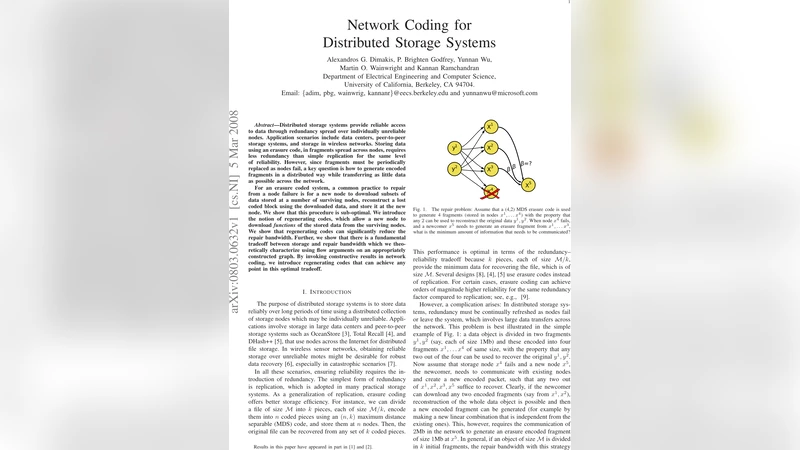
Distributed storage systems provide reliable access to data through redundancy spread over individually unreliable nodes. Application scenarios include data centers, peer-to-peer storage systems, and storage in wireless networks. Storing data using an erasure code, in fragments spread across nodes, requires less redundancy than simple replication for the same level of reliability. However, since fragments must be periodically replaced as nodes fail, a key question is how to generate encoded fragments in a distributed way while transferring as little data as possible across the network. For an erasure coded system, a common practice to repair from a node failure is for a new node to download subsets of data stored at a number of surviving nodes, reconstruct a lost coded block using the downloaded data, and store it at the new node. We show that this procedure is sub-optimal. We introduce the notion of regenerating codes, which allow a new node to download \emph{functions} of the stored data from the surviving nodes. We show that regenerating codes can significantly reduce the repair bandwidth. Further, we show that there is a fundamental tradeoff between storage and repair bandwidth which we theoretically characterize using flow arguments on an appropriately constructed graph. By invoking constructive results in network coding, we introduce regenerating codes that can achieve any point in this optimal tradeoff.
💡 Research Summary
The paper tackles a fundamental inefficiency in distributed storage systems that use erasure codes: the repair process traditionally requires a newcomer node to download entire data fragments from a set of surviving nodes, reconstruct the original file, and then re‑encode a new fragment. Although erasure coding reduces storage overhead compared with simple replication, the repair bandwidth can be as large as the size of the whole file (M), which is often prohibitive in large‑scale or high‑churn environments.
The authors introduce regenerating codes, a new class of codes that allow a newcomer to download only functions (linear combinations) of the stored data from d surviving nodes, each contributing β bits, for a total repair bandwidth γ = d·β. By carefully designing these functions, the newcomer can generate a fresh encoded fragment without ever reconstructing the full file.
To analyze the fundamental limits of this approach, the paper defines an information flow graph. The graph contains a source node S (the original data), for each storage node i an input vertex x_i^in and an output vertex x_i^out linked by an edge of capacity α (the amount stored per node), and data collector nodes DC that request reconstruction. When a node fails and a newcomer joins, edges of capacity β are added from the d chosen active nodes’ outputs to the newcomer’s input. The min‑cut between S and any DC must be at least M for reconstruction to be possible. This yields the key inequality
\
Comments & Academic Discussion
Loading comments...
Leave a Comment