Cooperative Spectrum Sensing Using Random Matrix Theory
In this paper, using tools from asymptotic random matrix theory, a new cooperative scheme for frequency band sensing is introduced for both AWGN and fading channels. Unlike previous works in the field, the new scheme does not require the knowledge of…
Authors: L. S. Cardoso, M. Debbah, P. Bianchi
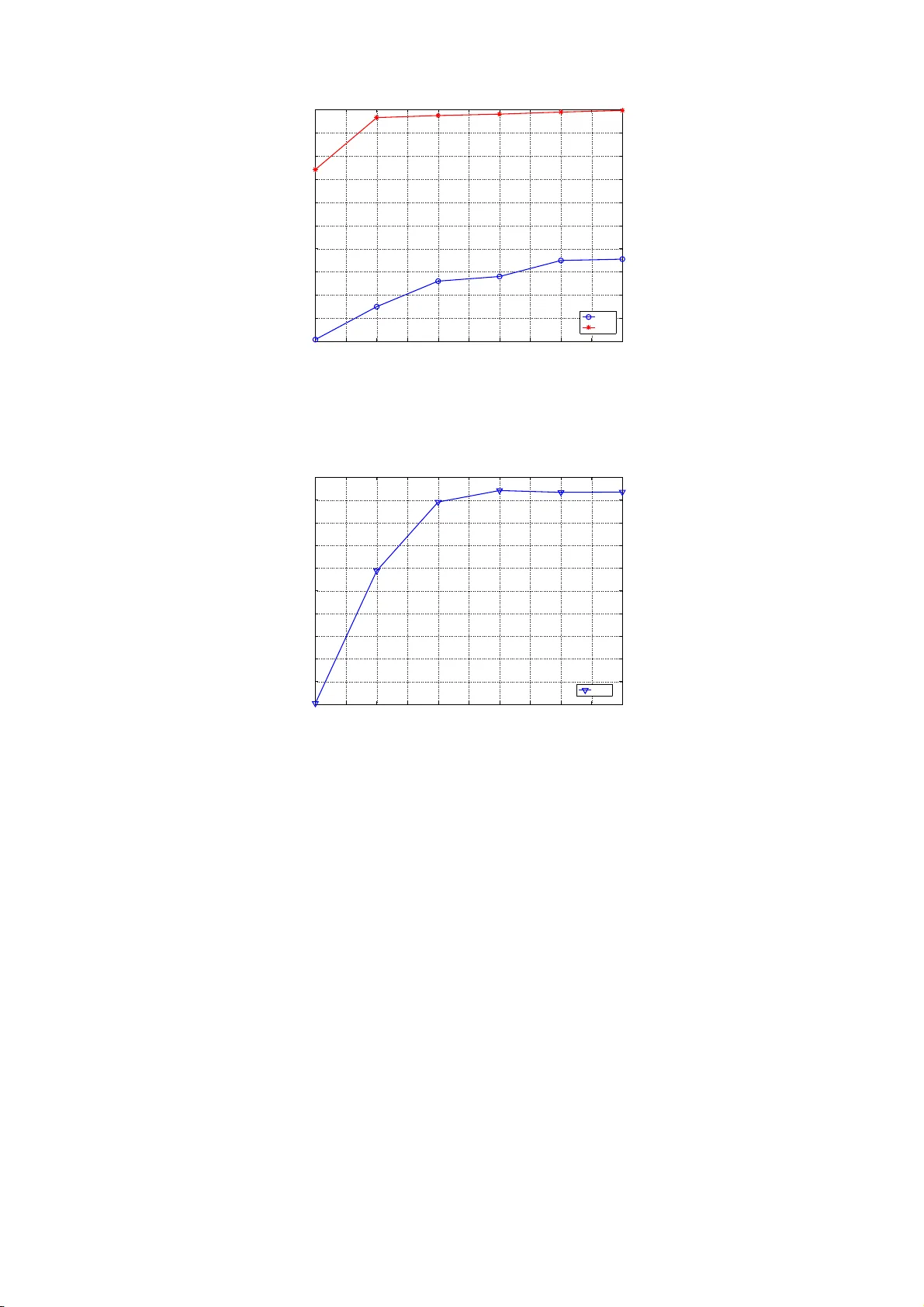
Co op erativ e Sp ectrum Sensing Using Random Matrix Theory Leonardo S. Cardoso and Merouane Debbah and Pascal Bianchi Jamal Na jim SUPELEC ENST Gif-sur-Yvette, F rance Paris, F rance { leonardo .cardoso, merouane.debbah and pa scal.bianc hi } @ supelec.fr jamal.na jim@enst.fr No vem b er 20, 2018 Abstract In t h is pap er, using to ols from asymptotic r an d o m matrix theory , a new co op erativ e scheme for fr equency band sensing is int ro duced for b oth A W GN and fading c hann els. Unlike previous w orks in the field, the new scheme do es not require the kn o wledge of the noise statistics or its v ariance and is related to the b eha vior of the largest and smallest eigen v alue of random matrices. Remark ably , sim ulations sho w that the asymp totic claims hold even for a small n umb er of observ ations (whic h mak es it con ve nient for time-v arying top ologies), outp erforming classical energy detection tec hn iques. 1 In tro ducti on It has already b ecome a common understanding that curren t mobile comm unication systems do not ma ke full use o f the av ailable sp ectrum, either due to sparse user a c- cess o r to the system’s inherent deficiencies, a s sho wn by a rep ort from the F ederal Comm unications Commission (FC C) Sp ectrum P olicy T ask F orce [1]. It is en vi- sioned that future systems will b e able to opp ortunistically exploit those sp ectrum ’left-o vers ’, b y means of kno wledge o f the environme nt and cognitio n capability , in order t o a da pt their radio parameters accordingly . Suc h a t echnology has b een pro- p osed b y Joseph Mitola in 2 0 00 and is called cognitiv e radio [2]. D ue to the fact that recen t adv ances on micro-electronics and computer sys tems are p o in ting to a -not so far- era when suc h radios will b e feasible, it is of utmost imp or t ance to dev elop go o d p erforming sensing tec hniques. In its simplest form, sp ectrum sensing means lo oking for a signal in the presence of no ise for a giv en f requency band (it could also encompass being able to classify the signal). This problem has been extensiv ely studied b efore, but it has regained atten tion no w as part of the cognitiv e ra dio researc h efforts. There are sev eral classical tec hniques for this purp ose, suc h as the energy detector (ED) [3–5], the matc hed filter [6 ] and the cyclostationary feature detection [7–9]. These tec hniques ha v e their strengths and weak nesses and are we ll suited for ve ry sp ecific a pplicatio ns. Nev ertheless, the problem of sp ectrum sensing as seen from a cognitiv e radio p ersp ectiv e, has v ery stringen t requiremen ts and limitations, suc h as, • no prior kno wledge o f the signal structure (statistics, noise v ariance v alue, etc...); 1 • the detection of signals in the shortest time p ossible; • ability to detect reliably ev en o ve r heav ily faded environme nts; The works b y Cabric et al. [7 ], Akyildiz et al. [10] and Ha ykin [11] provide a summary of these classical tec hniques from the cognitiv e netw ork p oin t of view. It is clear from these w orks, t ha t none can fully cop e with all t he requiremen ts of the cognitiv e radio net w orks. In simple A W GN (Additiv e White Ga ussian Noise) channe ls, most classical ap- proac hes p erform v ery w ell. Ho w ev er, in the case of fast fading, these tec hniques are no t able to provide satisfactory solutions, in particular to the hidden no de pro b- lem [12 ]. T o this end, sev eral w orks [13–16] hav e lo ok ed in to the case in whic h cognitiv e radio s co op erate for sensing the sp ectrum. These works aim at reducing the probabilit y of false alarm by adding ex tra redundancy to the sensin g pro cess. They also aim at reducin g the num ber of samples collected, and thus , the estima- tion times b y t he use parallel measuring devices. How ev er, ev en though one could exploit t he spatial dime nsion effic iently , these works are based on the same funda- men tal tec hniques, whic h require a priori knowledge of the signal. In this w or k, w e in tro duce an alternativ e metho d for blind (in the sens e that no a priori know ledge is needed) spectrum sensing. This me tho d relies on the use of m ultiple receiv ers to infer on the structure of the receiv ed signals using random ma- trix theory (RMT). W e sho w tha t w e can estimate the sp ectrum o ccupancy reliably with a small amoun t of receiv ed samples. The remainder o f this w ork is divided as follows. In section 2, w e formulate the problem of blind sp ectrum sensing. In section 3 , w e in tro duce the prop osed approac h based on ra ndo m matrix theory . In section 4, w e presen t some practical results whic h confirm that the asymptotic a ssumptions hold ev en for a small a moun t of samples. Then, in section 5, w e show the p erformance results o f the prop osed metho d. Finally , in section 6, w e draw the main conclusions and p oint out further studies. 2 Problem F orm ulation The basic problem concerning sp ectrum sensing is the detection of a signal within a noisy measure. This turns out to b e a difficult task, esp ecially if the receiv ed signal p ow er is v ery low due to pathloss or fading, whic h in the blind spectrum sens ing case is unkno wn. The problem can b e p osed a s a h yp o t hesis test suc h that [3]: y ( k ) = n ( k ): H 0 h ( k ) s ( k ) + n ( k ): H 1 , (1) where y ( k ) is the receiv ed v ector of samples at instant k , n ( k ) is a noise (not neces - sarily gaussian) of v ariance σ 2 , h ( k ) is the fading comp onent, s ( k ) is the signal which w e wan t to detect, suc h that E [ | s ( k ) | 2 ] 6 = 0, and H 0 and H 1 are the noise-only and signal h yp ot hesis, resp ectiv ely . W e supp ose that the channe l h stays constan t during N blo c ks ( k = 1 ..N ). Classical t ec hniques for sp ectrum sensing based on energy detection compare the signal energy with a know n threshold V T [3–5] deriv ed fro m the statistics of the noise a nd ch annel. The follo wing is considered to b e the decision rule decision = H 0 , if E [ | y ( k ) | 2 ] < V T H 1 , if E [ | y ( k ) | 2 ] ≥ V T , 2 where E [ | y ( k ) | 2 ] is the energy of the signal and V T is usually tak en as the noise v a r ia nce. One dra wbac k of this approac h is that neither the noise /channel distri- bution nor V T are know n a priori. In real life scenarios V T dep ends on the radio c haracteristics and is hard to b e estimated pro p erly . Moreo v er, in the case of fading and path loss, the energy of the receiv ed signal can b e of the order of the noise, making it difficult to b e detected all the more a s the num ber o f samples N may be v ery limited. Indeed, E [ | y ( k ) | 2 ] is estimated by 1 N N X k =1 | y ( k ) | 2 , whic h is not a go o d estimator for the small sample size case. In t he following, w e pro vide a co op erativ e approach for cognit ive netw orks to detect the signal from a pr imar y system without the need to kno w the noise v ariance using results fro m random matrix theory . 3 Random Matrix Th eory for S p ectrum Sen sing Consider the scenario depicted in Figure 1, in whic h primary users (in white) comm unicate to their dedicated ( primary) base station. Secondary base stations { B S 1 , B S 2 , B S 3 , ..., B S K } are co op erative ly sensing the c hannel in order to identify a white space and exploit the medium. P S f r a g r e p la c e m e n t s p r i m a r y b a s e s t a t i o n B S 1 B S 2 B S 3 B S K Figure 1: Considered scenario for sp ectrum sensing. Before going any further, let us assume the follo wing: • The K base stations in the secondary system share informa t io n b etw een them. This can b e p erformed b y transmission ov er a wired high sp eed bac kb one. • The base statio ns are analyzing the same p ortion of the sp ectrum. Let us consider the following K × N ma t r ix consisting of the samples receiv ed b y all the K secondary base stations ( y i ( k ) is the sample receiv ed b y base station i at instant k ): Y = y 1 (1) y 1 (2) · · · y 1 ( N ) y 2 (1) y 2 (2) · · · y 2 ( N ) y 3 (1) y 3 (2) · · · y 3 ( N ) . . . . . . . . . y K (1) y K (2) · · · y K ( N ) . The goal of the random matrix theory approa c h is to p erform a test o f indep en- dence of the signals receiv ed b y the v arious base stations. Indeed, in the presence 3 of signal ( H 1 case), all the receiv ed samples are corr elated, whereas when no signal is presen t ( H 0 case), the samples are decorrelated whatev er the fading situation. Hence, in this case, for a fixe K and N → ∞ , the sample co v ariance matrix 1 N YY H con v erge σ 2 I . How ev er, in practice, N can b e of the same o r der of magnitude than K and therefore one can not infer directly 1 N YY H indep endence of the samples. This can b e formalized using to o ls f rom random matrix theory [17]. In the case where the en tries of Y are indep enden t (irresp ectiv ely of the sp ecific probabilit y distribution, which corresponds to the case where no signal is t r ansmitted - H 0 ) results from asymptotic random matrix theory [17] state that: Theorem. Consid er an K × N matrix W whose en tries are indep endent zero- mean complex (or real) random v ariables with v ariance σ 2 N and fourth momen ts of order O ( 1 N 2 ). As K, N → ∞ with K N → α , the empirical distribution of WW H con v erges almost surely to a nonrandom limiting distribution with densit y f ( x ) = (1 − 1 α ) + δ ( x ) + p ( x − a ) + ( b − x ) + 2 π α x where a = σ 2 (1 − √ α ) 2 and b = σ 2 (1 + √ α ) 2 . In terestingly , when there is no signal, the supp ort o f the eigenv alues of the sample co v ariance matrix (in Figure 2, denoted b y ˇ MP) is finite, whatev er the distribution of the noise. The Marc henk o-Pastur law th us serv es as a theoretical prediction under the assumption that matrix is ”all noise”. Deviations from this theoretical limit in the eigen v alue distribution should indicate non-noisy comp onents i.e they should suggest info rmation ab out the ma t r ix. P S f r a g r e p la c e m e n t s ˇ MP a b Figure 2: The Marchenk o - P astur supp ort ( H 0 h yp othesis). In the case in whic h a signal is presen t ( H 1 ), Y can b e rewritten as Y = h 1 σ 0 . . . . . . h K 0 σ s (1) · · · s ( N ) z 1 (1) · · · z 1 ( N ) . . . . . . z K (1) · · · z K ( N ) , where s ( i ) a nd z k ( i ) = σ n k ( i ) are r esp ective ly the indep enden t signal and noise with unit v ariance at instan t i a nd base station k . Let us denote by T the matrix: T = h 1 σ 0 . . . . . . h K 0 σ . 4 TT H has clearly one eigenv alue λ 1 = P | h i | 2 + σ 2 and all the rest equal to σ 2 . The b eha vior of the eigen v alues of 1 N YY H is r elat ed to the study of the eigen v alue of la rge sample co v a riance matrices of spik ed p opulatio n mo dels [1 8 ]. Let us define the signal to noise ratio (SNR) ρ in t his w ork as ρ = P | h i | 2 σ 2 . Recen t w orks of Baik et al. [18, 19] hav e sho wn that, when K N < 1 and ρ > r K N (2) (whic h are assumptions that are clearly met when the n um b er of samples N are sufficien tly high), the maxim um eigen v alue o f 1 N YY H con v erges a lmost surely to b ′ = ( X | h i | 2 + σ 2 )(1 + α ρ ) , whic h is superior to b = σ 2 (1 + √ α ) 2 seen for the H 0 case. Therefore, whenev er the distribution of the eigen v a lues of the matrix 1 N YY H departs fr o m the Marchenk o -P astur la w (Figure 3) , t he detector know s tha t the signal is presen t. Hence, one can use this in teresting feature to sense the sp ectrum. P S f r a g r e p la c e m e n t s ˇ MP a b b ′ Figure 3: The Marc henk o-P astur supp ort plus a signal comp onent. Let λ i b e the eigenv alues of 1 N YY H and G = [ a, b ], the co o p erativ e sensing algorithm w orks as f ollo ws: 3.1 Noise distribution u nkno wn, v ariance kno wn In this case, the f ollo wing criteria is used: decision = H 0 : , if λ i ∈ G H 1 : otherw ise (3) Note that refinemen ts of this algorithm (where the pro babilit y of false a larm is tak en into accoun t in the non-asymptotic case) can b e found in [2 0]. The results are based on the computat io n of the asymptotic lar gest eigenv alue distribution in t he H 0 and H 1 case. 5 3.2 Both noise distribution and v ariance unkno wn Note that the ratio of t he maxim um and the minim um eigen v alues in the H 0 h y- p othesis case do es not depend on the noise v ariance. Hence, in order to circum v en t the need for the knowledge of the noise, the following criteria is used: decision = ( H 0 : , if λ max λ min ≤ (1+ √ α ) 2 (1 − √ α ) 2 H 1 : other w ise (4) It should b e noted t hat in this case, one needs to still tak e a sufficien tly high n um b er of samples N suc h that the conditions in Eq. (2) are met. In other w ords, the n um b er of samples scales quadratically with the in v erse of the signal to noise ratio. Note moreo v er that the test H 1 pro vides also a go o d estimator of the SNR ρ . Indeed, the ratio of largest eigen v alue ( b ′ ) and smallest ( a ) of 1 N YY H is related solely to ρ and α i.e b ′ a = ( ρ + 1)(1 + α ρ ) (1 − √ α ) 2 T o our knowledge , this estimator of the SNR has nev er b een put forw ard in the literature b efore. 4 P erformance Analysis The previous theoretical results ha v e sho wn that one is able to distinguish a signal from no ise by the use of only a limiting rat io of the hig hest to the smallest eigenv alue of t he sample co v ariance matrix. F or finite dimensions, the op erating region fo r suc h an alg orithm is still an issue and is related to the asymptotic distribution of a scaling factor o f the ratio [20]. This section pro vides some c hara cterization of this region through the analysis of the ratio b et we en λ max and λ min of 1 N YY H for v a rious matrix sizes. Figures 4 and 5 presen t the λ max /λ min for v arious sizes of Y in the pure noise case, with α = 1 / 2 and α = 1 / 10, res p ectiv ely . F rom the figur es we see that b oth cases pro vide a go o d approx imation of the asymptotic ratio ev en with small matrix sizes. If one ta k es, for example, N = 100 ( K = 50 for α = 1 / 2 and K = 10 for α = 1 / 10) , it can b e seen that the sim ulated cases are resp ectiv ely equal to 81% p ercen t a nd 83% o f the asymptotic limit fo r α = 1 / 2 and α = 1 / 1 0. As exp ected, for a larger Y matrix size, the empirical ratio a ppro ac hes the asymptotic one. Figures 6 and 7 show t he b eha vior of the λ max /λ min for the signal plus noise case for α = 1 / 2 and α = 1 / 10 , resp ective ly . In b oth cases, σ 2 = 1 /ρ (with a ρ of - 5 dB) with P | h i | 2 = 1 (whic h holds under the criteria in Eq. (2)). In this case, λ max λ min = b ′ a , for the pure signal case. In terestingly , for N = 100 ( K = 50 for α = 1 / 2 and K = 10 fo r α = 1 / 10), it can b e seen that the sim ulated case is appro ximately 70% p ercen t and 83 % o f the asymptotic limit fo r α = 1 / 2 and α = 1 / 10, resp ectiv ely . As exp ected, the larger the Y matrix sizes, the closer one gets to the asymptotic ratio. A go o d appro ximation w as obta ined f or v alues of N as lo w as 100 samples. 5 Results Sim ulations w ere carried out t o establish the p erfo r ma nce of the random matrix theory detector sche me in comparison to the co op erative energy detector sc heme 6 0 50 100 150 200 250 300 350 400 0 5 10 15 20 25 30 35 N (number of samples) λ max / λ min H 0 case, fixed α = 1/2 λ max / λ min (Asymptotic) λ max / λ min (Simulated) Figure 4: Beha vior of λ max /λ min for increasing N ( case H 0 , α = 1 / 2 ). 0 200 400 600 800 1000 1200 1400 1600 1800 2000 1 1.5 2 2.5 3 3.5 4 N (number of samples) λ max / λ min H 0 case, fixed α = 1/10 λ max / λ min (Asymptotic) λ max / λ min (Simulated) Figure 5 : Beha vior of λ max /λ min for increasing N (case H 0 , α = 1 / 1 0). based on v oting [15, 16]. The f ramew ork for t he energy detector is exp o sed in section 2, with h ( k ) mo deled a s a rayleigh m ultipath fading of v aria nce 1 /K . The v ariance is normalized to take into accoun t the fact that the energy do es not increase without b ound as the n um b er of base stations increases due to the pa t h loss. A total of 10 secondary base stations w ere sim ulated. F or the voting sc heme, the decision rule is the follo wing: one considers the ov erall spectrum o ccupancy decision to b e the one chose n by most of the secondary base stations. The t hr eshold V T is tak en a s σ 2 (for the kno wn noise v ariance case). F or the random matrix theory based sc heme, a fixed to tal of ( K = 10) base stations w ere adopted. Note that the algorithms can b e optimized for the v ot ing and random matrix theory based rules by adopting decision margins [2 0 ]. Figure 8 depicts the p erformance of t he energy detector sc heme along with the random matr ix theory one fo r N = { 10 , 20 , ..., 60 } samples and a kno wn noise v ari- ance of σ 2 at SNR equal to -5dB. It is imp ortant to stress tha t since K is fixed, α is not constan t a s in the previous section. As clearly s hown, the random matrix theory sche me outp erforms the co op erativ e energy detector case for all n um b er of samples due to its inheren t robustness. Figure 9 plots the p erformance of the random matrix theory sc heme for a n un- kno wn noise v ariance (the v ot ing sc heme can no t b e compared as it relies on the 7 0 50 100 150 200 250 300 350 400 0 5 10 15 20 25 30 35 40 N (number of samples) λ max / λ min H 1 case, SNR = −5 dB, fixed α = 1/2 λ max / λ min (Asymptotic) λ max / λ min (Simulated) Figure 6: Beha vior of λ max /λ min for increasing N ( case H 1 , α = 1 / 2 ). 0 200 400 600 800 1000 1200 1400 1600 1800 2000 1 1.5 2 2.5 3 3.5 4 N (number of samples) λ max / λ min H 1 case, SNR = −5 dB, fixed α = 1/10 λ max / λ min (Asymptotic) λ max / λ min (Simulated) Figure 7 : Beha vior of λ max /λ min for increasing N (case H 1 , α = 1 / 1 0). kno wledge of the noise v ariance). One can see that, indeed, ev en without the know l- edge o f a no ise v ariance, one is still able to ac hiev e a v ery go o d perfo rmance f o r sample sizes greater than 30. 6 Conclus ions In this pap er, we hav e provided a new sp ectrum sensing tec hnique based on random matrix theory and shown its p erformance in comparison to the co op erative energy detector sc heme for b o th a kno wn and unkno wn noise v ariance. Remark ably , the new tec hnique is quite robust and do es not require the kno wledge of the s igna l or noise statistics. Moreo v er, the asymptotic claims turn o ut to b e v alid ev en for a v ery lo w num ber of dimensions. The metho d can b e enhanced (see [20]) b y adj usting the threshold decision, taking in to accoun t the num b er o f samples tho ug h the deriv ation of the proba bilit y o f false ala rm of t he limiting ratio of the larg est to the smallest eigen v alue. 8 10 15 20 25 30 35 40 45 50 55 60 0.9 0.91 0.92 0.93 0.94 0.95 0.96 0.97 0.98 0.99 1 N (number of samples) Ratio of correct detections Correct detections at SNR = −5 dB (known noise) ED RMT P S f r a g r e p la c e m e n t s N u m b e r o f s a m p l e s P r o p o r t i o n o f c o r r e c t d e t e c t i o n s Figure 8: Comparison b et w een the ED and random matrix theory approach ( ρ = − 5 dB ). 10 15 20 25 30 35 40 45 50 55 60 0.5 0.55 0.6 0.65 0.7 0.75 0.8 0.85 0.9 0.95 1 N (number of samples) Ratio of correct detections Correct detections at SNR = −5 dB (unknown noise) RMT P S f r a g r e p la c e m e n t s N u m b e r o f s a m p l e s P r o p o r t i o n o f c o r r e c t d e t e c t i o n s Figure 9: Random matrix theory appro ac h for an unkno wn noise v ariance. Ac kno wled gmen t This w ork was funded b y the Alcatel-Lucen t Chair in Flexible Radio. The authors w ould lik e to thank prof . W alid Ha chem for fruitful discussions on the to pic. References [1] Sp ectrum Efficiency W orking G roup. Rep ort of the Sp ectrum Efficiency W o r k- ing Group. T echnic al rep ort, FC C, No ve mber 2002. [2] J. Mitola. Co gnitive R adio An In te gr ate d Agent Ar chite ctur e for Softwar e De- fine d R adio . PhD thesis, Roy al Institute of T ec hnology (KTH), Ma y 2000. [3] H. Urk o witz. Energy detection of unkno wn determinis tic signals. Pr o c e e dings of the IEEE , 55:523–53 1 , 1967. [4] V. I. Kost ylev. Energy detection of a signal with ra ndom amplitude. 2002 . 9 [5] F. F. D igham, M. S. Alouini, and M. K. Simon. On the energy detection of unkno wn signals o ve r fading c hannels. 2003 . [6] A. Sahai, N. Hov en, and R. T andra. Some f undamen tal limits on cognitive radio. A l lerton Confer enc e on C ommunic ation, Contr ol, an d Computing , 2003. [7] D . Cabric, S. M. Mishra, and R. W. Bro dersen. Implemen tation issues in sp ec- trum sensin g for c og nitiv e radios. In Signals, Systems and Com p uters, 2004. Confer enc e R e c or d of the Thirty-Eighth Asilomar Confer enc e on , volume 1, pages 772–776 V ol.1, 2004. [8] A. F ehsk e, J. Gaeddert, and JH Reed. A new approac h to signal classification using sp ectral correlation a nd neural net w orks. Pr o c. IEEE Int. Symp. New F r ontiers Dynamic S p e ctr. A c c ess Networks , 1:1 44–150. [9] H. T ang. Some ph ysical lay er issues of wide-band cognitiv e ra dio systems. Pr o c. IEEE I nt. Symp. New F r ontiers Dynami c Sp e ctr. A c c ess Networks , 1:151– 1 59. [10] I. F. Akyildiz, W. Y. Lee, M.C. V uran, and S. Mohant y . NeXt genera- tion/dynamic sp ectrum access/cognitiv e radio wireless net w orks: a surve y . Comput. Networks , 50(13):2 1 27–2159 , 200 6. [11] S. Ha ykin. Cognitiv e radio: brain-emp ow ered wireless comm unications. Sele cte d A r e as in C ommunic ations, IEEE Journal on , 23(2):201– 220, 2005. [12] C.L. F ullmer and JJ Ga rcia-Luna-Acev es. Solutions to hidden terminal prob- lems in wireless net w orks. Pr o c e e dings of the ACM SIGCOMM’97 c onfer enc e on Applic ations, te chnolo gies, ar chite ctur es, a nd pr oto c ols for c omputer c om- munic ation , pages 39–49, 1997. [13] S. M. Mishra, A. Sahai, and R. W. Bro dersen. Co o p erativ e sensing among cognitiv e radios. In C ommunic ations, 2006. ICC ’06 . IEEE In ternational Con- fer enc e on , v olume 4, pages 16 58–1663, 200 6. [14] G. Ganesan and Y. Li. Co op era t iv e spectrum sensing in cognitiv e radio net- w orks. In New F r ontiers in D ynamic Sp e ctrum A c c ess Networks, 20 0 5. D ySP AN 2005. 2005 First I EEE I nternational Symp osium on , pages 137–143, 2 0 05. [15] A. Ghasemi and E. S. Sousa. Collab ora tiv e sp ectrum sensing for opp ortunistic access in fading en vironmen ts. New F r ontiers in Dynam ic Sp e ctrum A c c ess Networks, 20 0 5. DySP AN 200 5 . 2005 First I EEE International Symp osium on , pages 131–136, 20 0 5. [16] A. G hasemi and E. S. Sousa. Sp ectrum sensing in cognitive radio net w or ks: the co op eratio n-pro cessing tradeoff. Wir eless Communic ations and Mobile Com- puting - WILEY, 2007. , pages 10 4 9–1060, 200 7 . [17] V. A. Marc henk o and L. A. Pastur. Distributions of eigen v alues fo r some sets of r a ndom matrices. Math USS R- S b ornik , 1:457–48 3, 1967. [18] J. Baik, G. B. Arous, and S. P ec he. Phase transition of the largest eigen v alue for nonnull complex sample cov ariance matrices. Ann. Pr ob ab , 3 3(5):1643 – 1697, 2005. 10 [19] J. Baik and J. W. Silv erstein. Eigen v alues of large sample co v ar iance matrices of spike d p opulatio n mo dels. J. Multivar. Anal. , 97 (6):1382–1 408, 2006. [20] L. S. Cardoso, M. Debbah, P . Bianchi, J. Na jim, and W. Hac hem. Coop erativ e Sp ectrum Sensing for Opp ortunistic Wireless Access Using Random Matrix Theory (under preparat ion). 20 0 8. 11
Original Paper
Loading high-quality paper...
Comments & Academic Discussion
Loading comments...
Leave a Comment