A trajectory approach to two-state kinetics of single particles on sculpted energy landscapes
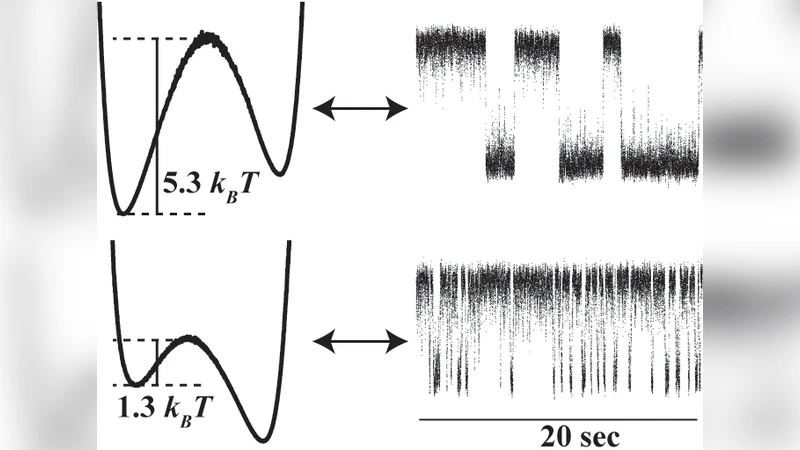
We study the trajectories of a single colloidal particle as it hops between two energy wells A and B, which are sculpted using adjacent optical traps by controlling their respective power levels and separation. Whereas the dynamical behaviors of such systems are often treated by master-equation methods that focus on particles as actors, we analyze them here instead using a trajectory-based variational method called Maximum Caliber, which utilizes a dynamical partition function. We show that the Caliber strategy accurately predicts the full dynamics that we observe in the experiments: from the observed averages, it predicts second and third moments and covariances, with no free parameters. The covariances are the dynamical equivalents of Maxwell-like equilibrium reciprocal relations and Onsager-like dynamical relations. In short, this work describes an experimental model system for exploring full trajectory distributions in one-particle two-state systems, and it validates the Caliber approach as a useful way to understand trajectory-based dynamical distribution functions in this system.
💡 Research Summary
In this paper the authors present a combined experimental‑theoretical study of a single colloidal particle that hops between two sculpted energy wells, A and B, created by a pair of adjacent optical traps. By varying the laser power and the separation of the traps, they can control the relative depth of the wells and the barrier height, thereby tuning both the occupancy probabilities and the transition rates. The particle’s position is recorded at 20 kHz, yielding trajectories that span from 20 minutes to over an hour. A simple threshold algorithm assigns each time point to state A or B, producing a binary time series for each experimental run.
Instead of the conventional master‑equation approach, which focuses on the evolution of state probabilities, the authors adopt the Maximum Caliber (MC) formalism—a dynamical analogue of Jaynes’ maximum‑entropy principle. In MC one defines a dynamical partition function (Q_d) that sums over all possible trajectories, each weighted by a product of four “statistical weights’’: (\alpha) (probability of staying in A), (\beta) (probability of staying in B), (\omega_f) (A→B transition probability), and (\omega_r) (B→A transition probability) for a single time step (\Delta t). The four unknown weights are fixed by imposing the experimentally measured first‑moment constraints: the average numbers of AA, BB, AB, and BA transitions per trajectory, denoted (\langle N_{AA}\rangle, \langle N_{BB}\rangle, \langle N_{AB}\rangle,) and (\langle N_{BA}\rangle). Because the process is stationary, (\alpha+\omega_f=1) and (\beta+\omega_r=1).
The authors show that the partition function can be expressed compactly using a 2 × 2 propagator matrix \
Comments & Academic Discussion
Loading comments...
Leave a Comment