Stochastic Network Model of Receptor Cross-Talk Predicts Anti-Angiogenic Effects
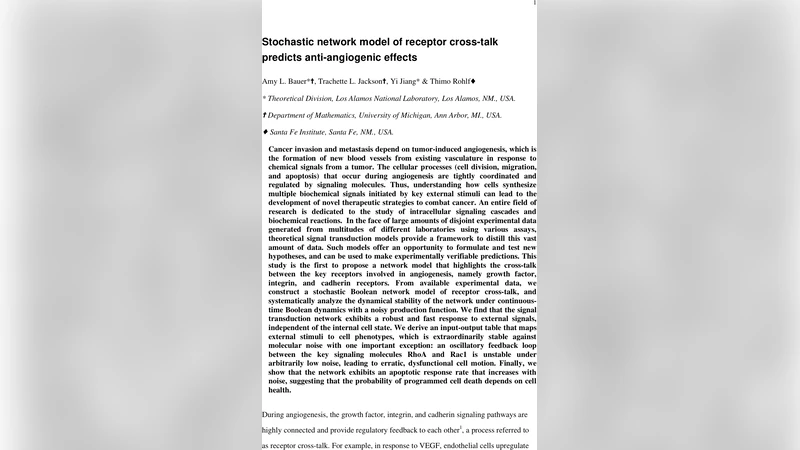
Cancer invasion and metastasis depend on angiogenesis. The cellular processes (growth, migration, and apoptosis) that occur during angiogenesis are tightly regulated by signaling molecules. Thus, understanding how cells synthesize multiple biochemical signals initiated by key external stimuli can lead to the development of novel therapeutic strategies to combat cancer. In the face of large amounts of disjoint experimental data generated from multitudes of laboratories using various assays, theoretical signal transduction models provide a framework to distill this vast amount of data. Such models offer an opportunity to formulate and test new hypotheses, and can be used to make experimentally verifiable predictions. This study is the first to propose a network model that highlights the cross-talk between the key receptors involved in angiogenesis, namely growth factor, integrin, and cadherin receptors. From available experimental data, we construct a stochastic Boolean network model of receptor cross-talk, and systematically analyze the dynamical stability of the network under continuous-time Boolean dynamics with a noisy production function. We find that the signal transduction network exhibits a robust and fast response to external signals, independent of the internal cell state. We derive an input-output table that maps external stimuli to cell phenotypes, which is extraordinarily stable against molecular noise with one important exception: an oscillatory feedback loop between the key signaling molecules RhoA and Rac1 is unstable under arbitrarily low noise, leading to erratic, dysfunctional cell motion. Finally, we show that the network exhibits an apoptotic response rate that increases with noise, suggesting that the probability of programmed cell death depends on cell health.
💡 Research Summary
The paper presents a novel stochastic Boolean network model that captures the cross‑talk among the three principal receptor families governing angiogenesis: growth‑factor receptors (e.g., VEGFR, FGFR), integrin receptors (mediating extracellular‑matrix attachment), and cadherin receptors (mediating cell‑cell adhesion). Starting from an extensive literature survey, the authors extracted roughly thirty experimentally validated interactions among twelve intracellular signaling nodes (including PI3K, Akt, MAPK, Src, FAK, and the small GTPases RhoA, Rac1, Cdc42) and three external inputs (VEGF, ECM binding, and cell‑cell contact). Each node is represented as a binary variable (0 = inactive, 1 = active) and updated according to logical rules that reflect the underlying biochemistry.
A key methodological innovation is the incorporation of a noisy production function into a continuous‑time Boolean dynamics framework. The noise parameter ε defines the probability that a node’s logical update will be flipped, thereby mimicking stochastic fluctuations inherent to intracellular molecular processes. By treating the system as a continuous‑time Markov chain, the authors are able to simulate the evolution of the network under varying noise levels (ε ranging from 0 to 0.5) and from a large ensemble of random initial conditions.
The dynamical analysis reveals two major findings. First, for the vast majority of input combinations the network rapidly converges (within two to three update steps) to a stable attractor—either a proliferative/migratory phenotype (when VEGF and ECM signals are present) or an apoptotic phenotype (when strong cell‑cell contact dominates). This input‑output mapping is remarkably robust: the attractor landscape changes negligibly for ε ≤ 0.1, indicating strong noise‑resilience of the angiogenic signaling circuitry. Second, an oscillatory feedback loop formed by the mutual inhibition of RhoA and Rac1 behaves as an exception. Even infinitesimal noise destabilizes this sub‑circuit, leading to persistent, erratic oscillations that translate into dysfunctional cell motility in the model. The authors label this phenomenon “functional disruption” and argue that it mirrors the irregular migration patterns observed in highly invasive tumor cells.
A further, biologically significant observation is that the probability of reaching the apoptotic attractor increases non‑linearly with noise intensity. When ε exceeds approximately 0.2, the deterministic fixed points disappear and the system undergoes stochastic escape toward the death state. This suggests that cellular stressors that elevate molecular noise (e.g., reactive oxygen species, DNA damage) can tip the balance toward programmed cell death, providing a mechanistic explanation for the observed correlation between cell health and apoptosis rates.
From a therapeutic perspective, the model generates two actionable insights. Targeting the RhoA‑Rac1 feedback loop—either by pharmacologically stabilizing one of the GTPases or by disrupting the mutual inhibition—could suppress the erratic motility that underlies metastasis. Simultaneously, deliberately increasing intracellular noise (for instance, through ROS‑inducing agents or microtubule destabilizers) may push angiogenic endothelial cells into the apoptotic basin, enhancing the efficacy of anti‑angiogenic drugs. The authors emphasize that these strategies exploit dynamic properties of the signaling network that are invisible to static, deterministic models.
The paper also acknowledges limitations. The binary abstraction neglects graded signal amplitudes and does not incorporate inter‑cellular communication, hypoxia gradients, or extracellular pH, all of which are known to influence angiogenesis. Future work is proposed to integrate continuous variables, multi‑scale spatial modeling, and patient‑specific data, thereby refining predictive power for personalized anti‑angiogenic therapy.
In summary, this study provides a rigorous stochastic Boolean framework for angiogenic receptor cross‑talk, demonstrates that the network is generally fast and robust yet contains a critical noise‑sensitive RhoA‑Rac1 loop, and shows that apoptosis rates are noise‑dependent. These insights open new avenues for designing anti‑angiogenic interventions that either stabilize the unstable feedback loop or harness molecular noise to trigger tumor‑vascular regression.
Comments & Academic Discussion
Loading comments...
Leave a Comment