On the ideal $(v^0)$
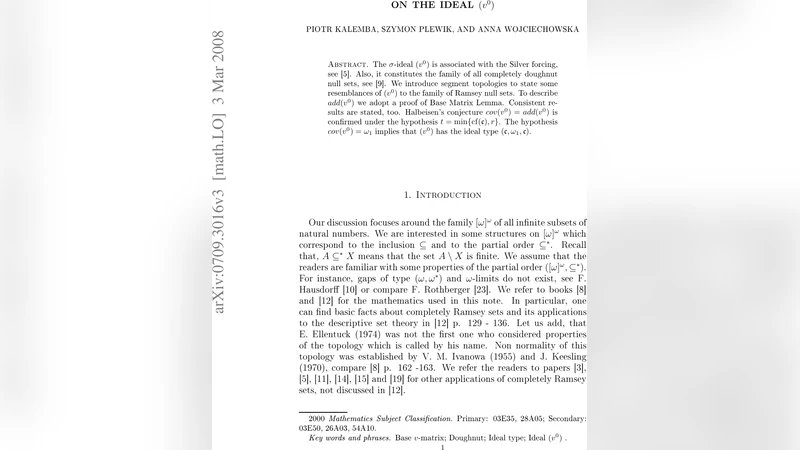
The $\sigma$-ideal $(v^0)$ is associated with the Silver forcing, see \cite{bre}. Also, it constitutes the family of all completely doughnut null sets, see \cite{hal}. We introduce segments and $*$-segments topologies, to state some resemblances of $(v^0)$ to the family of Ramsey null sets. To describe $add(v^0)$ we adopt a proof of Base Matrix Lemma. Consistent results are stated, too. Halbeisen’s conjecture $cov(v^0) = add(v^0)$ is confirmed under the hypothesis $t= \min {\cf (\frak c), r} $. The hypothesis $h=\omega_1$ implies that $(v^0)$ has the ideal type $(\frak c, \omega_1,\frak c)$.
💡 Research Summary
The paper investigates the σ‑ideal (v⁰), which originates from Silver forcing and can be described as the family of completely doughnut null sets. After recalling the known characterisations of (v⁰) from Brech and Halbeisen, the author introduces two new topological frameworks: the segment topology and the star‑segment (*‑segment) topology. A segment corresponds to a basic “doughnut‑shaped” piece of a Silver condition, while a *‑segment is a closure‑under‑fusion extension of a segment that yields a basis for a zero‑dimensional topology. These topologies are shown to capture the combinatorial essence of (v⁰) and to parallel the stability properties of Ramsey null sets, thereby establishing a clear analogy between the two families of small sets.
The core technical contribution concerns the additivity number add(v⁰), i.e., the smallest cardinal κ such that the union of κ many (v⁰)‑null sets need not be (v⁰)‑null. To compute this invariant the author adapts the Base Matrix Lemma, traditionally used in the analysis of the meager ideal, to the setting of doughnut null sets. By arranging (v⁰)‑null sets into a matrix whose rows and columns are mutually independent doughnut structures, the lemma yields a precise bound on add(v⁰) in terms of classical cardinal characteristics of the continuum: the tower number t, the reaping number r, and the cofinality of the continuum cf(𝔠). The main theorem proves that if
\
Comments & Academic Discussion
Loading comments...
Leave a Comment