Rips complexes and covers in the uniform category
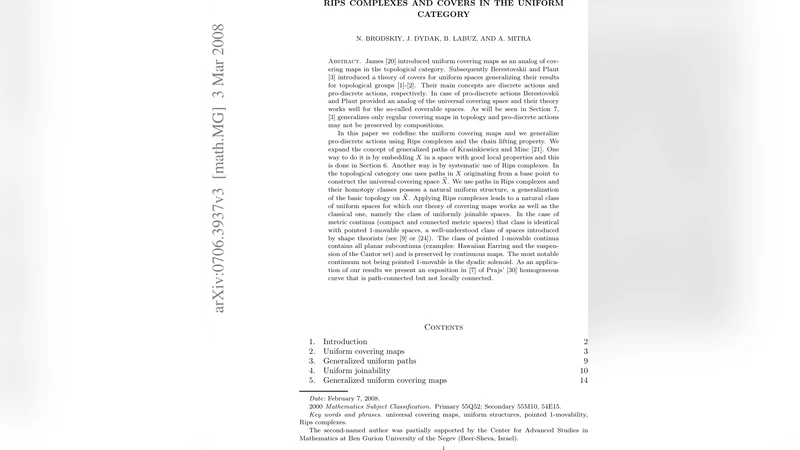
James \cite{Jam} introduced uniform covering maps as an analog of covering maps in the topological category. Subsequently Berestovskii and Plaut \cite{BP3} introduced a theory of covers for uniform spaces generalizing their results for topological groups \cite{BP1}-\cite{BP2}. Their main concepts are discrete actions and pro-discrete actions, respectively. In case of pro-discrete actions Berestovskii and Plaut provided an analog of the universal covering space and their theory works well for the so-called coverable spaces. As will be seen in Section \ref{SECTION-Comparison}, \cite{BP3} generalizes only regular covering maps in topology and pro-discrete actions may not be preserved by compositions. In this paper we redefine the uniform covering maps and we generalize pro-discrete actions using Rips complexes and the chain lifting property. We expand the concept of generalized paths of Krasinkiewicz and Minc \cite{KraMin}.
💡 Research Summary
The paper revisits the notion of uniform covering maps, originally introduced by James, and later generalized by Berestovskii and Plaut through the concepts of discrete and pro‑discrete actions. While the pro‑discrete framework supplies a universal covering object for a class of “coverable” uniform spaces, it is limited to regular (i.e., normal) coverings and fails to be closed under composition, which restricts its applicability to many natural examples. To overcome these shortcomings, the author proposes a new definition of uniform covering maps based on Rips complexes and a chain‑lifting property.
A Rips complex Rε(X) is built from a uniform space (X, U) by taking all finite subsets whose pairwise distances are less than ε and treating them as simplices. This construction translates the uniform structure into a combinatorial simplicial object, making it possible to examine group actions and covering maps at the level of simplices rather than merely points. The central technical tool is the chain‑lifting property: for every ε‑chain (a finite sequence of points with successive distances < ε) in the base space X and for any chosen lift of its initial point, there exists a unique ε‑chain in the covering space ˜X that projects onto the original chain. Together with the requirement that the induced map Rε(˜X) → Rε(X) be a local simplicial isomorphism for each ε, these conditions define a uniform covering map in the new sense.
With this definition the author introduces generalized pro‑discrete actions. Instead of demanding a globally discrete action, one only requires that for each ε the group acts freely on the simplices of Rε(X) and that the chain‑lifting property holds. This weaker, locally discrete condition includes many actions that are excluded from the classical pro‑discrete setting, notably those arising from non‑regular coverings or from actions that are only locally free.
The paper also extends the notion of generalized paths introduced by Krasinkiewicz and Minc. In the Rips‑complex framework a path is represented by a 1‑chain (a sequence of adjacent vertices) rather than a continuous map from an interval. The author shows that such generalized paths lift uniquely through any uniform covering map defined above, thereby providing a path‑space model that itself carries a natural uniform covering structure. This mirrors the classical relationship between path spaces and universal covers but now respects the uniform structure.
A detailed comparison with the earlier theory demonstrates why the classical pro‑discrete approach captures only regular coverings: the global discreteness of the action guarantees that compositions of coverings remain coverings, but it excludes many natural examples where the action is only locally discrete. By working with Rips complexes, the new theory can detect fine uniform information at arbitrarily small scales (by choosing ε sufficiently small) and thus preserve the covering property under composition. The author proves that the composition of two maps satisfying the chain‑lifting property again satisfies it, establishing closure under composition.
Finally, the paper discusses implications for the broader study of uniform spaces. The Rips‑complex viewpoint provides a bridge between uniform topology, coarse geometry, and simplicial methods, opening avenues for studying uniform fundamental groups, uniform homology, and uniform versions of classical covering space results. The generalized pro‑discrete actions and the chain‑lifting framework are expected to be useful in analyzing uniform spaces with non‑trivial large‑scale geometry, such as metric groups, spaces with fractal‑like uniform structures, and spaces arising in analysis on metric measure spaces.
In summary, the work redefines uniform covering maps via Rips complexes, introduces a robust chain‑lifting condition, generalizes pro‑discrete actions to a locally discrete setting, and connects these ideas with generalized path theory. This yields a more flexible and composition‑stable covering theory for uniform spaces, extending the reach of uniform covering concepts well beyond the regular case treated in earlier literature.
Comments & Academic Discussion
Loading comments...
Leave a Comment