This paper presents the design, fabrication and preliminary experimental results of a flexure plate wave (FPW) resonator using sol-gel derived lead zirconate titanates (PZT) thin films. The resonator adopts a two-port structure with reflecting grates on the composite membrane of PZT and SiNx. The design of the reflecting grate is derived from a SAW resonator model using COM theory to produce a sharp resonant peak. The comparison between the mass and the viscosity effects from the theoretical expression illustrates the applications and the constraints of the proposed device in liquid sensing. Multiple coatings of sol-gel derived PZT films are adopted because of the cost advantage and the high electromechanical coupling effect over other piezoelectric films. The fabrication issues of the proposed material structure are addressed. Theoretical estimations of the mass and the viscosity effects are compared with the experimental results. The resonant frequency has a good linear correlation with the density of low viscosity liquids, which demonstrate the feasibility of the proposed device.
Deep Dive into Liquid Density Sensing Using Resonant Flexural Plate Wave Device with Sol-Gel PZT Thin Films.
This paper presents the design, fabrication and preliminary experimental results of a flexure plate wave (FPW) resonator using sol-gel derived lead zirconate titanates (PZT) thin films. The resonator adopts a two-port structure with reflecting grates on the composite membrane of PZT and SiNx. The design of the reflecting grate is derived from a SAW resonator model using COM theory to produce a sharp resonant peak. The comparison between the mass and the viscosity effects from the theoretical expression illustrates the applications and the constraints of the proposed device in liquid sensing. Multiple coatings of sol-gel derived PZT films are adopted because of the cost advantage and the high electromechanical coupling effect over other piezoelectric films. The fabrication issues of the proposed material structure are addressed. Theoretical estimations of the mass and the viscosity effects are compared with the experimental results. The resonant frequency has a good linear correlation w
Stresa, Italy, 25-27 April 2007
LIQUID DENSITY SENSING USING RESONANT FLEXURAL PLATE WAVE DEVICE
WITH SOL-GEL PZT THIN FILMS
Jyh-Cheng Yu* and Huang-Yao Lin
Department of Mechanical and Automation Engineering
National Kaohsiung First University of Science and Technology
2, Juoyue Rd., Nantz District, Kaohsiung 811, Taiwan, R.O.C.
ABSTRACT
This paper presents
the
design, fabrication
and
preliminary experimental results of a flexure plate wave
(FPW) resonator using sol-gel derived lead zirconate
titanates (PZT) thin films. The resonator adopts a two-port
structure with reflecting grates on the composite
membrane of PZT and SiNx. The design of the reflecting
grating is derived from a SAW resonator model using
COM theory to produce a sharp resonant peak. The
comparison between the mass and the viscosity effects
from the theoretical expression illustrates the applications
and the constraints of the proposed device in liquid
sensing. Multiple coatings of sol-gel derived PZT films
are adopted because of the cost advantage and the high
electromechanical coupling effect over other piezoelectric
films. The fabrication issues of the proposed material
structure are addressed. Theoretical estimations of the
mass and the viscosity effects are compared with the
experimental results. The resonant frequency has a good
linear correlation with the density of low viscosity liquids,
which demonstrate the feasibility of the proposed device.
INTRODUCTION
Acoustic wave devices have attracted enormous attention
for sensor application because that the wave velocity and
damping are sensitive to external disturbances such as
temperature, pressure, additive mass, and viscosity [1].
Among them, the phase velocity of lamb waves, unlike
the velocity of surface acoustic wave (SAW), depends on
the thickness of the propagating plate. They can be
considered as two Rayleigh waves that are strongly
coupled and propagating on both sides of the plate. Two
vibrating modes can propagate through the plate
independently, namely the symmetric and the anti-
symmetric lamb modes. The anti-symmetric zero mode A0,
also called “flexural plate wave” (FPW), propagating on a
thin membrane with thickness 5% or less of the acoustic
wavelength, has a phase velocity lower than the sound
velocity of loading liquid. FPW sensors are suitable for
liquid sensing because a slow mode of propagation, such
as A0 mode, will minimize the radiation energy loss.
The excitation and the detection of the acoustic waves
are most readily accomplished by the use of interdigital
transducers (IDTs) [2] on thin piezoelectric plate that is
used to be realized from the etching processes on a bulk
piezoelectric substrate. Piezoelectric thin films have the
cost advantage over crystalline materials. Many literatures
addressed FPW sensors using ZnO[3] and AlN[5]. The
electromechanical coupling effect and the dielectric
constant of PZT are much higher than AlN and ZnO,
which makes PZT films potentially suitable for sensor
application. However, the polycrystalline structure of PZT
and the required high temperature of heat treatment during
the coating process complicate the realization.
The potential applications of FPW sensors to
chemical and liquid sensing have attracted a lot of
research interests. Costello et al.[3] proposed a simple
theory for the mass sensitivity of a delay-line oscillator
with ZnO on silicon nitride membrane, and modeled the
attenuation of plate waves in contact with viscous liquids.
Laurent et al.[4] addressed the configuration design of the
FPW devices using AlN and ZnO on silicon membrane,
and showed that the FPW device has a large mass
sensitivity compared to other acoustic devices. Weinberg
et al.[5] derived the fluid-damping model for resonant
FPW devices. To increase the differentiability of the
resonant frequency shift, reflecting gratings are added to
the FPW devices that is first reported by Joshi[6] using a
Y-X lithium niobate plate. Nakagwa[7] also adopted the
same configuration but on an AT-cut quartz substrate.
Mass, tensile stress, and viscosity effects might
couple when in contact with liquids, which will
complicate the differentiablity in sensor applications.
Very few literatures address the practical issues and
strategy in liquid density sensing.
This study will discuss the design and application
issues for the FPW resonator using the sol-gel derived
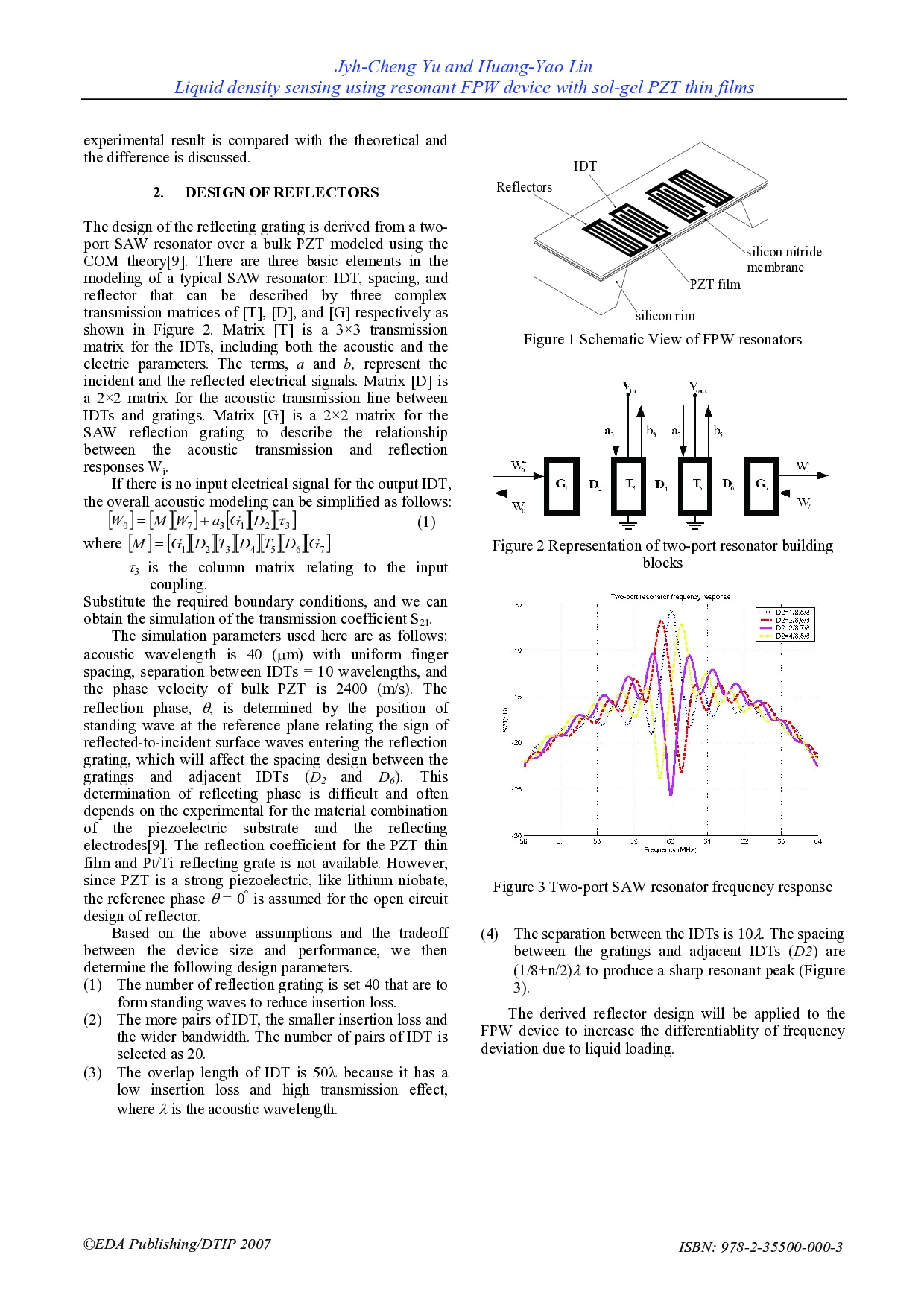
PZT on silicon nitride membrane as shown in Figure 1.
We will derive the design of the reflecting grating using
the Coupling of Modes (COM) theory, and apply to the
FPW devices. The mass loading when the device is in
contact with liquid will introduce the deviation of
resonant frequency that is determined by the liquid
density and viscosity. The constraints of the proposed
device in liquid density sensing will be discussed. Finally,
©EDA Publishing/DTIP 2007
ISBN: 978-2-35500-000-3
…(Full text truncated)…
This content is AI-processed based on ArXiv data.