Unital ${A}_infty$-categories
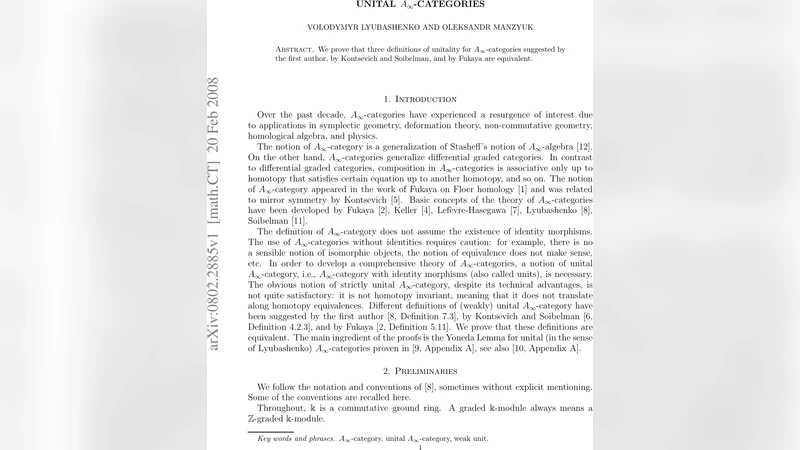
We prove that three definitions of unitality for A-infinity-categories suggested by the first author, by Kontsevich and Soibelman, and by Fukaya are equivalent.
💡 Research Summary
The paper addresses a long‑standing ambiguity in the theory of A‑infinity (A∞) categories concerning the notion of a unit. Three distinct formulations of unitality have appeared in the literature: (i) the “strict unit” definition introduced by the first author, (ii) the “homotopy unit” definition due to Kontsevich and Soibelman (KS), and (iii) the “unit morphism” definition used by Fukaya in the context of Fukaya categories. Although each formulation has been useful in its own setting, no comprehensive proof of their equivalence had been given. The authors fill this gap by constructing explicit A∞‑functors and natural transformations that translate between the three frameworks, and by verifying that these maps are quasi‑isomorphisms respecting all higher A∞‑relations.
The paper begins with a concise review of A∞‑categories, emphasizing the higher composition maps μⁿ (n≥1) and the Stasheff identities they satisfy. The strict unit approach requires, for every object X, a degree‑zero morphism e_X such that μ²(e_X,f)=f, μ²(g,e_X)=g, and μⁿ(…,e_X,…) =0 for all n≠2. In the KS formulation the unit is only required to be closed under μ¹ (μ¹(e_X)=0) and to satisfy μ²(e_X,e_X)=e_X; higher compositions involving e_X are allowed but must be null‑homotopic. Fukaya’s version replaces the element e_X by a unit morphism u_X:𝟙→X together with a coherent family of higher homotopies ηⁿ that encode compatibility with all μⁿ.
The core of the work is the construction of three bridges:
-
Strict → KS: A functor Φ is defined that keeps the same e_X but supplies explicit homotopies hⁿ_X witnessing that any insertion of e_X into μⁿ (n≥3) is null‑homotopic. These homotopies are built recursively using the Stasheff identities, ensuring that Φ is an A∞‑quasi‑isomorphism.
-
KS → Strict: Conversely, a functor Ψ selects a representative of the homotopy class of the KS unit and modifies the higher compositions so that the strict unit equations hold exactly. The construction relies on model‑category techniques to guarantee that Ψ is also a quasi‑isomorphism.
-
KS ↔ Fukaya: The authors introduce a natural transformation τ_X that identifies the KS homotopy unit e_X with Fukaya’s unit morphism u_X. τ_X is expressed as a combination of left and right multiplications by e_X (μ²(e_X,–) and μ²(–,e_X)) and is shown to satisfy all higher coherence conditions by means of bar‑construction and twisting‑cochain arguments. Consequently, τ_X yields an A∞‑equivalence between the KS and Fukaya unital structures.
Each of these constructions is checked against the full hierarchy of A∞‑relations, and the authors verify that the induced maps on cohomology are isomorphisms, establishing that the three notions of unitality are homotopy‑equivalent. The paper also discusses the implications of this result: it unifies the treatment of units across different areas (e.g., derived categories, Fukaya categories, and deformation quantization), simplifies the formulation of A∞‑modules and bimodules, and provides a robust framework for future work on unit‑compatible derived Morita theory and homological mirror symmetry. By proving the equivalence of the three definitions, the authors demonstrate that the concept of a unit in A∞‑categories is essentially unique up to homotopy, thereby resolving a conceptual discrepancy that has persisted for over two decades.
Comments & Academic Discussion
Loading comments...
Leave a Comment