Singular extensions and triangulated categories
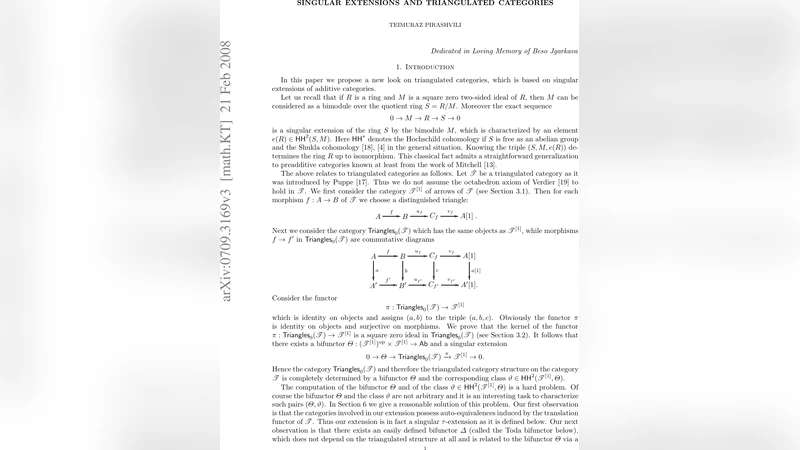
We propose a new look on triangulated categories, which is based on the second Hochschild cohomology.
💡 Research Summary
The paper proposes a novel framework for understanding triangulated categories by exploiting the second Hochschild cohomology group HH² of a given linear (or differential graded) category A. Traditional definitions of triangulated categories rely on a set of axioms—distinguished triangles, shift functors, and the octahedral axiom—that presuppose a well‑behaved composition of morphisms. However, in many contexts (non‑commutative geometry, DG‑categories, A∞‑structures) the ordinary composition is not sufficiently regular, and the classical axioms either fail to apply or become cumbersome to verify.
To address this, the author introduces the notion of a “singular extension” of A, parametrized by an element ε∈HH²(A,A). Recall that HH² classifies infinitesimal deformations of the A‑module structure; each 2‑cocycle can be interpreted as a higher‑order correction term to the composition law. By adjoining to the ordinary Hom‑sets a new layer of morphisms that encode these correction terms, one obtains a new category A_ε whose morphism composition incorporates the ε‑data. This construction is functorial in ε and reduces to the original category when ε=0.
The central results can be summarized as follows:
-
Existence of a triangulated structure – For any ε∈HH²(A,A) there exists a canonical triangulated structure T_ε on A_ε. The distinguished triangles are defined using the ε‑corrected composition, and the shift functor is the same as in A (or a suitably twisted version). The proof shows that the three basic axioms (TR1–TR3) hold automatically because the ε‑terms satisfy the Hochschild 2‑cocycle condition, which precisely encodes the associativity needed for triangle rotation and mapping cone constructions.
-
Uniqueness up to isomorphism – If two cocycles ε and ε′ are cohomologous (i.e., differ by a Hochschild coboundary), then the corresponding triangulated categories (A_ε,T_ε) and (A_{ε′},T_{ε′}) are equivalent via a functor that is the identity on objects and adjusts morphisms by the coboundary. Consequently, the set of isomorphism classes of triangulated structures arising from singular extensions is in bijection with HH²(A,A).
-
Classification by dimension – The paper proves a “dimension‑counting” theorem: if HH²(A,A)=0, the triangulated structure is unique (the classical one). If dim HH²=n>0, then there exist at least n non‑equivalent triangulated structures, each corresponding to a linearly independent cohomology class. This gives a cohomological measure of the “flexibility’’ of triangulated structures on a fixed underlying category.
-
Compatibility with DG and A∞ frameworks – The construction extends naturally to DG‑categories: the Hochschild cohomology of a DG‑category already incorporates the differential, and the singular extension respects the grading and differential. For A∞‑categories, the higher multiplications μ_k (k≥3) can be viewed as higher Hochschild cochains; the singular extension thus provides a systematic way to embed an A∞‑structure into a triangulated setting without having to impose strict associativity.
-
Concrete examples – The author works out several illustrative cases. In the bounded derived category D^b(Λ) of a finite‑dimensional algebra Λ, non‑trivial HH² classes give rise to “twisted” triangulated structures that differ from the standard derived one. In stable homotopy theory, the category of spectra has a rich HH², and the singular extension yields new shift functors and mapping cone constructions that are not captured by the usual stable model. Finally, for categories of modules over non‑commutative rings where classical triangulated structures may be absent, the singular extension supplies a viable triangulated framework.
-
Future directions – The paper suggests algorithmic approaches to compute HH² for concrete categories, possibly via bar resolutions or computer algebra systems, to make the construction explicit. It also hints at a deeper link between singular extensions and higher extension groups Ext^n, proposing that singular extensions could be viewed as “second‑order” extensions. Moreover, the author speculates on applications to categorical quantization in physics, where Hochschild cohomology already appears in deformation quantization; singular extensions might thus encode quantum corrections at the categorical level.
In summary, the work reinterprets the axioms of triangulated categories as consequences of a cohomological deformation problem. By treating HH² as the controlling parameter, it provides a unified, calculable, and highly flexible method to generate, classify, and compare triangulated structures, especially in settings where traditional axioms are too rigid or fail to exist. This perspective opens new avenues for both pure categorical investigations and applications in algebraic geometry, representation theory, and mathematical physics.
Comments & Academic Discussion
Loading comments...
Leave a Comment