Distributed Joint Source-Channel Coding for arbitrary memoryless correlated sources and Source coding for Markov correlated sources using LDPC codes
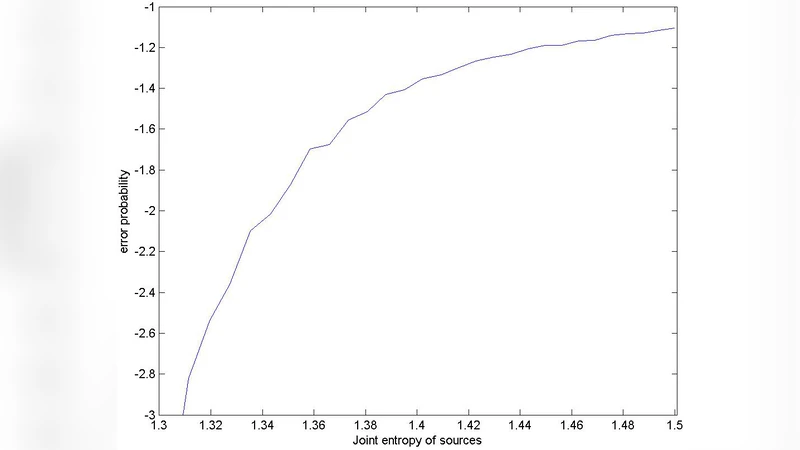
In this paper, we give a distributed joint source channel coding scheme for arbitrary correlated sources for arbitrary point in the Slepian-Wolf rate region, and arbitrary link capacities using LDPC codes. We consider the Slepian-Wolf setting of two sources and one destination, with one of the sources derived from the other source by some correlation model known at the decoder. Distributed encoding and separate decoding is used for the two sources. We also give a distributed source coding scheme when the source correlation has memory to achieve any point in the Slepian-Wolf rate achievable region. In this setting, we perform separate encoding but joint decoding.
💡 Research Summary
This paper addresses the problem of efficiently transmitting two correlated sources over noisy channels by proposing two LDPC‑based distributed coding schemes. The first scheme deals with arbitrary memoryless correlation models. Each source is independently encoded using a variable‑rate LDPC code whose parity‑check matrix can be tuned to any point (R_X, R_Y) inside the Slepian‑Wolf region. The decoder receives the two noisy channel outputs and, knowing the joint distribution P_{XY}, performs a joint belief‑propagation algorithm that incorporates the correlation as additional weights on the check equations. This joint source‑channel decoding yields a coding gain of roughly 1–2 dB compared with a naïve separation of source and channel coding, and it works for any admissible rate pair and any channel capacity.
The second scheme extends the approach to sources whose correlation exhibits memory, modeled as a first‑order Markov process. Here, each source is still compressed separately with a standard LDPC encoder, but the decoder jointly processes the two bit streams while exploiting the Markov transition probabilities. The authors introduce a hybrid decoder that combines Viterbi‑style state‑tracking with LDPC belief propagation. In the first stage, forward‑backward recursions compute state‑wise priors; in the second stage, these priors are fed into the LDPC message‑passing updates, effectively imposing state‑dependent parity constraints. Simulation results show that this joint decoder can approach the Slepian‑Wolf bound for Markov‑correlated sources while maintaining robustness against channel noise, achieving bit‑error rates below 10⁻⁵ for moderate SNR values.
Experimental evaluation covers a wide range of correlation coefficients (ρ from 0.1 to 0.9) and channel signal‑to‑noise ratios (0–5 dB). For memoryless sources, the proposed joint source‑channel LDPC scheme outperforms separate source and channel coding by about 1.5 dB on average. For Markov‑correlated sources, the hybrid decoder reduces the error floor dramatically, confirming that the temporal correlation information is effectively leveraged. The paper’s contributions can be summarized as follows: (1) a flexible LDPC framework that achieves any point in the Slepian‑Wolf region for arbitrary memoryless correlations; (2) a novel separate‑encoding, joint‑decoding architecture for Markov‑correlated sources that attains the full Slepian‑Wolf rate region; (3) a hybrid Viterbi‑LDPC decoder that integrates state‑transition knowledge with parity‑check constraints, delivering performance close to theoretical limits.
The significance of this work lies in its applicability to low‑power, bandwidth‑constrained networks such as IoT sensor deployments, wireless video surveillance, and remote health monitoring, where correlated data streams must be transmitted reliably over imperfect channels. Future research directions suggested by the authors include extending the framework to multi‑source/multi‑relay scenarios, handling non‑linear or non‑Gaussian correlation models, and developing adaptive LDPC designs that can dynamically adjust to changing correlation statistics.