Coarse differentiation and quasi-isometries of a class of solvable Lie groups I
This is the first of two papers which aim to understand quasi-isometries of a subclass of unimodular split solvable Lie groups. In the present paper, we show that locally (in a coarse sense), a quasi-isometry between two groups in this subclass is cl…
Authors: Irine Peng
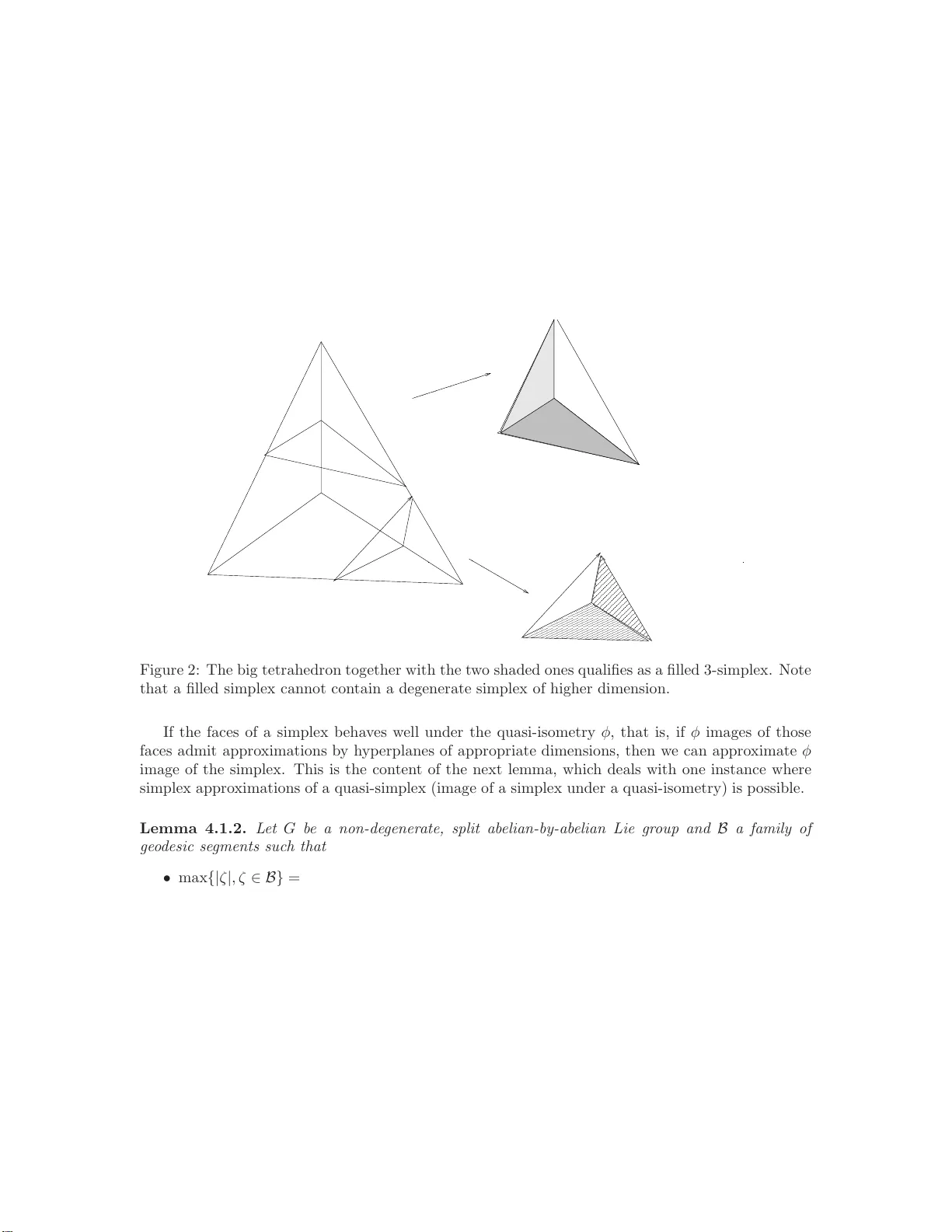
Coarse differen tiation and quasi-isom etries of a class of solv able Lie groups I Irine P eng Abstract This is th e first of tw o pap ers (the other one b eing [P]) which aim to understand quasi- isometries of a sub class of un imodu lar split solv able Lie groups. In the present pap er, we sho w that locally (in a coarse sense), a quasi-isometry b etw een tw o groups in th is sub class is close to a map that resp ects their group structures. Con ten ts 1 In tro duction 1 1.1 Pro of outline . . . . . . . . . . . . . . . . . . . . . . . . . . . . . . . . . . . . . . . . 3 2 Preliminaries 4 2.1 Geometry of a cer ta in cla s s o f so lv able Lie g roups . . . . . . . . . . . . . . . . . . . . 4 2.2 Notations . . . . . . . . . . . . . . . . . . . . . . . . . . . . . . . . . . . . . . . . . . 6 2.2.1 General remarks abo ut paths, neighborho o ds . . . . . . . . . . . . . . . . . . 6 2.2.2 Notations used in split ab elian- by-abelian gr o ups . . . . . . . . . . . . . . . . 7 3 Quasi-geo desics 10 3.1 Some facts a bo ut non-degenerate, split a be lian-by-abelia n groups . . . . . . . . . . 10 3.2 Efficient scale . . . . . . . . . . . . . . . . . . . . . . . . . . . . . . . . . . . . . . . . 12 3.3 Monotone scale . . . . . . . . . . . . . . . . . . . . . . . . . . . . . . . . . . . . . . . 17 3.4 Occurrence of w e a kly monoto ne se g ments . . . . . . . . . . . . . . . . . . . . . . . . 26 3.5 Pro of of Theo rem 3.1 . . . . . . . . . . . . . . . . . . . . . . . . . . . . . . . . . . . . 27 4 Inside of a box 30 4.1 Geometry of flats . . . . . . . . . . . . . . . . . . . . . . . . . . . . . . . . . . . . . . 31 4.2 Averaging . . . . . . . . . . . . . . . . . . . . . . . . . . . . . . . . . . . . . . . . . . 37 4.3 Pro of of Theo rem 1.1 . . . . . . . . . . . . . . . . . . . . . . . . . . . . . . . . . . . . 42 1 In tro duction A ( κ, C ) quasi-iso metry f betw e en metric spa ces X and Y is a map f : X → Y satisfying 1 κ d ( p, q ) − C ≤ d ( f ( p ) , f ( q )) ≤ κ d ( p, q ) + C 1 with the a dditional prop er t y that there is a num b er D suc h that Y is the D neighbor ho o d of f ( X ). Two q uasi-isometr ies f , g are considered to b e equiv alent if there is a num be r E > 0 such that d ( f ( p ) , g ( p )) ≤ E for all p ∈ X . F rom [A], a ny so lv able Lie gr o up L has the for m 1 → U → L → R s → 1 where U largest connec ted normal nilpo tent subgr oup of L , called its nilr adic al , a nd R s is the ab elianization of its Car tan s ubgroup. In a group G , an element x ∈ G is called exp onent ial ly distorte d if there are num b ers c, ǫ suc h that for a ll n ∈ Z , 1 c log( | n | + 1) − ǫ ≤ k x n k G ≤ c log( | n | + 1) + ǫ where k x n k G is the distance b etw een the identit y and x n in G . In the case of a c onnected, simply connected solv able Lie gr oup G , Osin show ed in [O] that the set of expo nent ially distorted elemen ts forms a normal s ubgroup R exp ( G ) inside of the nilr a dical of G . Motiv ated by the Gro mov pr ogram o f cla ssifying groups up to quas i- isometries, we consider , in this tw o- part pap er, qua s i-isometries betw een connected, simply-connected unimo dular solv able Lie g roup G whose exp onential r adical coincides with its nilr adical and is a semidirect pr o duct betw een its ab elian Cartan subgr oup and its ab elian nilradica l that is ’ir reducible’ in some sense. (F or example, is not a direct pro duct with ab elian factors). By applying the techniques introduced by Eskin-Fisher- Wh yte in [EFW0], [EFW1], and [EFW2], we ar e a ble to show that (The or em ?? in [P](abridge d)) L et G , G ′ b e non-de gener ate, unimo dular, split ab elian-by-ab elian solvable Lie gr oups, and φ : G → G ′ a κ, C qu asi-isometry. Then φ is b ounde d distanc e fr om a c omp osition o f a left tr anslation and a standar d map. Here a standard map is one that resp ect the factors in the semidirect pro duct and their group struc - tures. (See de finitio n 2.1 .1). Consequently , w e are a ble to see that (Cor ol lary ?? in [P] ) QI ( G ) = Y [ α ] B i l ip ( V [ α ] ) ⋊ Sym( G ) Here V [ α ] ’s a re subspaces of the nilradical, and S y m ( G ) is a finite group, ana logous to the W eyl group in reductive Lie gr oups. It reflects the symmetries o f G . (See section 2.1) W riting a non-degenera te, unimo dular , split ab elian-by-ab elian solv able group as G = H ⋊ ϕ A , where H is the ab elian nilradical and A an ab elian Cartan s ubgroup. W e can a lso distinguis h g roups depe nding on whether the action of the Cartan subgroup o n the nilradical (via ϕ ) is diaonalizable or not. (Cor ol lary ?? in [P]) L et G , G ′ b e non-de gener ate, unimo du lar, split ab elian-by-ab elian sol vable Lie gr oups wher e actions of their Cartan sub gr oups on the nilr adic als ar e ϕ and ϕ ′ r esp e ctively. If ϕ is diagonal izable and ϕ ′ isn ’t, then ther e is no quasi-isometry b etwe en them. 2 When ϕ is diagonalizable, as an applica tion the w o rk by Dymarz [D] on quasi-conforma l maps on the b oundar y o f G , and a theor em of Mostow that says p olycyclic groups are vir tua lly la ttices in a co nnec ted, simply connected solv able L ie group, we ha ve (Cor ol lary ?? , ?? in [P]) In the c ase that ϕ is dia gonalizable, if Γ is a finitely gener ate d gr oup quasi- isometric to G = H ⋊ ϕ A , then Γ i s virtual ly p olycyclic , and is virtual ly a lattic e in a unimo dular semidir e ct pr o duct of H and A . Note that in the statement ab ov e w e are not able to determine if the target semidirect pro duct of H a nd A is actually G b eca use the la tter is a semidirect pro duct of the sa me facto rs with some additional conditions, w hich w e a r e no t able to detect at this stag e . All the arg ument in this pap er are loca l in nature and b e low is a description of the main re sult. Let G = H ⋊ ϕ A , G ′ = H ′ ⋊ ϕ ′ A ′ be connected, simply connected non- degenerate unimo dular split solv able groups (See s e ction 2.1 for definitions). W e say a map from G to G ′ is standar d , if it splits as a pro duct map that resp ects ϕ and ϕ ′ (See definition 2.1 .1). A compa c t conv ex set Ω ⊂ R n determines a b o unded set B (Ω) in G (See sec tion 2 .2 ). W riting ρ Ω for the co mpact co nvex set o btained by sca ling Ω by ρ from the baryce nter of Ω, we show in this pap er that Theorem 1. 1. L et G , G ′ b e non- de gener ate, un imo dular, split ab elian-by-ab elian Lie gr oups, and φ : G → G ′ b e a ( κ, C ) quasi-isometry. Given 0 < δ, η < ˜ η < 1 , ther e exist numb ers L 0 , m > 1 , , ˆ η < 1 dep ending on δ , η , ˜ η and κ, C with the fol lowing pr op erties: If Ω ⊂ A is a pr o duct of intervals of e qual size at le ast mL 0 , the n a tiling of B (Ω) by isometric c opies of B ( Ω) B (Ω) = G i ∈ I B ( ω i ) ⊔ Υ c ontains a subset I 0 of I with r elative m e asur e at le ast 1 − ν su ch that (i) F or ev ery i ∈ I 0 , ther e is a subset P 0 ( ω i ) of B ( ω i ) of re lative me asur e at le ast 1 − ν ′ (ii) The r estriction φ | P 0 ( ω i ) is within ˆ η di am ( B ( ω i )) Hausdorff n eighb orho o d of a st andar d map g i × f i . Her e, ν , ν ′ and ˆ η al l appr o ach zer o as ˜ η , δ go to zer o. The me asur e of set Υ is at most δ ′ pr op ortion of m e asur e of B (Ω) , wher e δ ′ dep ends on δ a nd go es to zer o as the latter appr o aches zer o. 1.1 Pro of outline The idea of the pro of is as follows. W e employ the tec hnique of ‘coarse differentiation’ to images of a particular family of geo desic s (whic h fills up the set B (Ω)) in B (Ω) to obtain the scale ρ on which those quas i-geo desics b ehav e like cer tain simple g eo desics. W e a re also able to obtain a tiling bec ause the group G is unimo dular and B (Ω) hav e small b o undary a rea compared to its volume. W e then use the prop er ties of the gr oups b eing non-degener ate, unimodula r and split abe lia n-by-abelia n to r each the conclusion on those smaller tiles. Ac knowledgemen t I would like to thank Alex Eskin for his pa tience and g uidance. I also owe m uch to Da vid Fisher for his help and supp or t. 3 2 Preliminaries In this sec tio n, we first describ e the geometry of the sub class of unimo dular so lv able Lie gro up men tioned in Intro duction, followed by a list of nota tions that will be use d in the rema ining of this pap er. 2.1 Geometry of a certain class of solv able Lie groups Non-degenerate, spl it ab elian-by-abeli an solv able Lie groups Let g b e a (real) solv a ble Lie algebra, and a be a Ca rtan subalg ebra. Then there are finitely many non-zero linear functiona ls α i : a → C called r o ots , such tha t g = a ⊕ M α i g α i where g α i = { x ∈ g : ∀ t ∈ a , ∃ n, such that ( ad ( t ) − α i ( t ) I d ) n ( x ) = 0 } , I d is the iden tity ma p on g , and ad : g → D er R ( g ) is the adjoint repr esentation. W e say g is split ab elian-by-ab elian if g is a semidirect pro duct of a and L i g α i , and b oth are ab elian Lie algebras; unimo dular if the the ro ots sum up to zer o; and non-de gener ate if the ro ots span a ∗ . In particular, non-deg enerate means that each α i is real- v alued, and the num b er of roo ts is at leas t the dimension of a . Being unimodula r is the same as s aying tha t for every t ∈ a , the trace of ad ( t ) is zero. W e extend these definitions to a Lie group if its Lie algebra has these pro p er ties. Therefore a connected, simply connected solv able Lie gr oup G that is non-deg enerate, split ab elian-by-abe lia n necessa ry takes the form G = H ⋊ ϕ A such that (i) b oth A a nd H are ab elian Lie g roups. (ii) the homomorphism ϕ : A → Aut ( H ) is injective (iii) there are finitely many α i ∈ A ∗ \ 0 which together span A ∗ , and a decomp ositio n o f H = ⊕ i V α i (iv) there is a basis B of H whose intersection with each of V α i constitute a basis of V α i , such that for each t ∈ A , ϕ ( t ) with re s pe c t to B is a matrix consists of blo cks, one for each V α i , of the form e α i ( t ) N ( α i ( t )), where N ( α i ( t )) is an upp er tr iangular with 1 ’s on the dia gonal and who se off-diagona l entries are polyno mials of α i ( t ). If in additio n, G is unimo dular, then ϕ ( t ) has determinant 1 fo r all t ∈ A . The r ank of a no n-degenera te, split a be lia n-by-abelia n gr oup G is defined to b e the dimensio n of A , and by a result of Co rnulier [C], if t wo such groups ar e quasi-isometr ic , then they hav e the same rank. Let △ denotes the ro o ts of G . F or eac h α ∈ △ , cho ose a basis { e α 1 , e α 2 , · · · e α n α } in V α such that ϕ ( t ) | V α i is upp er triangular for all t ∈ A . Also fix a basis { E j } in A (for example, the duals o f a subset o f ro o ts), and for each t ∈ A , wr ite t j for its E j co ordinate. W e co o r dinatize a p oint ( P α ∈△ P n α j =1 x j,α e α j )( t ) ∈ H ⋊ ϕ A b y the di m ( G )-tuple of n um b e rs (( x α ) α , ( t j )) ∈ R dim ( G ) , where x α = ( x 1 ,α , x 2 ,α , · · · , x dim ( V α ) ,α ). In this co ordinate system, a left inv a riant Riemannian metric at (( x α ) α , ( t j ) j ) is 4 X j d ( t j ) 2 + X α ∈△ e − 2 α ( t ) α i X i =1 dx i,α + n α X ι = i +1 P α i,ι ( α ( − t )) dx ι,α ! 2 where P α i,ι is a p olynomial with no constant term. W e see that the ab ov e Riemannia n metric is bilipschitz to the following Finsler metr ic : | d t | + X α ∈△ e − α ( t ) n α X i =1 [1 + Q i,α ( α ( − t ))] | dx i,α | where | d t | means P j | d t j | , and Q i,α is sum of absolute v alues of polyno mials with no co nstant ter ms. Remark 2. 1.1. S inc e we define d our metric t o b e left-invariant, left multiplic ation by an element of G i s an i sometry. O n the other hand, right multipli c ation typic al ly distorts distanc e. F or example, for p oints p, q ∈ H , t ∈ A , d ( t p, t q ) = d ( p, q ) , but d ( p t , q t ) usual ly is some exp onent ial-p olynomial multiple of d ( p, q ) . Let H s +1 = R s ⋊ ψ R b e a non-unimo dular so lv able Lie gro up suc h that with res pec t to ba ses { e i } , { E } of R s and R resp ectively , we hav e ψ ( tE ) = e at N ( t ), for all t ∈ R . Here a > 0 and N ( t ) is unipotent matrix (upper triangular with 1’s on the diago nal) with p olynomia l entries. By giving a p o int ( P x i e i )( tE ) ∈ H s +1 the coordina te of ( x 1 , x 2 , · · · x s , t ), and a rgue as ab ov e we see that a left-in v ariant Finsler metric bilipschitz to a left-inv a riant Riemannian metric can b e given as | dt | + e − at X i [1 + P i ( at )] | dx i | (1) where P i is the sum of absolute v a lues of p oly no mials with no constant terms. The following consequence is immediate. Lemma 2.1 . 1. If G is non- de gener ate, split ab elian-by-ab elian, t hen it c an b e QI emb e dde d into Q α ∈△ H dim ( V α )+1 . Remark 2.1.2. When ψ ( t ) is diagonal, H s +1 is just the usual hyp erb olic sp ac e. Pr o of. Because of the following relation 1 |△| X α ∈△ | dα ( t ) | + e − α ( t ) n α X i =1 [1 + Q i,α ( α ( − t ))] | dx i,α | ! ≤ | d t | + X α ∈△ e − α ( t ) n α X i =1 [1 + Q i,α ( α ( − t ))] | dx i,α | ≤ X α ∈△ | dα ( t ) | + e − α ( t ) n α X i =1 [1 + Q i,α ( α ( − t ))] | dx i,α | ! T o understand the ge ometry of H s +1 better , we can assume without loss of generality that a = 1, and no te that the Finsler metric in eq uation (1) is quasi-iso metric to o ne g iven by dt + e − t Q ( t ) d x for some p olynomial Q ( t ). Since expo nential g rows faster than p olynomials , for any large positive 5 nu mber x , there is a t 0 such that e − t Q ( t ) x ≤ 1 for all t ≥ t 0 , and w e see that a function q.i. to the metric on H s +1 is the following d (( x 1 , t 1 ) , ( x 2 , t 2 )) = | t 1 − t 2 | if e − t i Q ( t i ) | x 1 − x 2 | ≤ 1 for s o me i = 1 , 2; U Q ( | x 1 − x 2 | ) − ( t 1 + t 2 ) o ther wise (2) where U Q ( | x 1 − x 2 | ) = t 0 satisfies e − t 0 Q ( t 0 ) | x 1 − x 2 | = 1 F urthermore, the following relation 1 e t < Q ( t ) e t < e 1 / 2 t e t for t sufficiently la r ge and the fact that both e − t and Q ( t ) e − t are decr easing functions when t beco mes big enough means that w e have the following inequa lities for their inv er ses: ln( x ) − C Q ≤ U Q ( x ) ≤ 2 ln( x ) + C Q for x > 1 (3) for some co ns tant C dep ends only on the p olynomial Q . Back to the description o f G , we decla re tw o ro o ts equiv alent if they are p ositive multiples of each other, and write [Ξ] for the e quiv alence class containing Ξ ∈ △ . A left translate of V [Ξ] = ⊕ σ ∈ [Ξ ] V σ will be called a hor o cycle of r o ot class [Ξ]. A left tra nslate of H , or a subset of it, is ca lled a flat . F or tw o po int s p, q ∈ H with co ordinates ( x α ) α ∈△ and ( y α ) α ∈△ , w e compute subsets of p H and q H that are within distance 1 of ea ch other according to the embedded metric in Lemma 2 .1 .1, as the p and q translate of the subset of A : \ α ∈△ :ln( | x α − y α | ) ≥ 1 α − 1 [ U α ( | x α − y α | ) , ∞ ] As the ro ots sum up to z e ro in a non-de g enerate, unimo dular, split ab elian-by-ab elian group, the set where tw o flats come together can be empt y , i.e. the tw o flats hav e no intersection. If it is not empt y , then the equation a bove says that it is a n un b ounded con vex subset of A b ounded b y hyperplanes parallel to r o ot kernels. Definition 2 . 1.1. L et G , G ′ b e non-de gener ate, split ab elian-by-ab elian Lie gr oups. A map fr om G to G ′ or a subset of them, is c al le d standard if it takes t he form f × g , wher e g : H → H ′ sends foliatio n by r o ot cla ss ho r o cycles of G t o tha t of G ′ , and f : A → A sends f oliations by r o ot kernels of G to that of G ′ . Remark 2.1.3. Note t hat when G has a t l e ast rank ( G ) + 1 m any r o ot kernels, the c ondition on f me ans tha t f is a ffine, and when G is r ank 1, the c ondition on f is empty. 2.2 Notations 2.2.1 General remarks abo ut paths, neigh b o rho o ds Division of a curv e The w ord ’scale’ shall mean a num b er ρ ∈ (0 , 1]. W e w ill often examine a q uasi-geo des ic on different ’s cales’, and see if the quasi-geo de s ic ’on that sca le’ satisfies certa in 6 prop erties. This roug hly means that w e sub divide the quasi-geo des ic into subsegments whose lengths are ρ times the length of the orig inal one, and see if each o ne of them satisfies certain prop erties. In pr actice, howev er, instea d of dealing with ’leng th’, we us e ’distance b etw een end p oints’ of a curve. More precisely , let ζ : [ a, b ] → Y be rectifiable curve. • Given r > 0, we can divide ζ into subsegments whos e end p oints are r a pa rt. More precisely , ˆ S ( ζ , r ) = { q i } n r i =1 , is the set of the dividing p oints on ζ , where q 0 = ζ ( a ), q n r = ζ ( b ), and ζ − 1 ( q i +1 ) = min { t ≥ ζ − 1 ( q i ) | d ( ζ ( t ) , q i ) = r } • Given tw o points p, q ∈ ζ , we write ζ [ p,q ] for the part of ζ b etw ee n p and q . Define S ( ζ , r ) = { ζ [ q i ,q i +1 ] } , to b e the set of s ubsegments after division. • Let P b e a sta temen t. Define S ( ζ , r , P ) = { ζ i ∈ S ( ζ , r ) | ζ i satisfies P } to b e those subsegments satisfying sta temen t P . • W e write | ζ | for the distance betw een end p oints of ζ , and k ζ k denotes for the leng th of ζ . Neighborho o ds of a set W e write B ( p, r ) for the ball centered at p of ra dius r , and N c ( A ) for the c neighborho o d of the set A . W e also write d H ( A, B ) for the Ha us dorff dista nc e b etw e e n tw o sets A and B . If Ω ⊂ R k is a b ounded compa c t set, and r ∈ R , we write r Ω for the bounded co mpact set that is sca led fro m Ω with resp ect to the ba r ycenter of Ω. Given a set X , a point x 0 ∈ X , the ( η , C ) line ar neighb orho o d of X with r esp e ct to x 0 is the set { y , s.t. ∃ ˆ x ∈ X , d ( y , ˆ x ) = d ( y , X ) ≤ η d ( ˆ x , x 0 ) + C . Equiv alently it is the set S x ∈ X B ( x, η d ( x, x 0 ) + C ). By ( η , C ) linear neighborho o d o f a set X , w e mean the ( η , C ) linear neighborho o d of X with resp ect to s o me x 0 ∈ X . If a quasi- g eo desic λ is within ( η , C ) linear (or just η -linear) neighborho o d of a geo desic segment γ , where η ≪ 1 a nd C ≪ η | λ | , then we say that λ admits a ge o desic ap pr oximation by γ . 2.2.2 Notations used in split ab elian-by-a b eli an g roups Let G = H ⋊ A sta nds for a no n-degenerate, split abelian- b y-ab elian group, a nd △ denotes for its ro ots. Fix a p oint p ∈ G . W e define the following: • F or α ∈ △ a ro ot, we write ~ v α for the dual of α i of nor m 1 with r esp ect to the usual Euclidean metric. (This is really a function on ro ot classes.) • Given ~ v ∈ A , w e define W + ~ v = ⊕ Ξ( ~ v ) > 0 V Ξ W − ~ v = ⊕ Ξ( ~ v ) < 0 V Ξ W 0 ~ v = ⊕ Ξ( ~ v )=0 V Ξ • Let ℓ ∈ A ∗ , we define W + ℓ , W − ℓ , W 0 ℓ , as W + ~ v ℓ , W − ~ v ℓ , W 0 ~ v ℓ resp ectively , where ~ v ℓ ∈ A is the dual of ℓ . • By t he wal ls b ase d at p , we mean the set p S Ξ k er (Ξ). 7 • By a ge o desic se gment t hr ough p , we mean a set pAB , where AB is a directed line segment in A . By direction of a directed line segment in Euclidean spac e , we mean a unit v ector with resp ect to the usual Euclidean metric, and by direction of p AB w e mea n the dir ection of AB . • F or i = 2 , 3 , ..n − 1, by i -hyp erplane thr ough p , we mean a set pS , wher e S ⊂ A is a n i - dimensional linear subspace or an in ter section b e t ween an i -dimensio nal linea r subspace with a c onv ex set. • Let π A : G = H ⋊ A − → A be the pro jection onto the A factor as ( x , t ) 7→ t • F or each ro ot α i , define π α i : G − → V α i ⋊ h ~ v α i i as ( x 1 , x 2 , · · · x |△| ) t 7→ ( x i , α i ( t ) ~ v α i ). W e r efer to neg atively curved spaces V α i ⋊ h ~ v α i i or V [ α ] ⋊ h ~ v α i as weight (or ro ot) hyperb olic spaces. Now a ssume in addition that G is unimo dula r. Fix a net n in G . F or α ∈ △ , let b ( r ) ⊂ V α be maximal pro duct of interv als of size r , [0 , r ] dim ( V α ) , and since H is the direct sum of tho se V α ’s, we write Q α ∈△ b ( r α ) for the pr o duct of t hose b ( r α )’s as α ra nging o ver a ll roots . In o ther w o rds, Q α ∈△ b ( r α ) is just pro duct of in terv als in H where interv al length is r α in V α . Let Ω ⊂ A b e a co n vex compa ct set with non-empty in terior , e.g. a pr o duct of in terv als or a conv ex p olyhedra. Without lo ss of g enerality assume its barycenter is the identit y of A . W e define the b ox asso ciate d to Ω, B (Ω), a s the set Q |△| j =1 b ( e max( α j (Ω)) ) Ω. Remark 2. 2.1. A b ox B (Ω) as define d ab ove is just a union of left t r anslates of Ω ⊂ A by a su bset of H (pr o duct of intervals) whose size is determine d by Ω . The size of the interval s wer e cho sen so that a lar ge pr op ortion of p oints in the b ox B (Ω) lie on a qu adrilater al (se e Definition 4.1.2). In the definition ab ove we ha ve define d this su bset of H as a pr o duct of interval s, but this is just a choic e of c onvenienc e so that it is simple to describ e the size of this subset in H in terms of Ω . Asso ciate to the b ox B (Ω), we use the fo llowing nota tions: • L (Ω)[ m ] (o r L ( B (Ω))[ m ]) for the set of g eo desics in B (Ω) whos e π A images beg in and end a t po int s of ∂ Ω s uch that the ra tio betw een its length and the diameter of Ω lie s in the interv al [1 /m, m ]. • F or i = 2 , 3 , · · · , n , wr ite L i (Ω)[ m i ] (o r L i ( B (Ω))[ m i ]) for the set of i dimensional hyp e rplanes in B (Ω) such that the r atio b etw een its diameter and the diameter o f Ω lies in the in terv al [1 /m i , m i ]. • P (Ω) (or P ( B (Ω))) for the s e t of po int s in B (Ω). • Let S be an element o f S n i =2 L i (Ω) S L (Ω) S P (Ω). W e wr ite L ( S ), L i ( S ) for s ubset of L (Ω), L i (Ω) contained or c ontaining S , and P ( S ) for the subs et of P (Ω) contained in S . Remark 2. 2.2. As we ar e inter este d in a given quasi-isometry φ : G → G ′ which implicitly implies p articular choic es of n et s n ⊂ G , n ′ ⊂ G ′ , we wil l primarily c onsider φ as a map fr om n to n ′ ‡ . L et ˆ p : G → n that assigns x ∈ G , a closest n et p oint. In this way we tend to think of a set K ⊂ G not so much as a subset of the Lie gr oup G , but as a subset of n via the identific ation of K and ˆ p ( K ) . In p articular, the set of hyp erplanes and p oints asso ciate d to a b ox as define d ab ove would b e c onsider e d finite sets for us. ‡ But then an y t wo nets are bounded distance apart, and a b ounded mo dification does not ch ange the quasi-isometry class of φ , s o whatev er argument w e make for n and n ′ are v alid f or other cho ices of nets as well. 8 W e now use b oxes to pro duce a sequence o f F¨ olner sets. Lemma 2 .2.1. L et G = H ⋊ A b e a non- de gener ate, unimo dular, s plit ab elian-by-ab elian Lie gr oup. L et Ω ⊂ A b e c omp act c onvex with non-empty interior. Then, B ( r Ω) , r → ∞ is a F¨ olner se quenc e. The volume r atio b etwe en N ǫ ( ∂ ( B ( r Ω))) and B ( r Ω) is O ( ǫ/ diam ( B ( r Ω )) † . Pr o of. F or ea ch r o ot α j , w r ite α j (Ω) = [ b j , a j ]. Since the sum o f ro ots is zero , the volume element is ∧ j d x j ∧ d t . Therefor e vol( B ( r Ω)) = Q j e r a j r n | Ω | . On the other hand, the a rea of the b oundary is ∂ Y j [0 , e r a j ]( r Ω) = ∂ Y j [0 , e r a j ] ( r Ω) | {z } (1) + Y j [0 , e r a j ] ∂ ( r Ω) | {z } (2) W e estimate the s ize o f each term: (2) : Y j [0 , e r a j ] ∂ ( r Ω) = Y j e r a j r n − 1 | ∂ Ω | (1) : ∂ Y j [0 , e r a j ] ( r Ω) = 2 X j Z t ∈ r Ω Z x 1 ∈ b ( e ra 1 ) , ··· x i ∈ b e ra i e − α 1 ( t ) d x 1 · · · e − α i ( t ) d x i · · · | {z } i 6 = j d t = 2 X j Y i 6 = j e r a i Z t ∈ r Ω e α j ( t ) d t ≤ 2 X j Y i 6 = j e r a i ( e r a j − e r b j ) P r oj ker ( α j ) ( r Ω) = 2 Y i e r a i ! r n − 1 X j P r oj ker ( α j ) (Ω) (1 − e − ( r a j − r b j ) ) ≤ 2 |△| Y i e r a i ! r n − 1 max j P r oj ker ( α j ) (Ω) Remark 2.2.3. The same c alculation as ab ove sho ws that for any set ˜ B of the form Λ ⋊ Ω , wher e Λ ⊂ H , Ω ⊂ A , the r atio of volumes of N ǫ ( ∂ ˜ B ) and that of ˜ B is O ( ǫ/diam ( ˜ B )) . † because the ratio of v olumes of ∂ Ω to Ω is roughly 1 diam (Ω) , and r diam (Ω) = diam ( r Ω) 9 3 Quasi-geo desics The purpo se of this section is to prove Theorem 3. 1. L et G, G ′ b e non-de gener ate, u nimo dular, split ab elian-by-ab elian Lie gr oups, and φ : G → G ′ a ( κ, C ) quasi-isometry. Given 0 < δ, η < ˜ η < 1 , ther e ar e num b ers L 0 , m > 1 and 0 < ρ < 1 dep ending on δ, η , κ, C with the fol lowing pr op erties: If Ω ⊂ A is a pr o duct of intervals of e qual size at le ast mL 0 , the n a tiling of B (Ω) by isometric c opies of B ( ρ Ω) B (Ω) = G j ∈ J B (Ω j ) ⊔ Υ c ontains a subset J 0 whose me asur e is at le ast 1 − ϑ times that of J such that: (i) F or al l j ∈ J 0 , ther e is a subset L 0 j ⊂ L (Ω j )[ m ] , whose me asur e is at le ast 1 − κ times that of L (Ω j ) (ii) If ζ ∈ L 0 j , then φ ( ζ ) is within η -line ar neighb orho o d of a ge o desic se gmen t which makes an angle at le ast sin − 1 ( ˜ η ) with r o ot ke rnels. Her e ϑ , κ appr o ach zer o as ˜ η → 0 . The me asur e of set Υ is at most δ ′ pr op ortion of me asur e of B (Ω) , wher e δ ′ dep ends on δ and go es to zer o as the latter appr o aches zer o. 3.1 Some facts ab out non-degenerate, split ab elian-b y-ab elian groups In this s ubsection, G denotes for a non- degenerate, split ab elian-by-ab elian group. By Lemma 2.1.1, we can use the em be dded metric on G . W e will use the metric prop erty of those H s +1 spaces to obtain the following propo sition, which basica lly says that if a quasi-ge o desic in G is long, then its pro jection in A has to be long as well. Prop ositi o n 3.1.1. L et ζ : [0 , L ] → G b e a ( κ, C ) quasi-ge o desic se gment. Supp ose { π A ( ζ ( t )) } lies in a b al l o f d iameter s . Then for a ny p, q ∈ ζ , d ( p, q ) ≤ ~ s , wher e ~ is a c onstant tha t dep ends o nly on the numb er of r o ots. Corollary 3 . 1.1. (assumptions as in Pr op osition 3.1.1) If ther e a r e two p oints p, q on ζ such that d ( p, q ) > ~ s , then ther e must b e a p oint r ∈ [ ζ − 1 ( p ) , ζ − 1 ( q )] su ch that d ( π A ( p ) , π A ( ζ ( r ))) > s . T o prov e Pro po sition 3.1.1, we need the follo wing tw o lemmas whose verifications can b e found in the App endix. In H n ′ +1 = R n ′ ⋊ R , we write h for the pro j ection onto the R factor. Lemma 3.1.1. L et η : [ a, b ] → H n ′ +1 b e a c ont inu ous p ath such that • The image of h ◦ η is c ontaine d in an interval of length no bigger than s , wher e s > κ ( C H n ′ +1 ) 2 ( > 2) . Her e C H n ′ +1 is a c onstant de p ending only on H n ′ +1 (as in e quation (3)). • whenever i 1 ≤ i 2 ≤ ...i n ∈ [ a, b ] , P j d ( η ( i j ) , η ( i j +1 )) d ( η ( i 1 ) , η ( i n )) ≤ 2 κ 10 Then, for a ny two p oints p, q ∈ η ([ a, b ]) , d ( p, q ) ≤ ˆ C ( 2 κ ) s , wher e ˆ C dep ends only on C H n ′ +1 . Pr o of. see Appendix Lemma 3.1.2. L et a, b ≥ 0 , A, B > 0 . Supp ose a + b A + B = c α a A + c β b B , with c α + c β = 1 . Su pp ose c α ≥ c β , then A ≥ B . Pr o of. see Appendix Pr o of. of Pr op osition 3.1.1 W e pro ceed by induction on the num b er o f ro ots. The base step wher e there is just one ro ot is Lemma 3.1.1. Since ζ is a ( κ, c ) quasi- g eo desic, for a ny i 0 ≤ i 1 ≤ i 2 ≤ i 3 ....i n ∈ [0 , L ], we m ust hav e P j d ( ζ ( i j ) , ζ ( i j +1 )) d ( ζ ( i 0 ) , ζ ( i n )) ≤ 2 κ (4) W e re c all from Lemma 2.1.1 that d ( · , · ) = P |△| l =1 d α l ( π α l ( · ) , π α l ( · )), and pro ceed to simplify equa- tion(4) b y wr iting d α l ( π α l ( ζ ( i j )) , π α l ζ ( i j +1 )) as d α l j , and d α l ( π α l ( ζ ( i 0 )) , π α l ( ζ ( i n ))) a s d α l . Now equation (4) b ecomes P j d α 1 j + d α 2 j + · · · d α |△| j d α 1 + d α 2 + · · · d α |△| ≤ 2 κ • Supp ose for s ome weight, let’s say α 1 , w e have P j d α 1 j + P j ( d α 2 j + d α 3 j · · · + d α |△| j ) d α 1 + ( d α 2 + d α 3 + · · · + d α |△| ) = c α P j d α 1 j d α 1 + c β P j d α 2 j + d α 3 j · · · + d α |△| j ( d α 2 + d α 3 + · · · + d α |△| ) (5) with c α + c β = 1, and c α ≥ c β . T he r efore ⋆ c α ≥ 1 / 2 . Since equa tion (5) is bounded a bove by 2 κ , we now have an upper b ound for the first term: 1 2 P j d α 1 j d α 1 ≤ 2 κ That is, { π α ( ζ ( i j )) } are points whose heights in the α weigh t h yp erb olic space lie in a n int erv al of width no bigger than s (b eca us e π A ( ζ ( i j )) lies in a ball of diameter s ), and P j d α 1 ( π α 1 ( ζ ( i j )) , π α 1 ( ζ ( i j +1 ))) d α 1 ( π α ( ζ ( i 0 )) , π α ( ζ ( i n ))) ≤ 4 κ By Lemma 3 .1.1, d α ( π α ( ζ ( i 0 )) , π α ( ζ ( i n ))) ≤ ˆ C (4 κ ) s ⋆ Since c α ≥ c β , Lemma 3.1.2 says d α 1 ≥ P |△| l =2 d α l , which ma kes d ( ζ ( i 0 ) , ζ ( i n )) = d α 1 + P |△| l =2 d α l ≤ 2 ˆ C (4 κ ) s = 2 2 ˆ C (2 κ ) s 11 • If the first p oss ibilit y do e s n’t occur , then for every weigh t α i ′ , we must have P j ( d α 1 j + d α 2 j · · · d α |△| j ) d α 1 + d α 2 + · · · d α |△| = c α i ′ P j d α i ′ j d α i ′ + c β i ′ P j d α 1 j + d α 2 j · · · d α i ′ − 1 j + d α i ′ +1 j · · · d α |△| j P l 6 = i ′ d α l (6) with c α i ′ , c β i ′ ≥ 0, c α i ′ + c β i ′ = 1, BUT c α i ′ ≤ c β i ′ . W e fix such an i ′ . T he n ⋆ c β i ′ ≥ 1 / 2 . Since the equation (6) is b ounded ab ove b y 2 κ , we obtain an upper b ound for the sec ond ter m on the right hand side: P j ( d α 1 j + d α 2 j · · · d α i ′ − 1 j + d α i ′ +1 j · · · d α |△| j ) P l 6 = i ′ d α l ≤ 4 κ By inductiv e hypo thesis, X l 6 = i ′ d α l ( π α l ( ζ ( i 0 )) , π α l ( ζ ( i n ))) = X l 6 = i ′ d α l ≤ 2 2( |△|− 2) ˆ C (4 κ ) s ⋆ Finally , since c α i ′ ≤ c β i ′ , Lemma 3 .1.2 says d α i ′ ≤ P l 6 = i ′ d α l which means d ( ζ ( i 0 ) , ζ ( i n )) = d α i ′ + P l 6 = i ′ d α l ≤ 22 2( |△|− 2) ˆ C ( 4 κ ) s = 2 2( |△|− 1) ˆ C ( 2 κ ) s 3.2 Efficien t scale This subsection is based on definition 4.5 and lemma 4.6 in [EFW0], where ǫ -efficiency was defined. Here we note the conseq ue nce of an efficien t segmen t in a non- de g enerate, s plit abelian-by-ab elian group. Definition 3. 2.1. ( ǫ -efficient a t scale ˜ r ) L et Y b e a met ric sp ac e, and λ : [0 , L ] → Y a r e ctifiable curve. We say that λ is ǫ -efficient at s c ale ˜ r , 0 < ˜ r ≤ 1 if X j d ( p j , p j +1 ) ≤ (1 + ǫ ) d ( λ (0) , λ ( L )) , wher e { p j } = ˆ S ( λ, ˜ r d ( λ (0) , λ ( L ))) Remark 3. 2.1. Note that b eing efficient at sc ale r do es ne c essarily not impl y efficient at al l sales ˜ r < r . Efficiency provides with us the clos est description of b eing ‘straight’ in R n , whose meaning is made pr ecise b y the following lemma. Lemma 3.2 .1. If λ : [ a, b ] → R n is ǫ - efficient at sc ale r , then d H ( λ, λ ( a ) λ ( b )) ≤ ( r +1 . 5 ǫ 1 / 4 ) d ( λ ( a ) , λ ( b )) Pr o of. Let m = rd ( λ ( a ) , λ ( b )), a nd { p j } N j =0 = S ( λ, m ) so that d ( p 0 , p N ) = d ( λ ( a ) , λ ( b )) = L . Let h p 0 p N be the ortho g onal pro jection of λ ont o p 0 p N , ˜ p i = h pq ( p i ), so d ( ˜ p j , ˜ p j +1 ) ≤ d ( p j , p j +1 ) = m . Since ˜ p 0 = p 0 , ˜ p N = p N , S N − 1 i =0 ˜ p i ˜ p i +1 = p 0 p N , and Lemma 4.3.1 in the App endix gives that d ( p j , ˜ p j ) ≤ 1 . 5 ǫ 1 / 4 L . So if ˙ p ∈ λ , let p j be the closest p oint in S ( λ , m ), we then hav e d ( ˙ p, p 0 p N ) ≤ d ( ˙ p, p j ) + d ( p j , p 0 p N ) ≤ m + 1 . 5 ǫ 1 / 4 L . Similarly for ¨ p ∈ p 0 p N , there is a j such that ¨ p ∈ ˜ p j ˜ p j +1 , with d ( ¨ p, ˜ p j ) ≤ d ( ¨ p, ˜ p j +1 , then d ( ¨ p, λ ) ≤ d ( ¨ p, ˜ p j ) + d ( ˜ p j , λ ) ≤ 1 2 m + 1 . 5 ǫ 1 / 4 L . 12 The purpo se of this subsection is to prov e the follo wing lemma which roughly says that given a ǫ , if a path is sufficiently long , then it is ǫ -efficient on some sca le. Lemma 3.2. 2. L et G b e a non-de gener ate, split ab elian-by-ab elian gr ou p. T ake any N ≫ 2 , L stop ≥ (2 κ ) C , 0 < ǫ < 1 . If ˜ λ : [0 , L ] → G is ( κ, C ) quasi-ge o desic satisf ying 1 L stop 1 2 ǫ 1 / 4 ~ (2 κ ) 2 N + ǫ ǫ ≤ 2 κL then t her e is a sc ale 0 < ρ J ≤ 1 su ch t hat |S ( λ, ρ J | λ | , n ot ǫ efficient at sc ale 1 2 ǫ 1 / 4 ) | |S ( λ, ρ J | λ | ) | ≤ 1 N wher e λ = π A ( ˜ λ ) , and 1 2 ǫ 1 / 4 ρ J | λ | ≥ L stop . Pr o of. The idea of the pr o of is as follows: if a segment is not e fficie nt, then by sub div iding and adding up the dis tance betw een consecutive pairs of po ints in the subdivis ion, the sum ex ceeds the distance b etw een end po ints o f the orig inal s e gment by a fixed pr op ortion. In other words, lack of efficiency increas es leng th. How ever this cannot happ en at every scale (bigger than C d ( λ (0) ,λ ( L )) , where C is the additive constan t of the quasi-geo desics), b eca use t o ev ery sub divisio n, the sum of distance betw een succes sive pair s of points is bounded ab ov e by the length of the curve. W e now pro ceed with the pro o f. First no te that the condition on L in rela tion to ǫ , L and N is the same a s ln( L stop ) − ln(2 κL ) ln ǫ 1 / 4 2 − 1 ≥ ~ (2 κ ) 2 ǫ N (7) If λ ǫ -efficient at scale 1 2 ǫ 1 / 4 | λ | , we can ta ke r J = | λ | , ρ J = r J | λ | = 1 and we ar e done. Otherwis e , let { ˜ p 0 j } n 0 j =0 ⊂ { ˜ p 1 j } n 1 j =0 ⊂ { ˜ p 2 j } n 2 j =0 · · · ⊂ { ˜ p D j } n D j =0 be an increasing sets o f points on ˜ λ suc h that (i) r 0 = 1 2 ǫ 1 / 4 | λ | , r b = 1 2 ǫ 1 / 4 r b − 1 , r D = L stop (ii) { p b j } = ˆ S ( λ, r b ), where p b j = π A ( ˜ p b j ) W e note here that fo r each b betw een 0 and D , λ [ p b j ,p b j +1 ] lies in a ball of diameter r b , w e must hav e d ( ˜ p b j , ˜ p b j +1 ) ≤ ¯ hr b by Prop osition 3.1.1. The r efore ˜ λ − 1 ( ˜ p b j ) − ˜ λ − 1 ( ˜ p b j +1 ) ≤ ( ~ r b )(2 κ ) and { [ ˜ λ − 1 ( ˜ p b j ) , ˜ λ − 1 ( ˜ p b j +1 )] } ≥ L ( ~ r b )(2 κ ) 1 this long expressions r eally just says that L has to b e sufficien tly big wi th resp ect to given L stop , ǫ and N . 13 Thu s if we de no te P n b − 1 j =0 d ( p b j , p b j +1 ) b y L b , L b | λ | = P j d ( p b j , p b j +1 ) | λ | ≥ L ( ~ r b )(2 κ ) r b 1 | ˜ λ | ≥ L ~ 2 κ 1 2 κL = 1 ~ (2 κ ) 2 = ˆ c (8) which we note is a low er b ound that depe nds only o n κ and the group G . Let E b e an integer b etw een 0 and D . By co nstruction, for a ny p E j , p E j +1 , there ar e s 1 , s 2 such that p E +1 s 1 = p E j , p E +1 s 2 = p E j +1 . Then s 2 − 1 X i = s 1 d ( p E +1 i , p E +1 i +1 ) ≥ d ( p E j , p E j +1 ) If ho wev er the segment of λ [ p E j ,p E j +1 ] is no t ǫ -efficient o n sc ale 1 2 ǫ 1 / 4 , then s 2 − 1 X i = s 1 d ( p E +1 i , p E +1 i +1 ) ≥ (1 + ǫ ) d ( p E j , p E j +1 ) = d ( p E j , p E j +1 ) + ǫd ( p E j , p E j +1 ) This means n E +1 − 1 X i =0 d ( p E +1 i , p E +1 i +1 ) ≥ n E − 1 X j =0 d ( p E j , p E j +1 ) + ǫ X l ∈ B E d ( p E l , p E l +1 ) where B E are those in teger j b etw ee n 0 and n E − 1 such tha t λ [ p E j ,p E j +1 ] is not ǫ -efficient on scale 1 2 ǫ 1 / 4 . Deno te P l ∈ B E d ( p E l , p E l +1 ) b y Ω E the above says L E +1 ≥ L E + ( ǫ )Ω E Hence | λ | ≥ L D ≥ L D − 1 + ( ǫ )Ω D − 1 ≥ L D − 2 + ( ǫ )Ω D − 2 + ( ǫ )Ω D − 1 ≥ L D − 3 + ( ǫ )Ω D − 3 + ( ǫ )Ω D − 2 + ( ǫ )Ω D − 1 ≥ · · · ≥ L 0 + ( ǫ ) D X j =1 Ω D − j ≥ ( ǫ ) D X j =1 Ω D − j Dividing b oth sides by | λ | , and let δ i ( λ ) = Ω i L i be the prop or tion of element s in S ( λ, r j ) that are not ǫ -efficient at sc ale 1 / 2 ǫ 1 / 4 , we ha ve by equatio n (8) 1 ǫ ≥ D − 1 X i =0 Ω i | λ | = D − 1 X i =0 Ω i L i L i | λ | ≥ ˆ c D − 1 X i =0 δ i ( λ ) (9) Since w e sto p at r D = L stop , 1 2 ǫ 1 / 4 D +1 | λ | = L stop D = ln( L stop ) − ln( | λ | ) ln 1 2 ǫ 1 / 4 − 1 ≥ ln( L stop ) − ln(2 κL ) ln 1 2 ǫ 1 / 4 ≥ 1 ǫ ˆ c N 14 where w e used equations (7) a nd (8) in the last inequality . The right hand side of (9) has a t lea st 1 ǫ ˆ c N terms, so for some 0 ≤ J ≤ D , δ J ( λ ) ≤ 1 N , which means the prop or tion of s e gments in S ( λ, r J ) that a re not ǫ -efficient at scale 1 2 ǫ 1 / 4 is at most 1 N . The desired ρ J = r J | λ | = 1 2 ǫ 1 / 4 J +1 Corollary 3 .2.1. L et G b e a non-de gener ate, split ab elian-by-ab elian gr oup. T ake any 2 ≪ N 0 < N , L stop ≥ (2 κ ) C , 0 < ǫ < 1 , and let F = { ˜ λ i } b e a finite set of ( κ, C ) quasi-ge o desics. If every element of F , ˜ λ i : [0 , L i ] → G satisfies L stop 1 2 ǫ 1 / 4 ~ (2 κ ) 2 N + ǫ ǫ ≤ 2 κL i then t her e is a sc ale 0 < ρ J ≤ 1 and a subset F 0 such that (i) |F 0 | ≥ (1 − N 0 N ) |F | (ii) for every ˜ λ i ∈ F 0 , |S ( λ i , ρ J | λ i | , not ǫ efficient at sc ale 1 2 ǫ 1 / 4 ) | |S ( λ i , ρ J | λ i | ) | ≤ 1 N 0 wher e λ i = π A ( ˜ λ i ) , and 1 2 ǫ 1 / 4 ρ J | λ i | ≥ L stop . Pr o of. W e apply Lemma 3 .2.2 to each elemen t of F and stop at equa tion (9). That is, for every ˜ λ j ∈ F , we hav e 1 ǫ ≥ ˆ c D − 1 X i =0 δ i ( λ j ) therefore 1 ǫ = 1 |F | X ˜ λ j ∈F 1 ǫ ≥ ˆ c |F | X ˜ λ j ∈F D − 1 X i =0 δ i ( λ j ) = ˆ c D − 1 X i =0 1 |F | X ˜ λ j ∈F δ i ( λ j ) (10) F or the sa me rea son a s in Lemma 3.2.2, the right hand side of equation (10) ha s at leas t 1 ǫ ˆ c N terms, so for so me 0 ≤ J ≤ D 1 N ≥ 1 |F | X ˜ λ j ∈F δ J ( λ j ) Let F b be those ˜ λ j ∈ F whose δ J v alue is more than 1 N 0 . Applying Cheb yshev inequality w e see that 1 N ≥ |F b | 1 N 0 1 |F | the claim is obtained by setting F 0 as the co mplemen t of F b . The fo llowing lemma says that given an efficien t seg ment, most subsegments of length sufficiently larger than the efficient sca le are efficient. 15 Lemma 3.2.3. L et λ b e a r e ctifiable curve in a metric s p ac e Y whose end p oints ar e L ap art. Supp ose λ is ǫ -efficient at sc ale 1 2 ǫ 1 / 4 . L et { q i } b e a sub division of λ such that for some r s , r b ∈ [ ǫ 1 / 4 L, L ] , the distanc e b etwe en suc c essive sub division p oints satisfies r s ≤ d Y ( q i , q i +1 ) ≤ r b . Then pr ovide d r b r s ǫ 1 / 2 ≪ 1 , at le ast ǫ 1 / 2 r b r s pr op ortion of the subse gments { λ [ q i ,q i +1 ] } ar e ǫ 1 / 2 efficient at sc ale 1 2 ǫ 1 / 4 . Pr o of. Let { p j } = S i ˆ S ( λ [ q i ,q i +1 ] , 1 2 ǫ 1 / 4 d ( q i , q i +1 )). Then { q j } ⊂ { p j } . W rite q 0 = p n 0 , q 1 = p n 0 + n 1 , q 2 = p n 0 + n 1 + n 2 etc. With this notatio n we can write N − 1 X i =0 d ( p i , p i +1 ) = X j n 0 + n 1 ··· + n j +1 − 1 X i = n 0 + n 1 ··· + n j d ( p i , p i +1 ) F or each j , write q j = p s 1 , q j +1 = p s 2 . T he n EITHER d ( q j , q j +1 ) ≤ s 2 − 1 X i =0 d ( p i , p i +1 ) ≤ (1 + ǫ 1 / 2 ) d ( p s 1 , p s 2 ) = (1 + ǫ 1 / 2 ) d ( q j , q j +1 ) OR s 2 − 1 X i = s 1 d ( p i , p i +1 ) > (1 + ǫ 1 / 2 ) d ( p s 1 , p s 2 ) = (1 + ǫ 1 / 2 ) d ( q j , q j +1 ) in which ca se w e denote the se t of all such q j ’s as B . Note that the ca r dinality of the co arser division po int s |{ q i }| ≥ L r b . λ being efficient means ǫd ( p 0 , p N ) ≥ X j n 0 + n 1 ··· + n j +1 − 1 X i = n 0 + n 1 ··· + n j d ( p i , p i +1 ) − d ( p 0 , p N ) Hence ǫL = ǫd ( p 0 , p N ) ≥ X j n 0 + n 1 ··· + n j +1 − 1 X i = n 0 + n 1 ··· + n j d ( p i , p i +1 ) − d ( p 0 , p N ) ≥ X j n 0 + n 1 ··· + n j +1 − 1 X i = n 0 + n 1 ··· + n j d ( p i , p i +1 ) − d ( q j , q j +1 ) ≥ X q j ∈B ǫ 1 / 2 d ( q j , q j +1 ) ≥ ǫ 1 / 2 |B | r s therefore |B | ≤ ǫ 1 / 2 L r s , giving us a b ound on ♭ r , the pr op ortion o f B , as ♭ r = |B | |{ q j }| ≤ ǫ 1 / 2 L r s L r b = ǫ 1 / 2 r b r s 16 3.3 Monotone scale Definition 3.3.1. ( δ -monoto ne) L et G b e a split ab elian-by-ab elian gr oup, and ζ : [0 , L ] → G a ( κ, C ) quasi-ge o desic se gment such that ther e exist s a line se gment AB ∈ A satisfying d H ( π A ( ζ ) , AB ) ≤ ǫ | π A ( ζ ) | , for some 0 ≤ ǫ < 1 . L et h AB : π A ( ζ ) → AB b e the map that sends every p oint of π A ( ζ ) to the closest p oint on AB by o rtho gonal pr oje ction. We s ay that ζ is • δ -m onotone, if 1 > δ ≫ 2 ~ ǫ a nd h AB ( π A ◦ ζ ( t 1 )) = h AB ( π A ◦ ζ ( t 2 )) = ⇒ d ( ζ ( t 1 ) , ζ ( t 2 )) ≤ δ d ( ζ (0 ) , ζ ( L )) • ( ν, C 1 ) we akly monotone if for 1 > ν ≫ 2 ǫ ~ (2 κ ) 2 , t 1 > t 2 h AB ( π A ◦ ζ ( t 1 )) = h AB ( π A ◦ ζ ( t 2 )) = ⇒ d ( ζ ( t 1 ) , ζ ( t 2 )) ≤ ν d ( ζ ( t 1 ) , ζ (0 )) + C 1 Note that the definition of we akly monotone is n ot symmetr ic al to b oth end p oints: it’s biase d towar ds the starting p oint ζ (0) . The following says that in the cas e o f a non-degener ate group, a mono tone quasi-geo des ic is clo se to a g eo desic seg ment . Prop ositi o n 3.3.1. L et G b e a non-de gener ate, split ab elian-by-ab elian gr oup, and λ : [0 , L ] → G a ( κ, C ) quasi -ge o desic whose π A image is ǫ -efficient. Supp ose that with r esp e ct to λ (0) , λ lies outside of t he 3 δd ( λ (0) ,λ ( L )) -line ar + C neighb orho o d of the s et of wal ls b ase d at λ (0) . Then (i) λ is within O ( δ L ) 2 Hausdorff neighb orho o d of a stra ight ge o desic se gment when λ i s δ mono- tone. (ii) λ is in |△| η -line ar + O (1) 3 neighb orho o d of a str aight ge o desic when λ is ( η , C 1 ) we akly mono- tone. R e c al l that △ is the set of r o ots of G . Note that a monotone path is efficient by definition. So b eing clos e to a g e o desic segment is the same a s a sking that the movem ent of the pa th along H dir ection is not to o big. W e will prov e Prop ositio n 3.3 .1 b y using the obser v a tion that for a mo notone path in G , admitting a geo des ic approximation is the same as saying tha t for any ro ot α ∈ △ , its π α image a dmits a (vertical) geo desic a pproximations. The next lemma sets out o ne s c e nario where w e ha ve (v er tical) geo des ic approximation in H n +1 = R n ⋊ ψ R Recall that ψ ( t ) is e t N ( t ), where N ( t ) is a nilpo tent matrix with p olynomial entries. W e co or dinatize points in H n +1 as ( x, t ), where x ∈ R n , and t ∈ R . Let h denotes for the pro j ection ( x, t ) 7→ t . Lemma 3 .3.1. L et { p i } t i = − s , wher e s, t ∈ Z + , b e p oints in H n +1 such that for some h 0 > 2 , h ( p j ) = h ( p j − 1 ) + h 0 , ∀ j . F or i > 0 , let d i denote t he distanc e b etwe en p i and t he vert ic al ge o desic p assing thr ough p i − 1 ; for i < 0 , let d i denote for t he distanc e b etwe en p i and the vertic al ge o desic p assing p i +1 . (i) If for al l j , d j ≤ r , and 2 r ≪ h 0 , then ther e is a ge o desic γ 0 such that d ( γ 0 , p j ) ≤ 2 r , for al l j . 2 O ( δL ) here can b e taken as 2 |△| ( ~ √ δ 2 + 4 ǫ 2 | AB | + δd ( ζ (0) , ζ ( L ))) 3 the constan t O (1) can b e taken as |△ | ( ~ √ δ 2 + 4 ǫ 2 | AB | + C 1 ) 17 (ii) If for all j , d j ≤ η | j | + C 1 , wher e η ≪ 1 and 2 C 1 ≤ h 0 , then ther e is a ge o desic γ 0 such that d ( γ 0 , p j ) ≤ 2 η | j | + 2 C 1 . Pr o of. W e firs t pro duce geo desic γ + and γ − that stay close to { p i , i ≥ 0 } a nd { p i , i ≤ 0 } r esp ectively . Then w e show that γ + and γ − meet a t some p j , j ≥ 0 and set γ 0 to be the union b etw een ( γ + ∩ γ − ) and γ − − ( γ − ∩ γ + ). W rite p j = ( x j , t j ). W e can as sume without the loss o f g enerality that p 0 = (0 , 0). No te tha t the distance betw een a p oint ( x 1 , t 1 ) a nd the vertical g eo desic pa s sing thro ugh ( x 2 , t 2 ) is U ( | x 1 − x 2 | ) − t 2 by equation (2). • Then, b y equa tion (3 ), for j > 0, ln | x j − x j − 1 | − j h 0 ≤ d j Hence for all k ≥ 0, | x k | ≤ k X j =1 | x j − x j − 1 | ≤ X j e d j + j h 0 Let γ + be the geo des ic passing through p 0 . T he n for k ≥ 0, d ( p k , γ + ) ≤ 2 ln k X j e d j + j h 0 − 2 k h 0 = 2 ln k X j =1 e d j +( j − k ) h 0 • F or j < 0 , a gain b y equation (3) ln | x j +1 − x j | − j h 0 ≤ d j Hence | x j +1 − x j | ≤ e d j + j h 0 Note that under the assumptions of (i) or (ii), x −∞ = lim j →−∞ x j exists. So for a ll k < 0, | x k − x −∞ | ≤ ∞ X j = k − 1 e d j + j h 0 Let γ − be the vertical geo desic passing through ( x −∞ , 0). Then for k < 0, d ( p k , γ − ) ≤ 2 ln −∞ X k − 1 e d j + j h 0 ! − 2 k h 0 = 2 ln −∞ X j = k − 1 e d j +( j − k ) h 0 (i) In this cas e, d ( p k , γ + ) ≤ 2 r for all k ≥ 0 ; d ( p k ′ , γ − ) ≤ 2 r for all k ′ ≤ 0. In particular , d ( p 0 , γ − ) ≤ 2 r . Since γ + ∋ p 0 , the height a t which γ + and γ − come tog ether is at most h ( p 0 ) + 2 r < h ( p 1 ) by as sumption, ther efore γ 0 as defined ab ove satisfies the required condition. (ii) In this ca se, d ( p k , γ + ) ≤ (2 η ) k + 2 C 1 for k ≥ 0; d ( p k , γ − ) ≤ (2 η )( − k ) + 2 C 1 for k ≤ 0. In particular, d ( p 0 , γ − ) ≤ 2 C 1 , s o the he ig ht a t which γ + and γ − come tog ether o c c urs no hig he r than h ( p 0 ) + 2 C 1 . Since p 0 ∈ γ + , γ 0 therefore satisfies the requir ed co ndition. 18 W e now pro ceed to prove Pr op osition 3 .3 .1 by showing that if a path is mo notone, then for any ro ot α , its π α image satisfies the hypo thes is o f Lemma 3.3 .1. Pr o of. of Pr op osition 3. 3.1 Set • s = δ | AB | • t j = max { t | h AB ◦ π A ◦ λ ( t ) = j s } • t ′ j = min { t ∈ [ t j − 1 , t j ] | h AB ◦ π A ◦ λ ( t ) = j s } Therefore for t ∈ [ t j − 1 , t ′ j ], we must have h AB ◦ π A ◦ λ ( t ) ∈ [( j − 1 ) s, j s ]. Since d ( π A ( λ ) , AB ) ≤ ǫ AB , the set { π A ( λ ( t )) , t ∈ [ t j − 1 , t ′ j ] } lies in a ball of diameter a t most ˜ s = p s 2 + (2 ǫ | AB | ) 2 = √ δ 2 + 4 ǫ 2 | AB | , w hich means d ( λ ( t j − 1 ) , λ ( t ′ j )) ≤ ~ ˜ s by Pr op osition 3 .1.1. (i) In the ca se tha t λ is δ monotone, h AB ( π A ◦ λ ( t j )) = h AB ( π A ◦ λ ( t ′ j )) = ⇒ d ( λ ( t j ) , λ ( t ′ j )) ≤ δ d ( ζ (0) , ζ ( L )) (ii) If λ is ( η , C 1 ) w e a kly monotone h AB ( π A ◦ λ ( t j )) = h AB ( π A ◦ λ ( t ′ j )) = ⇒ d ( ζ ( t j ) , ζ ( t ′ j )) ≤ η d ( ζ ( t j ) , ζ (0 )) + C 1 Therefore d ( λ ( t j − 1 ) , λ ( t j )) ≤ d ( λ ( t j − 1 ) , λ ( t ′ j )) + d ( λ ( t ′ j ) , λ ( t j )) ≤ Υ where Υ = ~ ˜ s + δ d ( ζ (0) , ζ ( L )) when λ is δ -monotone; and Υ = ~ ˜ s + η d ( ζ ( t j ) , ζ (0 )) + C 1 when λ is ( η , C 1 ) w e a kly mono to ne. By assumption, λ lie s outside of 3 C -linear + C neig hborho o d of the set o f walls based at λ (0). Since d H ( π A ( λ ) , AB ) ≤ ǫ | AB | , h ( π Ξ ◦ λ ( t j )) − h ( π Ξ ◦ λ ( t j − 1 )) > 2 for a ny ro ot Ξ. The claims now follow from application of Lemma 3.3.1 to { π Ξ ( λ ( t j )) } j in the Ξ weight hyperb olic space for eac h ro ot Ξ. W e now prove the main lemma in this s ubsection whic h roughly says that given δ > 0, a suffi- ciently long quasi-geo desics whose π A image is ǫ -e fficient , is δ -monotone at s ome s cale. Lemma 3. 3.2. L et G b e a non- de gener ate, split ab elian-by-ab elian gr oup. F or any N ≫ 2 , L a ≥ 2 κ ( C ) , 0 < δ < 1 , and ǫ > 0 , if ζ : [0 , L ] → G i s a ( κ, C ) quasi-ge o desic satisfyi ng (i) π A ◦ ζ is ǫ -efficient at s c ale 1 2 ǫ 1 4 , wh er e ǫ ≤ min { δ 2 ~ 4 , δ 3 . 01 ~ 8 , (0 . 01) 8 } (ii) 4 2 L a 3 ǫ 1 / 8 ( δ ) (2 κ ) 2 ~ (2 N ) (1 − ǫ 1 / 2 ~ ) δ ≤ 2 κL 4 this long expressions j ust says that L is sufficiently big with resp ect to given data. 19 then t her e ar e sc ales ρ I +1 < ρ I ≪ 1 such that for i = I , I + 1 , |S ( ζ , ρ i L, P ) | |S ( ζ , ρ i L ) | ≤ 1 N wher e P is the statement ’either not δ -monotone, or is monotone but of opp osite dir e ction to t he δ -monotone se gment in S ( ζ , ρ i − 1 L ) t o which it is a su bset of. Pr o of. The idea of the pro of is similar to that of Lemma 3.2.2. Supp ose the π A image of a seg ment is efficient but the seg ment itself fails to b e δ monotone. Then we can find tw o p o ints whose π A images are close to each other, but the distance b etw een the tw o p oints is v er y large. By Pro po - sition 3.1.1, this means there must be some point in betw een those t wo p oints who se π A image is far aw ay from the π A images of those tw o p oints. This means that after a subdivis ion to the π A of the s egment, the sum of the dista nce b etw een co nsecutive p oints exceeds the dista nce of its end po int s by some pre-deter mined amount. In other w ords, not monotone gains length. But the length of the π A image is b ounded, a quasi-geo desic cannot fail to b e monoto ne a t smalle r and smaller scales. First we no te that the conditions on L in rela tion to L a , ǫ , δ and N is the same as ln 2 3 ǫ 1 / 8 L a 2 κL ln( δ ) ≥ (2 κ ) 2 ~ (1 − ǫ 1 / 2 ~ ) δ (2 N ) (11) The conditions on ǫ means that we ha ve (I) 2 ǫ 1 / 4 ~ ≪ δ (II) ǫ 1 / 4 ≤ 0 . 01 ǫ 1 / 8 (II I) 3 . 01 ǫ 1 / 8 ≤ δ ~ W rite L a = d ( π A ◦ ζ (0) , π A ◦ ζ ( L )). If ζ : [0 , L ] → G itself is δ monoto ne, we ar e done. O therwise let { p 0 j } n 0 j =0 ⊂ { p 1 j } n 1 j =0 ⊂ { p 2 j } n 2 j =0 ⊂ · · · ⊂ { p D j } n D j =0 be an increasing sets o f points on ζ such that (i) { p 0 j } = ˆ S ( ζ , L 1 ), L 1 = δ d ( ζ ( 0) , ζ ( L )) (ii) F or i ≥ 1, { p i j } n i j =0 = ˆ S ( ζ , L i +1 ), where L i +1 = δ L i . No te L i +1 < L i . (iii) 1 . 5( ǫ 1 / 2 ) 1 / 4 L D = L a Let 0 ≤ i ≤ D . { π A ( p i j ) } n j j =0 is a s ub divis io n of π A ( ζ ). The distance betw ee n co ns ecutive po int s satisfies L i +1 ~ ≤ d ( π A ( p i j ) , π A ( p i j +1 )) ≤ L i +1 . W e also have L i ~ , L i ∈ [ ǫ 1 / 4 L a , L a ]. Therefore by Lemma 3.2.3, there is a subset G i ⊂ { π A ( ζ ) [ π A ( p i j ) ,π A ( p i j +1 )] } , with |G i | ≥ (1 − ǫ 1 / 2 ~ ) |{ π A ( ζ ) [ π A ( p i j ) ,π A ( p i j +1 )] }| , such that whenev er π A ( ζ ) [ π A ( p i j ′ ) ,π A ( p i j ′ +1 )] ∈ G i , it is ǫ 1 / 2 efficient at scale 1 2 ǫ 1 / 4 . W e define the following : • C i = { 1 ≤ j ≤ n i | π A ( ζ ) [ π A ( p i j ) ,π A ( p i j +1 )] ∈ G i } is the set o f s ubs e gments pro duced b y { p i j } whose π A images a re ǫ 1 / 2 efficient at scale 1 2 ǫ 1 / 4 . 20 • N C i = { 1 ≤ j ≤ n i | j 6∈ C i } , is those subsegmen ts whose π A images a re not ǫ 1 / 2 efficient at scale 1 2 ǫ 1 / 4 . No te |C i | |C i | + |N C i | ≥ 1 − ǫ 1 / 2 ~ • B i = { 1 ≤ j ≤ n i | j ∈ C i , ζ [( p i j ) ,p i j +1 ] is not δ monotone } is those segments whose π A images are ǫ 1 / 2 efficient at scale 1 2 ǫ 1 / 4 but fails to b e δ mo notone. • ♭ i = |B i | |C i | be the prop or tion of subsegmen ts that a re ǫ 1 / 2 -efficient at sca le 1 / 2 ǫ 1 / 4 but fails to be δ monotone. • F or J ∈ C i − B i , Ψ i +1 ,J = { j ′ ∈ C i +1 − B i +1 | ζ [ p i +1 j ′ ,p i +1 j ′ +1 ] ⊂ ζ [ p i J ,p i J +1 ] , but those two have opp osite orientations } are basically those subsegments pro duced by { p i +1 j } n i +1 j =0 that are δ monotone and b elong to a δ monotone subsegment pro duced by { p i j } n i j =0 but their orientations do not agr ee. • R i +1 = S J ∈C i −B i Ψ i +1 ,J • ♮ i +1 = |R i +1 | |C i +1 | be the prop ortion of subsegments that are ǫ 1 / 2 -efficient a t scale 1 / 2 ǫ 1 / 4 and δ monotone but o f wro ng orie n tation. • W rite ˆ L = (1 − ǫ 1 / 2 ~ ) L a nd note that |C i | ≥ ˆ L 2 κL i +1 Since ζ is not δ -monoto ne, there are t wo p oints t 1 , t 2 ∈ [0 , L ] such that (i) h π A ◦ ζ (0) π A ◦ ζ ( L ) ( π A ◦ ζ ( t 1 )) = h π A ◦ ζ (0) π A ◦ ζ ( L ) ( π A ◦ ζ ( t 2 )). This means d ( π A ◦ ζ ( t 1 ) , π A ◦ ζ ( t 2 )) ≤ 4 ǫ 1 / 4 L a (12) bec ause π A ◦ ζ is ǫ -efficient on sc ale 1 2 ǫ 1 / 4 , which means the Hausdorff distance b etw een π A ◦ ζ and π A ◦ ζ (0) π A ◦ ζ ( L ) is at most 2 ǫ 1 / 4 L a . AND (ii) d ( ζ ( t 1 ) , ζ ( t 2 )) ≥ δ d ( ζ (0 ) , ζ ( L )). By Prop os ition 3.1.1, this means ∃ t ∈ [ t 1 , t 2 ] suc h that d ( π A ◦ ζ ( t ) , π A ◦ ζ ( t i )) ≥ δ ~ d ( ζ (0) , ζ ( L )) (13) for i = 1 , 2 in light of(12) Equations (12) and(13) tog ether means n 0 X j =0 d ( π A ( p 0 j ) b, π A ( p 0 j +1 )) − d ( π A ( p 0 0 ) , π A ( p 0 n 0 )) ≥ 2 δ ~ d ( ζ (0) , ζ ( L )) − 4 ǫ 1 / 4 L a i.e. n 0 X j =0 d ( π A ( p 0 j ) b, π A ( p 0 j +1 )) − L a ≥ 2 δ ~ − 4 ǫ 1 / 4 L a ≫ 0 21 where w e used prop erty (I) for the la st ineq uality and r ecalled that L a = d ( π A ( p 0 0 ) , π A ( p 0 n 0 )). Now for e ach D ≥ i ≥ 1, 1 ≤ j ≤ n i , • EITHER j ∈ B i . I n this c a se π A ◦ ζ [ p i j ,p i j +1 ] is ǫ 1 / 2 efficient a t sca le 1 2 ǫ 1 / 4 but not δ -monoto ne . Then there a r e tw o p oints t 1 , t 2 ∈ [ ζ − 1 ( p i j ) , ζ − 1 ( p i j +1 )] suc h that (i) h π A ( p i j ) ,π A ( p i j +1 ) ( π A ◦ ζ ( t 1 )) = h π A ( p i j ) ,π A ( p i j +1 ) ( π A ◦ ζ ( t 2 )) This means tha t d ( π A ◦ ζ ( t 1 ) , π A ◦ ζ ( t 2 )) ≤ 2 3 2 ( ǫ 1 2 ) 1 4 d ( π A ( p i j ) , π A ( p i j +1 )) + 1 2 ǫ 1 / 4 d ( π A ( p i j ) , π A ( p i j +1 )) by Lemma 3.2.1. Therefore by prop erty (II) in the hypothesis d ( π A ◦ ζ ( t 1 ) , π A ◦ ζ ( t 2 )) ≤ 3 . 01 ǫ 1 / 8 L i +1 (14) AND (ii) d ( ζ ( t 1 ) , ζ ( t 2 )) > δ L i +1 . B y Prop ositio n 3.1.1, this means ∃ t ∈ [ t 1 , t 2 ] suc h that d ( π A ( ζ ( t )) , π A ( ζ ( t i ))) ≥ δ ~ L i +1 (15) for i = 1 , 2 in lig ht o f (14) say p i j = p i +1 s 1 j , p i j +1 = p i +2 s 2 j , then (14) together with 15 imply that s 2 j − 1 X t = s 1 j d ( π A ( p i +1 t ) , π A ( p i +1 t +1 )) ≥ d ( π A ( p i j ) , π A ( p i j +1 )) + 2 δ L i +1 ~ − 3 . 0 1 ǫ 1 / 8 L i +1 ≥ d ( π A ( p i j ) , π A ( p i j +1 )) + H i +1 δ L i +1 where w e hav e set constants H i +1 to s a tisfy 2 δ ~ − 3 . 0 1 ǫ 1 / 8 ≥ H i +1 δ (16) Summing ov er all j ∈ B i we hav e 22 X j ∈B i s 2 j − 1 X t = s 1 j d ( π A ( p i +1 t ) , π A ( p i +1 t +1 )) ≥ X j ∈B i d ( π A ( p i j ) , π A ( p i j +1 )) + |B i | H i +1 δ L i +1 ≥ X j ∈B i d ( π A ( p i j ) , π A ( p i j +1 )) + ♭ i |C i | H i +1 δ L i +1 ≥ X j ∈B i d ( π A ( p i j ) , π A ( p i j +1 )) + ♭ i ˆ L 2 κL i +1 H i +1 δ L i +1 That is , X j ∈B i s 2 j − 1 X t = s 1 j d ( π A ( p i +1 t ) , π A ( p i +1 t +1 )) ≥ X j ∈B i d ( π A ( p i j ) , π A ( p i j +1 )) + ♭ i ˆ L 2 κ H i +1 δ (17) • OR j ∈ C i − B i . I n this case ζ [ p i j ,p i j +1 ] is δ -monotone. W rite p i j = p i +1 s 1 j , p i j +1 = p i +1 s 2 j , then s 2 j − 1 X t = s 1 j d ( π A ( p i +1 t ) , π A ( p i +1 t )) − X z ∈ Ψ i +1 ,j L i +2 ~ ≥ d ( π A ( p i j ) , π A ( p i j +1 )) Summing ov er all j ∈ C i − B i we hav e X j ∈C i −B i s 2 j − 1 X t = s 1 j d ( π A ( p i +1 t ) , π A ( p i +1 t )) ≥ X j ∈C i −B i d ( π A ( p i j ) , π A ( p i j +1 )) + X j ∈C i −B i X z ∈ Ψ i +1 ,j L i +2 ~ = X j ∈C i −B i d ( π A ( p i j ) , π A ( p i j +1 )) + |R i +1 | L i +2 ~ ≥ X j ∈C i −B i d ( π A ( p i j ) , π A ( p i j +1 )) + ♮ i +1 |C i +1 | L i +2 ~ ≥ X j ∈C i −B i d ( π A ( p i j ) , π A ( p i j +1 )) + ♮ i +1 ˆ L 2 κL i +2 L i +2 ~ That is , X j ∈C i −B i s 2 j − 1 X t = s 1 j d ( π A ( p i +1 t ) , π A ( p i +1 t )) ≥ X j ∈C i −B i d ( π A ( p i j ) , π A ( p i j +1 )) + ♮ i +1 ˆ L 2 κ ~ (18) • OR j ∈ N C i . W r ite p i j = p i +1 s 1 j , p i j +1 = p i +1 s 2 j , then s 2 j − 1 X t = s 1 j d ( π A ( p i +1 t ) , π A ( p i +1 t )) ≥ d ( π A ( p i j ) , π A ( p i j +1 )) 23 Summing ov er all j ∈ N C i we hav e X j ∈N C i s 2 j − 1 X t = s 1 j d ( π A ( p i +1 t ) , π A ( p i +1 t )) ≥ X j ∈N C i d ( π A ( p i j ) , π A ( p i j +1 )) (19) Putting (1 7), (1 8 ) and (19) together, we hav e X 1 ≤ w ≤ n i +1 d ( π A ( p i +1 w ) , π A ( p i +1 w +1 )) ≥ X 1 ≤ z ≤ n i d ( π A ( p i z ) , π A ( p i z +1 )) + ♭ i ˆ L 2 κ H i +1 δ + ♮ i +1 ˆ L 2 κ By e q uation (16), H i satisfies 2 δ ~ − 3 . 0 1 ǫ 1 / 8 ≥ H i +1 δ by prop erty (I I I) in the hypothesis o n ǫ and δ , 3 . 0 1 ǫ 1 / 8 ≤ δ ~ , so we ca n tak e H i = 1 ~ , hence X 1 ≤ w ≤ n i +1 d ( π A ( p i +1 w ) , π A ( p i +1 w +1 )) ≥ X 1 ≤ z ≤ n i d ( π A ( p i z ) , π A ( p i z +1 )) + ♭ i δ ˆ L 2 κ ~ + ♮ i +1 ˆ L 2 κ (20) W rite λ i = P 1 ≤ j ≤ n i d ( π A ( p i j ) , π A ( p i j +1 )), and us ing (2 0) w e have 2 κL ≥ λ D − L a = D − 1 X i =0 λ i +1 − λ i ! + λ 0 − L a ≥ D − 1 X i =0 λ i +1 − λ i ≥ D − 1 X i =0 ♭ i δ ˆ L 2 κ ~ + ♮ i +1 ˆ L 2 κ = δ ˆ L 2 κ ~ D − 1 X i =0 ♭ i + ˆ L 2 κ D − 1 X i =0 ♮ i +1 Divide both sides by ˆ L = (1 − ǫ 1 / 2 ~ ) L 2 κ 1 − ǫ 1 / 2 ~ ≥ δ 2 κ ~ D − 1 X i =0 ♭ i + 1 2 κ D − 1 X i =0 ♮ i +1 ≥ δ 2 κ ~ D − 1 X i =0 ( ♭ i + ♮ i +1 ) (21) Since L i +1 = δ L i for i ≥ 1 , L 1 = δ d ( ζ ( 0) , ζ ( L )), L i = δ i d ( ζ (0) , ζ ( L )). The conditio n on L D means 1 . 5( ǫ 1 / 2 ) 1 / 4 L D = L a 1 . 5 ǫ 1 / 8 δ D d ( ζ (0) , ζ ( L )) = L a 2 3 ǫ 1 / 8 L a d ( ζ (0) , ζ ( L )) = δ D D = ln( 2 3 ǫ 1 / 8 L a d ( ζ (0) ,ζ ( L )) ) ln( δ ) 24 By e q uation(11), w e have D ≥ 2 N (2 κ ) 2 ~ δ (1 − ǫ 1 / 2 ~ ) . So equation (21) implies that for some 1 ≤ I ≤ D − 1 we m ust ha ve ♭ I − 1 + ♮ I − 1 ≤ 1 N , ♭ I + ♮ I ≤ 1 N Recall that ♭ I ′ is the pro p ortion o f efficient subsegments pro duced by { p I ′ j } n I ′ j =0 that a r e not monoto ne, and ♮ I ′ is the pr op ortion that are monotone but of the wrong or ientation. The des ired ρ I = L I L , ρ I +1 = L I +1 L Corollary 3.3.1. L et G b e a non-de gener ate, split ab elian-by-ab elian gr oup. T ake any 2 ≪ N 0 < N / 2 , L 0 ≥ 2 κ ( C ) , 0 < δ < 1 , and ǫ > 0 , and let F = { ζ j } b e a finite set of ( κ, C ) quasi-ge o desics. If every element of F , ζ j : [0 , L j ] → G satisfies the fol lowing: (i) π A ◦ ζ j is ǫ -efficient at sc ale 1 2 ǫ 1 4 , wher e ǫ ≤ min { δ 2 ~ 4 , δ 3 . 01 ~ 8 , (0 . 01) 8 } (ii) 2 L 0 3 ǫ 1 / 8 ( δ ) (2 κ ) 2 ~ (2 N ) (1 − ǫ 1 / 2 ~ ) δ ≤ 2 κL j then t her e ar e sc ales ρ I +1 < ρ I ≪ 1 , and a subset F 0 ⊂ F such tha t (i) |F 0 | ≥ 1 − 2 N 0 N |F | (ii) for every ζ ∈ F 0 , and i = I , I + 1 , |S ( ζ , ρ i L, P ) | |S ( ζ , ρ i L ) | ≤ 1 N wher e P is the s t atement ’ either not δ - m onotone, or is monotone but of opp osite dir e ction to the δ -monotone se gment in S ( ζ , ρ i − 1 L ) to wh ich it is a subset of. Pr o of. W e apply Lemma 3.3 .2 to each element of G since its elements are all ( κ, C ) quasi-g e o desics. W e arrive at eq uation (21) for each element of F . That is, 2 κ 1 − ǫ 1 / 2 ~ ≥ δ 2 κ ~ D − 1 X i =0 ( ♭ i ( ζ j ) + ♮ i +1 ( ζ j )) therefore 2 κ 1 − ǫ 1 / 2 ~ ≥ 1 |F | X ζ j ∈F δ 2 κ ~ D − 1 X i =0 ( ♭ i ( ζ j ) + ♮ i +1 ( ζ j )) = δ 2 κ ~ D − 1 X i =0 1 |F | X ζ j ∈F ( ♭ i ( ζ j ) + ♮ i +1 ( ζ j )) Counting the n umber of terms on the r ight hand side means that for some 1 ≤ I ≤ D − 1, 1 |F | X ζ j ∈F ( ♭ I − 1 ( ζ j ) + ♮ I − 1 ( ζ j )) ≤ 1 N 1 |F | X ζ j ∈F ( ♭ I ( ζ j ) + ♮ I ( ζ j )) ≤ 1 N 25 Let F b consist o f those ζ whose ♭ I + ♮ I or ♭ I − 1 + ♮ I − 1 v alues is more tha n 1 N 0 . The des ired claim is obtained a fter applying Chebyshev inequa lit y a nd setting F 0 as the complement o f F b , and ρ I = δ I , ρ I +1 = δ I +1 . 3.4 Occurrence of w eakly monotone segmen ts In the previous subsection we sho w ed the existence of a δ -monoto ne scale. In this subsection, w e write G for a non-degenerate, split ab elian-by-ab elian g roup, and we will see that by chaining a lot of δ -monotone segments together, w e end up with a pa th that is weakly monotone. Definition 3 . 4.1. L et G b e a non-de gener ate, split ab elian-by-ab elian gr oup. L et ζ : [0 , L ] → G b e a ( κ, C ) quasi -ge o desic se gment that is δ -monotone. Supp ose for some L s ≫ 2 κC , |S ( ζ , L s , P ) | |S ( ζ , L s ) | ≤ 1 N wher e P is t he st atement ”not δ monotone, or is δ monotone but with opp osite orientation fr om ζ ”. F or a p oint x ∈ ζ , define P ( x, ζ , T ) = | B ( x, T ) ∩ ∆ | , wher e ∆ = [ λ ∈S ( ζ ,L s , P ) λ We say x is (M) unifor m a long ζ if for all T ≥ 0 , P ( x, ζ , T ) ≤ M |S ( ζ , L s , P ) | |S ( ζ , L s ) | T wher e M satisfies M N ≪ 1 . The main lemma of this subsection is : Lemma 3 .4.1. L et ζ b e a δ -monotone ( κ, C ) quasi-ge o desic in G . Su pp ose x ∈ ζ is a un iform p oint, with P ( x, ζ , T ) ≤ ν T , ν ≪ 1 . Then ζ c onsider as a ( κ, C ) quasi-ge o desic le aving x at T = 0 is ( ν (1 + ~ ) , 2 κL s ) we akly monotone. Pr o of. let h denote the pro jection of π A ( ζ ) onto the straight line joining the end p oints of π A ( ζ ). Then up to time T , provided T > L s , at most ν prop ortion of segments in S ( ζ , L s ) b elong to S ( ζ , L s , P ), and at lea s t 1 − ν pro po rtion are δ monotone. The r efore h ( ζ ( T )) − h ( x ) ≥ (1 − ν ) T ~ − ν T = (1 − ν − ~ ν ) T ~ (22) so π A ( ζ ) moves at a linear rate. F or any ˆ s > 0 , let t 1 , t 2 be the sma llest and largest num ber t such that h ( ζ ( t )) = ˆ s . Let b denotes the pro p o rtion of S ( ζ , L s ) in b etw ee n ζ ( t 1 ) and ζ ( t 2 ) that b elongs to S ( ζ , L s , P ). Either ζ ( t 2 ) − ζ ( t 1 ) ≤ L s , in which ca se t 2 − t 1 ≤ 2 κL s ; OR ζ ( t 2 ) − ζ ( t 1 ) > L s , in which ca se we have 0 = h ( ζ ( t 2 )) − h ( ζ ( t 1 )) ≥ (1 − b )( t 2 − t 1 ) ~ − b ( t 2 − t 1 ) 26 which means b > 1 1+ ~ . O n the other hand, we also k now tha t b ( t 2 − t 1 ) ≤ ν t 2 , therefore t 2 − t 1 ≤ ν t 2 b ≤ (1 + ~ ) ν t 2 That is, whenever h ( t 2 ) = h ( t 1 ), w e must hav e t 2 − t 1 ≤ (1 + ~ ) ν t 2 + 2 κL s . The following lemma provides us with abundant supply of uniform p oints. Lemma 3 . 4.2. L et ζ b e a δ -m onotone ( κ, C ) quasi-ge o desic in G . Then the pr op ortion of non- M uniform p oints in ˆ S ( ζ , L s ) is at most 2 M . Pr o of. W rite ∆ a s the union of a ll segments in S ( ζ , L s , P ), N as the mea sure of the unio n of all the segments in S ( ζ , L s ), and µ = | ∆ | N . F or every non-uniform p oint x , w e ca n find a n interv al I x , suc h that | I x ∩ ∆ | ≥ M µ | I x | Then the collection of all such interv al { I x } forms a cov e r for the set of non-uniform p oints. Cho ose a s ubcover so that P | I x ∩ ∆ | ≤ 2 | ∆ | . Then [ I x ≤ X | I x | ≤ X 1 M µ | I x ∩ ∆ | ≤ 2 | ∆ | M µ now divide bo th sides by N . Remark 3.4. 1. L et ζ b e a quasi-ge o desic se gment that lies within ( ν, c ) -line ar n eighb orho o d of a ge o desic se gment , wher e c ≪ ν | ζ | . In light of L emma 3.4.1, we may c al l a p oint p ∈ ζ as a ν - uniform p oint if the s ubse gments of ζ of lengt h ≫ ν | ζ | , viewe d as quasi-ge o desics start ing fr om p , lies in ( ν, c ′ ) -line ar neigh b orho o d of ge o desic se gment s for some c ′ ≪ ν | ζ | . Remark 3 . 4.2. By abuse of notation, fr om now on, when we say a p oint p is M uniform with r esp e ct to a qu asi-ge o desic s e gment for some M ≫ 1 , we me an definition 3.4.1; if we say p is ν uniform, wher e ν < 1 , we me an rema rk 3. 4.1. 3.5 Pro of of Theorem 3.1 So far our res ults from previous sectio ns only r equire the group to b e non-deg enerate and split ab elian-by-abe lia n. F rom now on, w e will req uire all our groups to b e unimo dular. Prop ositi o n 3.5.1. L et G, G ′ b e non-de gener ate, unimo dular, split ab elian-by-ab elian Lie gr oups, and φ : G → G ′ b e a ( κ, C ) quasi-isometry. Then, to a ny 0 < δ, η < ˜ η < 1 , ther e ar e numb ers L 0 , m > 1 , and 0 < ρ s < ρ b ′ < ρ b ≤ 1 dep ending on δ, η , and κ , C , with the fo l lowing pr op erties: If Ω ⊂ A i s a pr o duct of intervals o f e qual size at le ast mL 0 , b y writing • P = φ ( P (Ω)) as the φ images of p oints in B (Ω) , • L = S ζ ∈ φ ( L ( Ω)[ m ]) S ( ζ , ~ ρ s ρ b | ζ | ) as the union of su bse gments obtaine d by dividing e ach ζ ∈ L (Ω)[ m ] at sc ale ~ ρ s ρ b . Then, 27 (i) ther e is a subset L 0 ⊂ L , with | L 0 | ≥ (1 − ˜ q ) | L | , (ii) ther e is also a subset ˜ P ⊂ P , with | ˜ P | ≥ (1 − Q ) |P | such that for every p ∈ ˜ P , amongst al l elements in L c ontaining p , at le ast 1 − ˜ Q pr op ortion of them b elong to L 0 , and of those, a f urther 1 − ˆ Q pr op ortion admit ge o desic app r oximation. That is, if γ is in this set, then it is within ( η , ( δ + ρ b ′ ρ b ) | γ | ) -line ar neighb orho o d o f a ge o desic se gment tha t makes an angle of at le ast sin − 1 ( ˜ η ) with r o ot kernel dir e ctions. Her e ˜ η , ˜ q , Q, ˜ Q, ˆ Q → 0 as η , δ , ˜ η appr o ach zer o. Pr o of. Recall that G = H ⋊ A , G ′ = H ′ ⋊ A ′ , where H ′ , H , A ′ , A a re all are abelian, and △ ′ is the set of ro ots of G ′ . Fir st, we c ho ose the following constants: • N ≫ dim ( A ′ ) suc h that |△ ′ | √ N (1 + ~ ) < η , • m = N 1 / 3 • ǫ ≤ ˜ η min { δ 2 ~ 4 , δ 3 . 01 ~ 8 , (0 . 01) 8 } • L a ≥ 3 ε • L stop such that 2 L a 3 ǫ 1 / 8 ( δ ) (2 κ ) 2 ~ (2 N ) (1 − ǫ 1 / 2 ~ ) δ ≤ 2 κL stop • L 0 such that L stop 1 2 ǫ 1 / 4 ~ (2 κ ) 2 N + ǫ ǫ ≤ 2 κL 0 • M = η √ N . Let Ω ⊂ A b e a pr o duct of interv als of equal s ize at least mL 0 . W e will build ˜ P from the φ images of P (Ω) = S ζ ∈L (Ω)[ m ] P ( ζ ). Let F = φ ( L (Ω)[ m ]), a nd apply Lemma 10 to F and N 0 = √ N to obtain a scale ρ J and subset F 0 such that [ ζ ∈F 0 S ( π A ( ζ ) , ρ J | π A ◦ ζ | , ǫ -efficie nt at scale 1 / 2 ǫ 1 / 4 ) ≥ 1 − 1 √ N 2 [ ζ ∈F S ( π A ( ζ ) , ρ J | π A ◦ ζ | ) W rite M for the union of S ( π A ( ζ ) , ρ J | π A ◦ ζ ) as ζ ranges o ver F , and M 0 for th e subset of M that are ǫ -efficie n t at sca le 1 / 2 ǫ 1 / 4 . T he a b ove equa tion s ays | M 0 | ≥ (1 − 1 / √ N ) 2 | M | . Each element of M 0 is the π A image o f a subse g ment o f φ ( L (Ω)[ m ]). Let G b e the π A pre-images of M 0 . That is, ζ ∈ G means π A ( ζ ) ∈ M 0 . W e now apply Lemma 3.3.1 to G , and again tak ing N 0 = √ N , to o btain s cales ρ I , ρ I +1 and a s ubs et G 0 such that [ γ ∈ G 0 S ( γ , ρ I | γ | , δ -monotone) ≥ 1 − 1 √ N 2 [ γ ∈ G S ( γ , ρ I | γ | ) 28 In o ther words, setting L as the union o f S ( ζ , ~ ρ I ρ J | ζ | ) wher e ζ ra nges over a ll F , we have obtained a subset L g whose meas ure is a t lea s t (1 − 1 / √ N ) 4 that of L , and each e le ment in L g is δ monotone. Recall that P = φ ( P (Ω)) = S ζ ∈ L P ( ζ ), a nd for those p ∈ P (Ω) such that d ( p, ∂ B (Ω)) ≥ L a / (2 κ ), the intersection b etw een the union o f elements in F a nd B ( φ ( p ) , L a ) has full meas ure. Since B (Ω) has small boundary area compared to it s volume, and the ratio of L a to L 0 is a function of δ that go es to zero as δ a pproaches zero, we hav e a subs e t L 0 ⊂ L g with relative measure at least 1 − ϑ whose elemen ts mak e an ang le at least sin − 1 ( ˜ η ) with root kernels. Her e ϑ goe s to zero as ˜ η a nd δ approach zero. Let P g ⊂ P be those images co ming form a p oint in P (Ω) at least L a / (2 κ ) a wa y from ∂ B (Ω). W e w ill extr act those p oints o f P g that a re M unifor m with resp ect to at least s prop ortion of those elements in L 0 that contain it. W e will then cho o se s appropria tely so that the relative pr o p ortion of P − P 0 is small a nd dep ends on our input data. T o be gin, we note that the incident rela tion betw een P g and L 0 is symmetrical. Mor eov er w e know that for any tw o po ints in P g , the r atio of n umber s of elements in L 0 containing each o f them is b ounded by 2 dim ( A ) † . F o r any tw o elements of L , the ra tio o f num b er s o f points in P g lying on each of them is bo unded b y m . F or p ∈ P g (resp. ζ ∈ L 0 ) write Y ( p ) (resp. P ( ζ )) for the set o f elements in L 0 (resp. P g ) incident with p (res p. ζ ). L e t B P ⊂ P g consisting of p oints that fails to be M -uniform with resp ect to a t least s pro po rtion of elements in Y ( p ). W e know that for ζ ∈ L 0 , the prop or tion of non M -unifor m p oints is at most 2 M . Let χ denote for the characteristic function of the s ubs e t of { ( p, ζ ) : p ∈ P g , ζ ∈ L 0 , p ∈ ζ } consisting o f pair s ( p, ζ ) suc h that p fails to be M - uniform o f ζ . Then, starting from X p ∈P g X ζ ∈ Y ( p ) χ = X ζ ∈ L 0 X p ∈ ζ χ we hav e s | Y ( p ) | min |B P | ≤ X p ∈BP X ζ ∈ Y ( p ) χ = X p ∈P g X ζ ∈ Y ( p ) χ and X ζ ∈ L 0 X p ∈ ζ χ ≤ X ζ ∈ L 0 2 M |P ( ζ ) | ≤ 2 M | L 0 | |P ( ζ ) | max Therefore |B P | ≤ 2 / M s 2 dim ( A ) m |P g | . B y cho osing s = 2 N 1 / 6 2 dim ( A ) m , w e hav e |BP | |P | ≤ ˜ η N 1 / 3 . Se tting P 0 as P g − B P . The desir ed cla im now follows after Lemma 3.4.1. W e can now pr ove Theo rem 3.1. Pr o of. The or em 3.1 W e apply P rop osition 3.5 .1 to L (Ω) to obtain tw o scales: 1 = ~ ρ s ρ b ′ , 2 = ~ ρ s ρ b , a nd a subset ˜ L 0 ⊂ L = S γ ∈ L (Ω) S ( φ ( γ ) , 2 | φ ( γ ) | ), such that if ζ ∈ ˜ L 0 , then ζ is within ( η , 1 2 | ζ | )-linear neighbor ho o d o f a geo desic segment that mak e s an angle of at least sin − 1 ( η ) with ro ot k ernel direc tions. † because Ω is a pro duct of int erv als 29 F or each γ ∈ L (Ω), the pr e-images o f S ( φ ( γ ) , 2 | φ ( γ ) | ) under φ are subsegments C γ = { γ i } whose union is γ , whose lengths lie betw een 2 2 κ | γ | and 2 κ 2 | γ | . F urthermore, the subset C 0 γ = { ζ ∈ C γ : φ ( ζ ) ∈ ˜ L 0 } ha s large mea sure. If for so me γ i ∈ C 0 γ , an elemen t ζ ∈ S ( γ , 2 2 κ | γ | ) satisfies | ζ ∩ γ i | ≥ (1 − 1 2 2 κ ) | ζ | , then φ ( ζ ) is within ( η , 1 2 | φ ( ζ ) | )-linear neighborho o d of another geo desic segment. Since | C 0 γ | ≥ (1 − ˜ q ( η )) | C γ | , the subset D 0 γ = { ζ ∈ S ( γ , 2 2 κ ) : | ζ ∩ γ i | ≥ (1 − 1 2 2 κ ) | ζ | , for s ome γ i ∈ C 0 γ } has relative meas ure of a t lea s t 1 − ˙ Q ( η ), where ˙ Q ( η ) → 0 as η → 0. W e now tile B (Ω) by B ( 2 2 κ Ω): B (Ω) = G j ∈ J B (Ω j ) ⊔ Υ where Ω j = 2 2 κ Ω. Note that the union of F j L (Ω j ) with the subset o f L (Ω) consists of elements lying in Υ is L (Ω). Set L 0 = S γ ∈ L (Ω) D 0 γ . The ‘fav o urable’ b oxes are g oing to be those tiling b oxes that hav e most of their geo des ic s b elonging to L 0 . That is , we set J 0 = { j ∈ J : |L (Ω j ) ∩ ( L (Ω) − L 0 ) | ≤ ˜ q 1 / 2 |L (Ω j ) |} . Then, ˜ q 1 / 2 |L (Ω j ) || J − J 0 | ≤ X j ∈ J − J 0 ˜ q 1 / 2 |L (Ω j ) | ≤ X j ∈ J X ζ ∈L (Ω j ) χ L (Ω) −L 0 = |L − L 0 | ≤ θ |L| Hence | J − J 0 | ≤ ˜ q 1 / 2 |L (Ω) | |L (Ω j ) | ≤ ˜ q 1 / 2 | J | O ( 2 ) 4 Inside of a b o x In this section w e explo re the consequences of having geo desic approximations to a lar g e p ercentage of geo desic seg ments in a b ox, and extend Theorem 3.1 to the following: Theorem 1.1 L et G , G ′ b e non-de gener ate, unimo dular, split ab elian-by-ab elian Lie gr oups, and φ : G → G ′ b e a ( κ, C ) quasi-isometry. Given 0 < δ, η < ˜ η < 1 , ther e exist numb ers L 0 , m > 1 , , ˆ η < 1 dep ending o n δ , η , ˜ η and κ, C with the fol lowing pr op erties: If Ω ⊂ A is a pr o duct of intervals of e qual size at le ast mL 0 , the n a tiling of B (Ω) by isometric c opies of B ( Ω) B (Ω) = G i ∈ I B ( ω i ) ⊔ Υ c ontains a subset I 0 of I with r elative m e asur e at le ast 1 − ν su ch that (i) F or every i ∈ I 0 , ther e is a subset P 0 ( ω i ) ⊂ P ( ω i ) of re lative me asur e at le ast 1 − ν ′ (ii) The r estriction φ | P 0 ( ω i ) is within ˆ η di am ( B ( ω i )) Hausdorff n eighb orho o d of a st andar d map g i × f i . Her e, ν , ν ′ and ˆ η al l appr o ach zer o as ˜ η , δ go to zer o. 30 4.1 Geometry of flats W e now observe those geo metric prop erties o f non-degener ate, unimo dular, split ab elian- by-ab elian groups rele v a nt to Theorem 1.1. Specifically , this subsection explor es some implications of our knowledge that a larg e p ercentage of geo desics in a b ox admit geo desic approximations to its φ images. Lemma 4.1. 1. L et G b e a n on-de gener ate, split ab elian-by-ab elian gr oup, and γ , ζ ar e ge o desic se gments in G making a n angle of at l e ast sin − 1 ( ˜ η ) with ro ot kernels su ch t hat for some ˜ η ≪ η < 1 , d H ( γ , ζ ) = η ( | γ | + | ζ | ) . Then, γ and ζ lie on a c ommon flat for al l but η ˜ η pr op ortion of their lengths. Pr o of. If not, then there is a r o ot α suc h that π α ( γ ) a nd π α ( ζ ) disagrees f or more than η ˜ η of their length. But this mea ns tha t d H ( π α ( γ ) , π α ( ζ )) > η ˜ η ( | π α ( γ ) | + | π α ( ζ ) | ) ≥ η ( | γ | + | ζ | ) which is a contradiction b ecaus e d H ( γ , ζ ) ≥ d H ( π α ( γ ) , π α ( ζ )). Definition 4.1. 1. L et G b e a n on-de gener ate, split ab elian-by-ab elian Lie gr oup. We define the fol lowing obje cts in G . (i) A 2-simplex ∆ is a set of thr e e ge o desic se gments that interse ct p air-wisely. This includes the de gener ate c ase of a ge o desic se gment and t wo subse gments of it. Elements of ∆ ar e c al le d e dges of ∆ † . (ii) A fil le d 2-simplex ˜ ∆ is a set of 2-simplicies { ∆ } ∪ { δ i } such that for every i , every two e dges of δ i ar e su bse gments of two e dges of ∆ . The e dges of ∆ ar e c al le d fac es or e dges of ˜ ∆ . Figure 1: The big triangle to gether with the thre e little ones ins ide q ualifies as (deg enerate) 3-simplex F or I ≥ 3 , we define † A 2-simplex is just a triangle. The term ‘2-simpl ex’ is used here only because it is more conv enient to describe inductiv e argument l ater on 31 (iii) A I-simplex ∆ as a set of I + 1 many fil le d I − 1 -simplicies such that they interse ct p air- wisely at their at thei r I − 2 fac es. This includes the de gener ate c ase of a set of I + 1 many I − 1 -simplicies. Elements of ∆ ar e c al le d ( I − 1 )-fac e s of ∆ . (iv) A fil le d I-simplex ˜ ∆ is a c ol le ction of I -simplicies { ∆ } ∪ { δ i } such that for every i , I many fac es of δ i ar e su bsets of I many fac es of ∆ . F ac es of ˜ ∆ r efers to fac es of ∆ . 0000000 0000000 0000000 0000000 0000000 1111111 1111111 1111111 1111111 1111111 000000000 000000000 000000000 000000000 000000000 000000000 000000000 111111111 111111111 111111111 111111111 111111111 111111111 111111111 00000000000000 00000000000000 00000000000000 00000000000000 00000000000000 00000000000000 00000000000000 00000000000000 00000000000000 11111111111111 11111111111111 11111111111111 11111111111111 11111111111111 11111111111111 11111111111111 11111111111111 11111111111111 0000000 0000000 0000000 0000000 0000000 0000000 0000000 0000000 0000000 0000000 1111111 1111111 1111111 1111111 1111111 1111111 1111111 1111111 1111111 1111111 Figure 2: The big tetra hedron to g ether with the tw o sha ded ones qualifies as a filled 3-simplex. Note that a filled simplex cannot contain a degenerate simplex o f higher dimension. If the faces o f a simplex b ehav es w ell under the quasi-isometry φ , that is , if φ images of those faces admit approximations b y h yp erplanes of a ppr opriate dimensions, then we can approximate φ image of t he s implex . This is the con tent of the next lemma, which deals with one instance where simplex approximations of a quas i-simplex (image of a simplex under a quas i-isometry) is po ssible. Lemma 4.1. 2. L et G b e a non-de gener ate, s plit ab elian-by-ab elian Lie gr oup and B a family of ge o desic se gments such that • max {| ζ | , ζ ∈ B } = M ≪ ∞ • F or ζ ∈ B , φ ( ζ ) is within η | φ ( ζ ) | Hausdorff neighb orho o d of another ge o desic se gment ˆ ζ . We c al l ˆ ζ a ge o desic app r oximation of φ ( ζ ) . • F or some ˜ η ≫ η , the dir e ction of any two ge o desic appr oximation makes an angle of at most sin − 1 ( η ) , a nd their angle s e ach mak es an angle at le ast sin − 1 ( ˜ η )) r o ot kernels. • If ζ , γ ∈ B , γ ⊂ ζ , and let ˆ ζ , ˆ γ b e ge o desic appr oximations of φ ( ζ ) and φ ( γ ) . Then ther e i s a subse gment ˜ ζ ⊂ ˆ ζ such that d H ( ˜ ζ , ˆ γ ) ≤ 2 η | φ ( γ ) | . 32 Then for I ≤ n , the φ images of any I -simplex or fil le d I - simplex ma de o ut of elements of B is within O ( η M ) Hausdorff neighb orho o d of another simplex or fi l le d simplex of the same dimension lying on a flat. Pr o of. W e prov e the claims by induction on I , sta r ting with a 2-simplex, then filled 2-simplex follow ed b y 3 -simplex, filled 3-simplex etc. Base step. 2-simpl ex Fix three geo des ic approximations for φ images of edges of ∆, and for each weight Ξ, lo ok a t the imag es of those geo desic approximations under π Ξ . There are six p o ssible c o nfigurations shown in figure 3 b elow. T o sp ecify a 2- simplex on a flat that is clo se to these three geo desics, it is e no ugh to sp ecify the ro ot space co ordinates of this flat, a nd this is given b y the r o ot space co ordinate of the dotted line in each co nfig uration. Figure 3: The six configur ations in the Bas e step, 2-simplex case of pro of to Lemma 4.1.2. The dotted line is the image of a 2- simplex c lose to the quasi-2 -simplex. filled 2-simpl ex. Let ˜ ∆ = { ∆ } ∪ { δ i } i , and ˆ ∆, ˆ δ i ’s denote for the 2 -simplex a pproximation of φ (∆), φ ( δ i )’s, as g iven b y 2-simpl ex case a b ov e. Then for ev ery t wo edges of ˆ δ i , there ar e s ubsegments of tw o edges of ˆ ∆ such that ea ch pair satisfy the hypo thesis of Lemma 4.1.1. This means th e fla ts housing ˆ ∆ and ˆ δ i m ust co me together (becaus e the c o nclusion of Lemma 4.1 .1 says that they lie on a common flat). Since the the set where tw o flats come together is convex, we conclude ther efore that there is a 2-s implex ` δ i lying on the fla t that houses ˆ ∆ such tha t d H ( ˆ δ i , ` δ i ) ≤ η M , and tw o edges of ` δ i are subs e gments of t wo edges of ˆ ∆. Then ˇ ∆ = { ˆ ∆ } ∪ { ` δ i } i has the desir ed pr op erty . 33 Induction step. I -simpl e x Let ∆ = { ˜ δ i } I i =0 where each ˜ δ i is a filled I − 1 -simplex, and ˇ δ i be their filled I − 1 simplex approximations a s yielded by the inductiv e h yp othesis. Then we kno w for each weigh t Ξ, π Ξ ( ˇ δ i ) is a vertical geo desic segment, and for any ˇ δ i , ˇ δ j , π Ξ ( ˇ δ i ), π Ξ ( ˇ δ j ) come tog ether at some subsegment. If mo dulo η ˜ η prop ortion of the ends, π Ξ ( ˇ δ )’s do not lie on a common v ertical g eo desic segmen t, then the relationship betw ee n π Ξ ( ˇ δ i ), π Ξ ( ˇ δ j ) is that of a forking Y , see Figur e 4 b elow. Figure 4: Inductive step, I -simplex case in the pro o f of L e mma 4.1 .2: the so lid and dotted lines represent π Ξ ( ˇ δ i ) and π Ξ ( ˇ δ j ). But this contradicts the exis tence of another ˇ δ k that sha res a face with ˇ δ i and another face with ˇ δ j . So mo dulo the η ˜ η prop ortion of their ends, π Ξ ( ˇ δ i ), π Ξ ( ˇ δ j ) must lie o n a common v ertical geo desic. The same argument applied to every other weigh ts means that we can tra nslate e a ch ˇ δ i to ` δ i so that ` δ i , ` δ j share a common face. The collection of all ` δ i ’s forms our desir ed ˆ ∆ I -simplex . 5 filled I -s implex Let ˜ ∆ = { ∆ } ∪ { δ i } whe r e each of ∆ and δ i is a I -simplex , and let ˆ ∆ and ˆ δ i ’s denote for I -simplex approximations of φ (∆) and φ ( δ i )’s as yielded above. Then for every I faces of ˆ δ i there are I many corresp onding faces of ˆ ∆ to whic h they are a subset of, and this means the corres p o nding subsegments o f edges of faces o f ˆ ∆ and the edg es o f faces of ˆ δ i satisfy the hypo thesis of Lemma 4.1.1, so they lie on a common flat. This means the flats housing ˆ ∆ and ˆ δ i resp ectively m ust come together and since the set where t wo flats come together is a conv ex set, we conclude 5 The inductive step is not a replacement of the 2- s implex case in the Base s tep b ecause here, faces intersects at filled simplex of dimension I − 2, which has diameter compatible to that of the diameter of the I - simplicies of concern, whereas in the 2-simplex case, the pair -wise intersection of edges consist of just one p oint for eac h pair, so the same forking argument w ouldn’t work there. 34 therefore that there is a I - simplex ` δ i in the fla t containing ˆ ∆ such tha t d H ( ` δ i , ˆ δ i ) ≤ η M , and ` δ sha re I o f its faces with faces o f ˆ ∆. Then ˇ ∆ = { ˆ ∆ } ∪ { ` δ i } ha s the desir ed pr o p erty . Definition 4 .1.2. L et η < 1 . A η quadrilater al Q = { T i } 3 i =0 in G is a set of 4 oriente d ge o desic se gments T i ’s satisfying the fol lowing: (i) ∃ ~ v ∈ A fo r whi ch W 0 ~ v = { 0 } su ch that the dir e ct ions of T i ’s ar e al l p ar al lel to ~ v (ii) ∀ i , | T i | > 2 η P 3 j =0 | T j | (iii) for al l i , • d ( e i , b i +1 ) ≤ η ( | T i | + | T i +1 | ) , • d ( b i , e i +1 ) ≥ ( | T i | + | T i +1 | ) wher e b i , e i ar e the b e ginning and end p oints of T i . We wil l of ten r efer to T i ’s as e dges of Q , and wri te diam ( Q ) for the maximum length of its e dges. Example Supp ose the ra nk of G is 1 . Let V + , V − denote for the t wo ro o t class hor o cycles based at the identit y element. Let x ∈ V + , y ∈ V − , and the word xyx − 1 y − 1 represents a loop in H = V + ⊕ V − . If we r eplace x by t ˜ xt − 1 , and y by t − 1 ˜ y t for so me sma ll ˜ x ∈ V + and ˜ y ∈ V − , we obtain a lo op representing a quadrilateral. Note that the same co nstruction works if G is rank 1 and no n-unimo dular, as lo ng as there are tw o ro ot classes. Remark 4. 1.1. The first re quir ement of a quadrilater al me ans a quadrilater al exist s in the su b gr oup h ~ v i ⋉ H (or a left t r anslate of it). S inc e ~ v do es not act trivial ly on any pr op er su bsp ac e, quadrilater als exist when r ank of G is 2 or h igher for the same r e ason that they ex ist r ank 1 sp ac es as il lust ra te d by the p r evious example. Lemma 4.1.3. L et Q = { T i } 3 i =0 b e a η quadrilater al. Then the dir e ction of T i and T i +2 ar e p ositive mu ltiple of e ach other, and that of T i and T i +1 ar e ne gative multiple of e ach other. Pr o of. There are 1 6 p ossibilities to the re lationship amo ng dir ections of all the T i ’s (b eing p ositive or negative mult iples of each other). One chec ks that only the combination stated ab ov e is allow ed. An argument is g iven in the App endix. Let A ( t ) be a 1-par ameter matrix consisting of blocks of the fo rm e αt N ( t ) where α 6 = 0, N ( t ) a nilpo tent matrix with p olynomia l entries, and R ⋉ A R m be a semidir ect pro duct for which r ∈ R acts on R m by linear map A ( r ). W r ite an element of R ⋉ A R m as ( r, x ), wher e r ∈ R , x ∈ R m , and W + (resp. W − ) for the direct sum of positive (res p. ne g ative ) eigens paces of A . Lemma 4.1 . 4. In R ⋉ A R m , supp ose for some η ≪ 1 , we have r 0 , r 1 , r 2 , r 3 > 0 , u 0 , u 2 ∈ W + , u 1 , u 3 ∈ W − satisfying • d ( u j , e ) ≤ η ( r j + r j +1 ) , ∀ j • r j > 2 η P 3 ι =0 r ι , ∀ j 35 • The wor d ( r 0 , 0) u 0 ( − r 1 , 0) u 1 ( r 2 , 0) u 2 ( − r 3 , 0) u 3 is trivi al. Then | r i − r i +1 | ≤ d ( e, u i +1 ) + d ( e, u i +3 ) . In p articular t his implies that the sizes of r i ’s ar e e qual up to a n err or of at most η P 3 i =0 r i . Pr o of. See Appe ndix Lemma 4.1.5. L et Q = { T i } 3 i =0 b e a η quadrila ter al. Then (i) | T i | − | T j | ≤ η P 3 i =0 | T i | , ∀ i, j (ii) ∀ i , | π ~ v ◦ Π ~ v ( e i ) − π ~ v ◦ Π ~ v ( b i − 1 ) | ≤ d ( e i , b i +1 ) + d ( e i +2 , b i +3 ) (iii) { Π ~ v ( b i ) , Π ~ v ( e i +1 ) , Π ~ v ( b i +2 ) , Π ~ v ( e i +3 ) } ar e within η P 3 i =0 | T i | neighb orho o d of a c oset of W + ~ v (or W − ~ v ) if i = 0 (mo d 2), and of a c oset of W − ~ v (or W + ~ v ) otherwise. Pr o of. Mo difying T i ’s by a n amount of at most η P j | T j | , we can as sume π A ( e i ) = π A ( b i +1 ) for all i . F urthermore, the div erge n t as sumption b etw een b i and e i +1 means th at e − 1 i ( b i +1 ) ∈ W + ~ v (resp. W − ~ v ) if the direction of T i is p os itive (re sp. negative) m ultiples of ~ v . The result now follows fro m Lemma 4 .1.4. A schematic illustra tio n fo r a quadr ilateral with the corr ect orientation and lengths for its edges is g iven in Figure 5 b elow. p ′ 2 T 2 T 3 p 1 T 4 q 1 p 2 q ′ 2 q 2 p ′ 1 T 1 q ′ 1 Figure 5: A schematic illustr a tion o f a qua dr ilateral 36 Lemma 4.1. 6. L et Q = { γ j } 3 j =0 b e a 0 -quadrilater al in G , such t hat e ach γ j is p r op erly c ontaine d in a ge o desic se gment ˜ γ j , whose φ image is within η | ˜ γ | neighb orho o d of another ge o desic se gment whose dir e ction is p ar al lel to ~ v j ∈ A with W 0 ~ v j = { 0 } . Supp ose further that e ach | γ j | > 2 η P ι | ˜ γ ι | . Then, ther e is a ˆ η (= ma x { η ˜ γ j γ j } j ) -quadrilater al ˆ Q satisfying d H ( φ ( Q ) , ˆ Q ) ≤ ˆ η diam ( Q ) . Pr o of. F or each j , let ˜ T j be a n g e o desic approximation of φ ( ˜ γ j ). Since Q is a 0- q uadrilatera l, ˜ γ j ∩ ˜ γ j +1 is a geo desic segment with po sitive leng th, ther efore ∠ ( ~ v j , ~ v j +1 ) ≤ sin − 1 ( η ), and d ( ˜ T j , ˜ T j +1 ) ≤ η ( | ˜ T j | + | ˜ T j +1 | ). By moving each ˜ T j by an amount at most P ι | ˜ T ι | , w e can as sume the directions of ˜ T j ’s are all parallel to some ~ v with W 0 ~ v = { 0 } , and ˜ T j ∩ ˜ T j +1 is a geo desic segment of p ositive length. Let T j ⊂ ˜ T j be the subsegment clos e st to φ ( γ j ). Then ˆ Q = { T j } is a ˆ η -quadr ilateral. 4.2 Av er aging In this subsection, we put toge ther so me of the o bs erv ations in the last tw o subsectio ns to s how that if a larg e p ercentage of geo des ic seg men ts in a b ox admit geo des ic approximations to their φ ima ges, then for i ≥ 2 , a la rge p ercentage of i -hyperplanes in the b ox also admit i -hyp e rplane approximations to their φ images. In particular , there is a large subset of flats in the box whose φ images are clo s e fla ts . The following a veraging lemma that will be used rep eatedly for the r emaining of this section. Lemma 4.2.1. L et ( A, µ α ) , ( B , µ β ) b e two finite me asur e sp ac e, and ∼ is a symmetric r elation b etwe en t hem. F or a ∈ A , write B a = { b ∈ B , b ∼ a } as the su bset of B c onsist e d of elements r elate d to a , and A b , for b ∈ B , as the su bset of elements of A r elate d t o b . S upp ose µ β ( B a ) µ β ( B a ′ ) ≤ M A for any a, a ′ ∈ A , and µ α ( A b ) µ α ( A b ′ ) ≤ M B for any b, b ′ ∈ B . If for some s ≤ 1 M A M B , A s ⊂ A with µ α ( A s ) ≤ sµ α ( A ) , then the su bset B s,t = { b ∈ B : µ α ( A b ∩ A s ) ≥ tµ α ( A b ) } , satisfies µ β ( B s,t ) ≤ s t M A M B µ β ( B ) . Pr o of. See Appe ndix . Remark 4.2. 1. L emma 4.2.1 wil l often b e use d t o show that for subset A 0 ⊂ A of r elative lar ge me asur e, the su bset of B c onsisting of elements b ∈ B such that the me asur e of A b ∩ A 0 is lar ge r elative t o that of A b , i s lar ge. Lemma 4.2.2. L et µ b e a O ( k + 1) -invariant me asur e on O ( k + 1) / O ( k ) . L et { e ι } k +1 ι =1 b e an orthonormal b asis of R k +1 and H j b e line ar sp an of { e ι } ι 6 = j , M k as the c ommon value of d ( H j , H j ′ ) in O ( k + 1) / O ( k ) . Supp ose for some υ ≪ 1 , Ω is a subset with µ (Ω) ≥ (1 − υ ) µ ( O ( k + 1) / O ( k ) . Then we c an find k + 1 p oints x i ∈ Ω such that d ( x i , x j ) ≥ M k − W ( υ ) , wher e W ( υ ) → 0 as υ → 0 . Pr o of. Equip O ( k + 1 ) / O ( k ) × O ( k + 1) / O ( k ) with the product measure µ × µ . Then the rela tive measure of Ω × Ω is at lea st (1 − υ ) 2 . If the claim was no t true, then Ω is contained in a ba ll of radius M k , and this would crea te a contradiction to the measure of Ω × Ω when υ is sufficien tly sma ll. Lemma 4.2.3. L et G = H ⋊ A , G ′ = H ′ ⋊ A ′ b e non-de gener ate, u nimo dular, split ab elian-by- ab elian Lie gr oups, a nd φ : G → G ′ b e a ( κ, C ) quasi-isometry. L et Ω ⊂ A b e a pr o duct of interval s of e qual si ze. Inside of the b ox B (Ω) ⊂ G , supp ose for some η < 1 ther e is a su bset L 0 ⊂ L (Ω)[ m ] , 37 wher e m → ∞ as η → 0 , and |L 0 | ≥ (1 − F 1 ) |L (Ω)[ m ] | , wher e F 1 is a function of η and appr o aches zer o as η → 0 , such that for every l ∈ L 0 , (i) φ ( l ) is within η | l | Hausdorff neighb orho o d of a ge o desic se gment that makes an angle at le ast sin − 1 ( ˜ η ) with r o ot ke rnel dir e ctions. Her e ˜ η dep ends on η and appr o aches zer o as η → 0 . (ii) F or e ach l ∈ L 0 , the pr op ortion of η uniform p oints is at le ast 1 − F 1 . Then, for i = 2 , 3 , · · · dim ( A ) , ther e ar e subsets L 0 i ⊂ L i (Ω)[ m ] and fun ctions F i , to gether with a subset P 0 ⊂ P (Ω) and a function F 0 that satisfy the the fol lowing pr op erties. (i) F i ’s and F 0 ar e funct ions of η and appr o ach zer o as η → 0 . (ii) If S ∈ L 0 i , then φ ( S ) is within η diam ( B (Ω)) Hausdorff n eighb orho o d of a i -dimensional hyp er- plane. (iii) F or eve ry p ∈ P 0 , L ( p ) ∩ L (Ω)[ m ] ∩ L 0 ≥ (1 − F 1 ) 2 | L ( p ) ∩ L (Ω)[ m ] | and i = 2 , 3 , · · · , | L i ( p ) ∩ L i (Ω)[ m ] ∩ L| ≥ (1 − F i ) 2 | L i ( p ) ∩ L i (Ω)[ m ] | (iv) The r elative m e asur e of L 0 i and P 0 in L i (Ω)[ m ] and P (Ω) ar e at le ast 1 − F i and 1 − F 0 r esp e ctively. Pr o of. More precisely , we prov e the fo llowing cla ims: F or i = 2 , 3 , · · · dim ( A ), there are subsets L 0 i ⊂ L (Ω)[ m ], P i ⊂ ˆ P i of P (Ω), all of relative larg e measure such that a. elements of L 0 i − 1 admit i − 1 hyperplane approximations. L 0 1 is defined to b e L 0 . b. if S ∈ L 0 i , p ∈ P i , p ∈ S , then a lar ge pr o p ortion of elements in L i − 1 ( p ) ∩ L i − 1 ( S ) lies in L 0 i − 1 . Here, ‘large’ means closer to 1 as η → 0 . c. Elements of L 0 i admit i -hyperplane approximations. The pro o f pro ceeds in t wo steps. First, we constr uct L 0 i (Ω) a nd subsets P i ⊂ P (Ω) by induction. Then we use P i to s how that elements of L 0 i satisfies the desire d prop erties. T he set P 0 will b e the int ersection of thos e P i from the firs t step. W e start with the base case when i = 2. The incidence r elation b e tw een L (Ω)[ m ] and L 2 (Ω)[ m ] is symmetrical. Therefore, by Lemma 4.2.1 we can cho ose s 2 ( η ) ≪ 1 appropria tely so that the set L 0 2 = { S ∈ L 2 (Ω)[ m ] : L 1 ( S ) ∩ L (Ω)[ m ] ∩ L 0 ≥ (1 − s 2 ) | L 1 ( S ) ∩ L (Ω)[ m ] |} satisfies L 0 2 ≥ (1 − F 1 / 2 1 ) |L (Ω)[ m ] | 38 Fix a S ∈ L 0 2 . Let P ( S ) bad ⊂ P ( S ) consisting of those p oints p suc h that p fails to b e uniform with resp ect to at leas t s b prop ortion of elements in L ( p ) ∩ L ( S ) ∩ L (Ω)[ m ]. Note that this means if ζ is not an element of L ( p ) ∩ L ( S ) ∩ L 0 , then p is no t unifor m with resp ect to ζ . W e obtain a b ound on the rela tive size o f P ( S ) bad as follows. Let χ b e the characteris tic function of the subset o f { ( p, ζ ) : p ∈ P ( S ) , ζ ∈ L ( S ) ∩ L (Ω)[ m ] , p ∈ ζ } consisting of pair s ( p, ζ ) such that either ζ 6∈ L 0 or ζ ∈ L 0 but p fails to be a uniform po int on it. Then, sta r ting from X x ∈ P ( S ) X γ ∈ L ( x ) ∩ L ( S ) ∩L (Ω)[ m ] χ = X γ ∈ L ( S ) ∩L (Ω)[ m ] X p ∈ P ( γ ) χ we hav e X x ∈ P ( S ) X γ ∈ L ( x ) ∩ L ( S ) ∩L (Ω)[ m ] χ ≥ X x ∈ P ( S ) bad s b | L ( x ) ∩ L ( S ) ∩ L (Ω)[ m ] | ≥ s b P ( S ) bad | L ( x ) ∩ L ( S ) ∩ L (Ω)[ m ] | min ,x ∈ S and X γ ∈ L ( S ) ∩L (Ω)[ m ] X p ∈ γ χ = X γ ∈ L ( S ) ∩ ( L (Ω)[ m ] −L 0 ) X p ∈ γ χ + X γ ∈ L ( S ) ∩L 0 X p ∈ γ χ ≤ X ζ ∈ L ( S ) ∩L (Ω)[ m ] F 1 | P ( ζ ) | + X γ ∈ L ( S ) ∩L 0 F 1 | P ( γ ) | ≤ X ζ ∈ L ( S ) ∩L (Ω)[ m ] F 1 | P ( ζ ) | + X γ ∈ L ( S ) ∩L (Ω)[ m ] F 1 | P ( γ ) | ≤ 2 F 1 X ζ ∈ L ( S ) ∩L (Ω)[ m ] | P ( ζ ) | ≤ 2 F 1 | L ( S ) ∩ L (Ω)[ m ] | | P ( ζ ) ∩ P ( S ) | max ,ζ ∈L (Ω)[ m ] which yields P ( S ) bad ≤ 2 F 1 s k | P ( s ) | where k dep ends only on G . By c ho o s ing s b = 2 F 1 / 2 1 , we hav e the measur e of P ( S ) bad is at lea s t 1 − F 1 / 2 1 times that of P ( S ). W e no w apply Lemma 4.2.1 to P ( S ), L ( S ) ∩ L (Ω)[ m ], and P ( S ) bad to conclude that for some ν 2 ≪ 1, the subset L ( S ) bad = { ζ ∈ L ( S ) ∩ L (Ω)[ m ] : P ( ζ ) ∩ P ( S ) bad ≥ ν 2 | P ( ζ ) | } satisfies L ( S ) bad ≤ ν ′ 2 | L ( S ) | for some ν ′ 2 ≪ 1. Now apply Lemma 4.2 .1 ag a in to P ( S ), L ( S ) ∩ L (Ω)[ m ], and L ( S ) goo d = ( L ( S ) − L ( S ) bad ) ∩ L 0 to co nclude that for so me ˆ ν 2 ≪ 1, the subset 39 P ( S ) w = { p ∈ P ( S ) : L ( p ) ∩ L (Ω)[ m ] ∩ L ( S ) goo d ≤ (1 − ˆ ν 2 ) | L ( p ) ∩ L (Ω)[ m ] |} satisfies | P ( S ) w | ≤ ˜ ν 2 | P ( S ) | for some ˜ ν 2 ≪ 1 . Now set P ( S ) 0 as P ( S ) − P ( S ) bad − P ( S ) w , and let P 2 as the union of P ( S ) 0 as S ranges over L 0 2 . Now run the same a rgument for i = 3 , r eplacing ‘unifor m p oints’ of an element o f L 0 by P ( S ) 0 , where S ∈ L 0 2 . Rep ea t this pro cedure inductiv ely , to arrive at subsets L 0 i , and P ( S ) 0 ⊂ P ( S ) for every S ∈ L 0 i , all of rela tive lar ge measur e. F or a S ∈ L 0 i +1 , w e now show that φ ( P ( S ) 0 ) is close to a i + 1 - dimensional hyper plane. W e will do this by induction. The h yp othesis furnishes the base step. T ake p, q ∈ P goo d ( S ). By construction, for ˆ ν i , µ i ≪ 1, the φ imag es of at least 1 − ˆ ν i prop ortion of elemen ts in L i ( p ) and L i ( q ) hav e the prop er ties that 1) sp end at least 1 − µ i prop ortion of their area/ mea sure in P 0 ( S ), and 2) b elong to L 0 i , so admit i -hyperplane approximations by inductiv e hypothesis. There are tw o cases to consider. Case I. At leas t one of p, q is a t least η diam ( B (Ω)) awa y fro m ∂ B (Ω), in which case we can do one of the fo llowings: (see als o Figure 6 below.) • find i many po ints r ι ∈ P 0 ( S ), ι = 1 , 2 , · · · i a nd Q p ∈ L i ( p ) ∩ L i ( S ) ∩ L 0 i , Q r ι ∈ L i ( r ι ) ∩ L i ( S ) ∩ L 0 i such that they in ters e c t to form a i + 1-simplex ∆ with p, q and r ι ’s lying on its faces. • or pick an element Q p ∈ L i ( p ) ∩ L i ( S ) ∩ L 0 i . Since Q p has co dimension 1 in S , most element s of L i ( q ) ∩ L i ( S ) ∩ L 0 i will intersect it a nd we can find i ma ny elements Q q,ι ∈ L i ( q ) ∩ L i ( S ) ∩ L 0 i , ι = 1 , 2 , · · · i s uch that they int ersect Q p to make a i + 1-simplex ∆ with q b eing one of its vertices and p lying on the fa c e o ppo site to q . W e now apply Le mma 4.1.2 to conclude that the φ images of ∆ ar e within η diam( B (Ω)) neighbo rho o d of another i + 1-simplex on a i + 1 -dimensional hype r plane. Case I I. Both p and q with in η diam ( B (Ω)) of ∂ B (Ω). In this case w e make a i + 1- simplex with p as one of its v ertex as follows. (see also Figure 7 below) Apply Lemma 4.2 .2 to subsets L i ( p ) ∩ L i ( S ) ∩ L 0 i , which a llows us to pick out i + 1 elements Q p,ι ∈ L i ( p ) ∩ L 00 i ( S ) that are almost equally spac ed a part (up to an error of W ( η ) by Lemma 4.2.2). Since each Q p,ι sp ends at least 1 − µ i prop ortion of its measur e in the set P 0 ( S ), we can ce rtainly find x ∈ Q p, 1 ∩ P 0 ( S ). F urthermore we can assume x is at most O ( η diam ( B (Ω)) a wa y from ∂ B (Ω). The subset of L i ( x ) that intersect all o f Q p,ι ’s, for ι = 1 , 2 , · · · i has lar g e p o sitive mea sure bec ause elements of L i ( x ) has co dimension 1 in S . So we can find Q x ∈ L i ( x ) ∩ L 0 i ( S ) that intersects all of Q p,ι ’s, thus making a i + 1- simplex ∆. By choice, faces of ∆: Q p, 1 , Q p, 2 · · · Q p,i , Q x , when consider ed as points in O ( i + 1) / O ( i ), hav e pair-wise dis tance a t least M i − W ( η ), which means the volume o f the set bounded by ∆ is a t least 1 2 i prop ortion of the volume o f S . Let z ∈ P 0 ( S ) b e a po int that lie s in the interior of the set b ounded b y ∆. Then most elemen ts of L i ( z ) ∩ L i ( S ) ∩ L 0 i are going to in ter sect i + 1 faces o f ∆ thus making a smaller i + 1 -simplicies, i 40 l q, 2 OR p q l q, 1 l p p q r l r l p l q Figure 6: Case I: t wo wa ys of making a simplex when p, q a re far fro m the bo undary of the b ox. z P x q Q q, 1 Q q, 2 Q p, 1 Q p, 2 Q x Figure 7: Case I I: when either p or q is to o clo se to the boundary of the box, we first make a filled simplex using p and lo ok at the intersection b etw e e n i -hyperpla nes in L i ( q ) that in ter sect this filled simplex. 41 of its faces are subsets of faces of ∆. W e construct s uch i + 1-simplicies δ i for all points in P 0 ( S ), and the collec tio n of them together with ∆ g ives us ˜ ∆ = { ∆ } ∩ { δ i } a filled i + 1-simplex . By Lemma 4 .1.2, φ image ˜ ∆ is within η diam( B (Ω)) Hausdorff neig hbo rho o d from a nother filled i + 1-simplex ˇ ∆ on i + 1 h yp erplane, W e are done if in addition, q ∈ ˜ ∆. If not, then we ca n find t wo elemen ts Q q, 1 , Q q, 2 ∈ L i ( q ) ∩ L i ( S ) ∩ L 0 i such that they b oth ha ve no empt y in ters ection with ˜ ∆, becaus e the are a of the set b ounded by ∆ to that of S is at least 1 / 2 i . Let ˆ Q q, 1 , ˆ Q q, 2 be i -hyperplane approximations to φ ( Q q, 1 ) and φ ( Q q, 2 ). Then for any r o ot Ξ, π Ξ images of ˆ Q q, 1 and ˆ Q q, 2 on the ends aw ay from π Ξ ( φ ( q )) lie on a co mmon vertical geo desic segment b ecaus e they b oth intersect ˇ ∆ which lie on a i + 1-hyperpla ne, a nd on the π Ξ ( φ ( q )) end, the vertical geo desic segment containing them come together beca use b oth Q q,i ’s co nt ain q . Since an y t wo geo desic segmen ts in a hyperb olic space come together at mos t one end, this means π Ξ ( ˆ Q q, 1 ) and π Ξ ( ˆ Q q, 2 ) lie o n a common vertical geo desic seg ment . As Ξ r anges ov er all ro ots, this means that ˆ Q q, 1 and ˆ Q q, 2 lie on the same flat as ˇ ∆. La stly , as ˇ ∆ lie o n a i + 1-hyperpla ne and each of ˆ Q q,i ’s is a i -hyperplane, this g ives us ˇ ∆ ∪ { ˆ Q q,i } lie o n a common i + 1 -hyperplane within a flat. 4.3 Pro of of Theorem 1.1 Pr o of. of Th e or em 1 .1 Apply Theorem 3 .1 to B (Ω). T ake a B (Ω j ), j ∈ J 0 and apply Lemma 4 .2.3 to obtain subsets L 0 ⊂ L (Ω j )[ m ], L 0 ι ⊂ L ι (Ω j )[ m ] for ι = 2 , 3 , · · · ran k ( G ), and P 0 ⊂ P (Ω j ), a ll with relative measures approaching 1 as η , δ appro ach zero , s uch that if ζ ∈ L 0 , then φ ( ζ ) is within 2 κη | ζ | Hausdorff neighborho o d of a geo desic segment that makes a n angle at mo st sin − 1 ( ˜ η ) with ro ot angles. While when S is an element of L 0 ι for some ι = 2 , 3 , · · · r ank ( G ), φ images of the subset o f P 0 lying in S are within ηdi am ( B (Ω j )) of a hyperplane of appropriate dimens io n. This mea ns that the r estriction o f φ | B (Ω j ) to the subset P 0 sends left cosets of A to left cose ts o f A ′ up to an error of η diam ( B (Ω j )). F rom no w o n we dro p the subscript j . Let µ = ( ˜ η ) 1 / 2 and tile B (Ω) by B ( µ Ω): B (Ω) = G i ∈ I B ( ω i ) ∪ Υ By Lemma 2.2.1, we can a s sume ea ch of the tiles B ( ω i ) is at least µdiam ( B (Ω)) aw ay from the bo undary of B (Ω), a nd the measure of Υ is at mo st O ( ˜ η ) times that of B (Ω). By Chebyshev inequalit y and Le mma 4.2.1 w e can o btain a subse t I 0 ⊂ I with | I 0 | ≥ (1 − ς ) | I | such that for every i ∈ I 0 , ther e are subsets L 0 ( ω i ), L 0 r ank ( G ) ( ω i ) a nd P 0 ( ω i ) o f L ( ω i ), L r ank ( G ) ( ω i ), and P ( ω i ), all of rela tive mea sure at leas t 1 − υ whose ele ments a r e r estriction of L 0 , L 0 r ank ( G ) and P 0 to B ( ω i ). Here, ς and υ both go to zero as ˜ η → 0. T ake a B ( ω i ), i ∈ I 0 . Then the restr iction o f φ | B ( ω i ) to P 0 ( ω i ) sends fla ts to within η µ diam ( B ( ω i )) Hausdorff dis tance of a flat. Note that η < ˜ η < 1 , so η µ ≪ 1 and approaches zero when ˜ η → 0. Since t wo flats come together a t a conv ex s et whose bo unda ry is a un ion of hyperplanes parallel to ro ot kernels. T o obtain a pro duct structure o n P 0 , w e pro ceed to s how that φ | f and φ | f ′ for f , f ′ ∈ L 0 r ank ( G ) are iden tical up to a translationa l er ror of η diam ( B (Ω j )). In the pro c ess of doing so, w e will also show that left c o sets of H are sen t to left cosets of H ′ up to an err or o f the same o rder. 42 First we s how that the claim is true for tw o flats f , f ′ ∈ L 0 r ank ( G ) ( ω i ) that are at lea st 8 η µ diam ( B ( ω i )) units a part and contains po int s p ∈ f ∩ P 0 ( ω i ), p ′ ∈ f ′ ∩ P 0 ( ω i ) s uch that p, p ′ lie on a common r o ot class horo cycle. Since p, p ′ ∈ P 0 ( ω i ) ⊂ P 0 , we ca n find geo desic s egments l p, 1 , l p, 2 ∈ L 0 (Ω) co ntaining p , l q, 1 , l q, 2 ∈ L 0 (Ω) containing q such that for some subsegments ˆ l ∗ ,ι ⊂ l ∗ ,ι , ∗ = p, q , ι = 1 , 2, Q = { ˆ l p,ι , ˆ l q,ι } ι =1 , 2 is a 0 quadrila teral. As d ( p, p ) ≥ 8 η µ diam ( B ( ω i )), by Lemma 4.1.6, there is a η quadrilateral ˆ Q within η diam ( B (Ω j )) (i.e. η µ diam ( B ( ω i ))) Hausdorff distance aw ay from φ ( Q ). Applying Lemma 4.1.5 to ˆ Q , we see that φ ( p ) and φ ( p ′ ) are within η µ diam ( B ( ω i )) neighborho o d of a left translate of W + ~ v or W − ~ v where ~ v is the direction of edges of ˆ Q . Since p, p ′ ∈ P 0 ( ω i ), we ca n build quadrilater als Q 1 , Q 2 , · · · Q k for k ≤ n + 2 , the edges of each ar e e le men ts of L 0 (Ω) such that their resp ective a pproximating quadrila terals ˆ Q 1 , ˆ Q 2 , · · · ˆ Q k , with edge dir ections ~ v 1 , ~ v 2 , · · · ~ v k satisfies ∩ k ι =1 W σ ( ι ) ~ v ι with σ ( ι ) ∈ { + , −} , is V [ α ] for some ro ot cla ss [ α ]. Argue as b efor e, w e s e e that φ ( p ) and φ ( q ) lie w ithin η µ diam ( B ( ω i )) Hausdorff neighborho o d of a translate W σ ( ι ) for ι = 1 , 2 , · · · k , ther efore φ ( p ) and φ ( q ) lie within η µ diam ( B ( ω i )) Hausdorff neighborho o d o f a trans late o f V [ α ] . By using mo re quadrilater als, the argument above a ls o shows that φ | f ∩P 0 ( ω i ) are the s ame as φ | f ′ ∩P 0 ( ω i ) up to an error of η µ diam ( B ( ω i )). In gene r al, for tw o arbitrary p oints p, p ′ ∈ P 0 i in the same left cose t of H , w e ca n find at mos t |△| num b er of po int s p 0 = p, p 1 , p 2 , · · · p l = p ′ , s uch that each pair of s uccessive p oints lie on a common ro ot class horo cyc le. The quadr ila teral ar gument a bove then s hows that φ ( p ) a re φ ( q ) within |△| η µ diam ( B ( ω i )) Hausdorff neig hbo rho o d of a translate of H ′ . References [A] L. Auslander. An exp os ition of the s tructure o f s o lvmanifolds, B ull. Amer. Math. So c (1973), 227-2 85 [BH] M. Bridson, A. Haefliger . Metric Spaces of non-p ositive curv a ture. Spring er-V erla g Berlin Heidelber g 1999 [C] Y. de Co rnulier. Dimension of asy mptotic cones of Lie groups . [D] T. Dymar z. La rge s c a le g eometry o f certain s olv able gr oups. Preprint. [EFW0] A. Eskin, D. Fisher, K. Whyte. Quas i- isometries and rig idity of so lv a ble groups. Pr e pr int. Pur. Appl. Math. Q. [EFW1] A. Eskin, D. Fisher, K. Whyte. Coar s e differentiation o f quasi-isometr ies I: spaces not quasi-isometr ic to Cayley graphs. [EFW2] A. Eskin, D. Fis her, K. Whyte. Coars e differentiation of qua si-isometries I I: Rig idity for Sol and La mplighter groups, preprint [K] A.W.Knapp. Lie groups b eyond a n introduction. Birkha user. [O] D. Osin. Expo nential r adicals o f solv alb e Lie gr oups, J. Algebra 248 (2002), 79 0-805 . 43 [P] I. Peng. Coar se differentiation and quas i-isometries of a cla s s of solv able Lie groups II. Preprint. App endix Pr o of. of L emma 3.1.1 W e will use the notations from eq ua tion (2). W rite p = ( x, t ), q = ( x ′ , t ′ ). By a ssumption, | t − t ′ | ≤ s . If U ( | x − x ′ | ) ≤ min { t, t ′ } , then as s ume t ≥ t ′ d (( x, t ) , ( x ′ , t ′ )) ≤ d (( x, t ) , ( x ′ , t )) + d (( x ′ , t ) , ( x ′ , t ′ )) ≤ 2( t − t ′ ) + 1 ≤ 3 s and we are done. Now suppo se U | x − x ′ | ≥ t, t ′ , but U | x − x ′ | ≤ 4 s , then d (( x, t ) , ( x ′ , t ′ )) ≤ d ( ( x, t ) , ( x, U ( | x − x ′ | ))) + d (( x, U ( | x − x ′ | )) , ( x ′ , U ( | x − x ′ | ))) + d (( x ′ , U ( | x − x ′ | )) , ( x ′ , t ′ )) ≤ 2 U ( | x − x ′ | ) − ( t + t ′ ) + 1 ≤ 8 s + 1 ≤ 12 κs and we are done. Finally supp ose U ( | x − x ′ | ) ≥ t, t ′ , a nd U ( | x − x ′ | ) ≥ 4 s . Since η is c ontin uous, we can find i 0 ≤ i 1 ≤ i 2 ≤ i 3 .....i n ∈ [ a, b ] and therefor e p oints { p j = η ( i j ) } n j =1 such that p = ( x, t ) = η ( i 0 ) = p 0 , p n = η ( i n ) = q = ( x ′ , t ′ ), a nd U ( | x j − x j +1 | ) = 4 s , for all j except mayb e the last o ne, wher e U ( | x n − 1 − x n | ) ≤ 4 s . Then by equation (2) P n − 1 j =0 ( U ( | x j − x j +1 | ) − ( t j + t j +1 )) ( U ( | x 0 − x n | ) − ( t 0 + t n )) ≤ P n − 1 j =0 d ( p j , p j +1 ) d ( p 0 , p n ) ≤ 2 κ Simplifying using eq ua tion (3 ) yields ( n − 1)2 s 2 ln( ne 4 s ) ≤ 2 κ which means ( n − 1) s ≤ 2 κ (ln( n ) + 4 s ) ns − 2 κ ln( n ) ≤ s + 8 κs 1 2 ns ≤ ns − 2 s ln( n ) ≤ ns − 2 κ ln( n ) ≤ s + 8 κs ≤ 9 κ s n ≤ 2 0 κ So d ( p 0 , q 0 ) ≤ n − 1 X j =0 d ( p j , p j +1 ) ≤ n − 1 X j =0 ( U ( | x j − x j +1 | ) − ( t j + t j +1 )) ≤ 20 κs = 80 κs 44 Pr o of. of L emma 3. 1.2 The claim is clear if c α = 1. Otherwise w e k now c α c β = b B − a + b A + B a A − a + b A + B c α ≥ c β therefore gives us that a A − a + b A + B ≤ b B − a + b A + B • Supp ose b B < a A . W r iting b = c 1 a , B = c 2 A , w e have 1 − 1 + c 1 1 + c 2 < 1 + c 1 1 + c 2 − c 1 c 2 1 + c 1 c 2 < 2 1 + c 1 1 + c 2 c 2 (1 + c 2 ) + c 1 (1 + c 2 ) < 2(1 + c 1 ) c 2 c 2 + c 2 2 + c 1 + c 1 c 2 ≤ 2 c 2 + 2 c 1 c 2 c 2 ( c 2 − 1) < c 1 ( c 2 − 1) So if A < B = c 2 A , then 1 < c 2 , and this g ives us c 2 < c 1 , which means 1 < c 1 c 2 . Multiplying bo th sides by a A this means a A < b B , cont radiction. So A ≥ B . • now supp ose a A < b B . T he n ag ain, that a A is clo ser to a + b A + B then b B means a + b A + B − a A < b B − a + b A + B 1 + c 1 1 + c 2 − 1 < c 1 c 2 − 1 + c 1 1 + c 2 2 1 + c 1 1 + c 2 < 1 + c 1 c 2 2 c 2 (1 + c 1 ) < c 2 (1 + c 2 ) + c 1 (1 + c 2 ) 2 c 2 + 2 c 1 c 2 < c 2 + c 2 2 + c 1 + c 1 c 2 c 1 ( c 2 − 1) < c 2 ( c 2 − 1) If A < B , then c 2 > 1, and this g ives us c 1 < c 2 , which means c 1 c 2 < 1. Multiplying b y a A this says b B < a A , cont radiction. So A ≥ B . Lemma 4.3. 1. Given a triangle in R 2 with vertic es A,B, C, and opp osites of length a,b,c, satisfying a + b c ≤ 1 + ǫ for some ǫ ∈ [0 , 0 . 5 ] , then • d ( C, AB ) ≤ 1 . 5 ǫ 1 / 4 AB 45 • min { A, B } ≤ max { π − cos − 1 ( − 1 + q ǫ 1+ ǫ ) , sin − 1 ( √ ǫ 1+ ǫ 2 ) } Pr o of. the condition on the length means 1 ≥ c 2 ( a + b ) 2 = ( a + b ) 2 − 2 ab (1 + cos( C )) ( a + b ) 2 ≥ 1 1 + ǫ W rite 1 1+ ǫ = 1 − ˆ ǫ ,(note that ˆ ǫ = 1 − 1 1+ ǫ ≤ ǫ ) for so me sma ll ˆ ǫ > 0, w e hav e 0 ≤ 2 ab ( a + b ) 2 (1 + c o s( c )) ≤ ˆ ǫ which means EITHER • (1 + cos( C )) ≤ √ ˆ ǫ . In this case , cos( C ) ≤ − (1 − √ ˆ ǫ ), so cos − 1 ( − 1 + √ ˆ ǫ ) ≤ C ≤ π , leaving A, B < A + B ≤ π − co s − 1 ( − 1 + √ ˆ ǫ ) g iving d ( C, AB ) = | AC | sin( A ) ≤ | AB | sin( π − cos − 1 ( − 1 + √ ˆ ǫ )) = | AB | sin(co s − 1 ( − 1 + √ ˆ ǫ )) Hence d ( C, AB ) ≤ | AB | q 1 − (1 − √ ˆ ǫ ) 2 ≤ | AB | q (1 − 1 + √ ˆ ǫ )(1 + 1 − √ ˆ ǫ ) ≤ | AB | q 2 √ ˆ ǫ OR • 2 ab ( a + b ) 2 ≤ √ ˆ ǫ . By Sine rule, this is the same thing as 2 sin( A ) sin( B ) (sin( A ) + sin( B )) 2 ≤ √ ˆ ǫ Divide top and b o ttom b y sin( B ) (if sin( A ) = sin( B ) = 0 then we a re done, so a s sume o ne of them is not zero) so 2 sin( A ) ≤ 2 sin( A ) sin( B ) ≤ 2 sin( A ) sin( B ) 1 + sin( A ) sin( B ) 2 ≤ √ ˆ ǫ yields A ≤ sin − 1 √ ˆ ǫ 2 . Since ǫ ≤ 0 . 5 , ˆ ǫ = 1 − 1 1+ ǫ ≤ 1 3 . So ∠ A ≤ 16 . 7 8 ◦ . Since C + B = π − A , WLOG C ≥ B , C ≥ π − A 2 ≥ 45 ◦ so tan( C ) ≥ 1 . Therefo re | AC | | AB | = sin( B ) sin( C ) = sin( π − C − A ) sin( C ) = sin( π − C ) co s( A ) sin( C ) − sin( A ) cos( π − C ) sin( C ) = co s( A ) + sin( A ) tan( C ) ≤ cos( A ) + sin( A ) ≤ 2 Hence d ( C, AB ) = sin( A ) | AC | ≤ sin( A )2 | AB | ≤ √ ˆ ǫ 2 2 | AB | = √ ˆ ǫ | AB | 46 Pr o of. of L emma 4. 1.3 The q uadrilatera l is the s a me a s the lo op b elow. V_2 T_1 U_1 T_2 V_1 T_3 U_2 T_4 Figure 8: The lo op given by a quadrilatera l W rite T i = T i v . Since | U 1 | , | U 2 | , | V 1 | , | V 2 | are a ll les s than η ( P | T i | ), the first claim that P 4 i =1 T i ≤ η ( P 4 i =1 | T i | ) follows by walking a round the lo o p a sso ciated to Q . So it cannot be the cas e that all the T i ’s are of the sa me sig n. WLOG w e can assume T 2 > 0 , and T 3 < 0. F urthermo re, regar dless of t he signs of the remaining T i ’s, there must be a nother pair of adjacent T i ’s of opp osite signs, and either this pair in volves o ne of { T 2 , T 3 } , or that it do esn’t. In the latter case, T 1 > 0 and T 4 < 0, and the pr o jection of this quadrila teral into h v i ⋉ R m is a quadrilater al with tw o cons ecutive upw ard and tw o consecutive down ward edges, a nd such a quadrilatera ls do esn’t exist. So either T 2 or T 3 is involv ed in a pair of oppositely signed edges . WLOG, w e assume T 1 < 0 . Then by (iv) in the definition of a quadrilater al, we hav e that d ( e, Π W + v ( U 1 )) ≥ 1, because T 1 < 0 and T 2 > 0 ; a nd d ( e, Π W − v ( V 1 )) ≥ 1, b eca use T 2 > 0 and T 3 < 0 , where Π W + v : ( x, t ) 7→ π W + v ( x ), π W + v is the usual pro jection from R m to W + v . Π W − v is defined similar ly . Suppo se T 4 < 0. Then | T 2 | = | T 1 | + | T 3 | + | T 4 | . W r iting the loo p as : e = T 2 V 1 T 3 U 2 T 4 V 2 T 1 U 1 = ( T 2 V 1 T − 1 2 )( T 2 T 3 U 2 T − 1 3 T − 1 2 )( T 2 T 3 T 4 V 2 T 1 ) U 1 47 we s e e that only in the first bracket do we hav e a co ordinate of size e | T 2 | . So T 4 > 0, and ag ain by (iv) in the definition of quadrilater al, we conclude that fo r i = 1 , 2, d ( e, Π W + v ( U i )) ≥ 1, d ( e, Π W − v ( V i )) ≥ 1. Pr o of. of L emma 4.1.4 Summing the R co or dina tes we see that r 0 + r 2 = r 1 + r 3 . The identit y w ord can be written as e = ( r 0 , 0) u 0 ( − r 1 , 0) u 1 ( r 2 , 0) u 2 ( − r 3 , 0) u 3 = (( r 0 , 0) u 0 ( − r 0 , 0))(( r 0 − r 1 , 0) u 1 ( r 1 − r 0 , 0))(( r 3 , 0) u 2 ( − r 3 , 0)) u 3 we see that | r 0 − r 3 | ≤ d ( e, u 0 ) + d ( e, u 2 ), and | r 0 − r 1 | ≤ d ( e, u 1 ) + d ( e, u 3 ) by c o mparing the W + and W − co ordinates. Similarly b y lo o king at the word starting from ( − r 1 , 0) w e hav e e = ( − r 1 , 0) u 1 ( r 2 , 0) u 2 ( − r 3 , 0) u 3 ( r 0 , 0) u 0 = (( − r 1 , 0) u 1 ( r 1 , 0))(( − r 1 + r 2 , 0) u 2 ( − r 2 + r 1 , 0))(( − r 0 , 0) u 3 ( r 0 , 0)) u 0 which gives us that | r 1 − r 0 | ≤ d ( e, u 1 ) + d ( e, u 3 ), and | r 2 − r 1 | ≤ d ( e, u 2 ) + d ( e, u 0 ). W e obtain the desired claim by writing the word starting at ( r 2 , 0) and ( − r 3 , 0) and argue simila r ly as ab ove. Pr o of. of Lemma 4.2.1 Equip the se t A × B with the pr o duct measure µ = µ α × µ β . The measure of the s et R = { ( a, b ) : a ∼ b } is therefor e µ ( R ) = R A µ β ( B a ) dµ α = R B µ α ( A b ) dµ β . Hence 1 M B µ ( R ) µ β ( B ) ≤ µ α ( A b ) min , µ β ( B a ) max ≤ µ ( R ) µ α ( A ) M A (23) Let χ b e the characteristic function of the set { ( a, b ) : a ∼ b, a ∈ A s } . Then Z B Z A b χdµ α dµ β = Z A Z B a χdµ β dµ α = Z A s µ β ( B a ) dµ α ≤ sµ α ( A ) µ β ( B a ) max Z B Z A b χdµ α dµ β ≥ Z B s,t Z A b χdµ α dµ β ≥ t Z B s,t µ α ( A b ) dµ β ≥ tµ α ( A b ) min µ β ( B s,t ) Therefore µ β ( B s,t ) ≤ sµ α ( A ) µ β ( B a ) max tµ α ( A b ) min ≤ s t M A M B µ β ( B ) where the la st inequa lit y c o mes from quoting equa tion(23) 48
Original Paper
Loading high-quality paper...
Comments & Academic Discussion
Loading comments...
Leave a Comment