Criticality of spreading dynamics in hierarchical cluster networks without inhibition
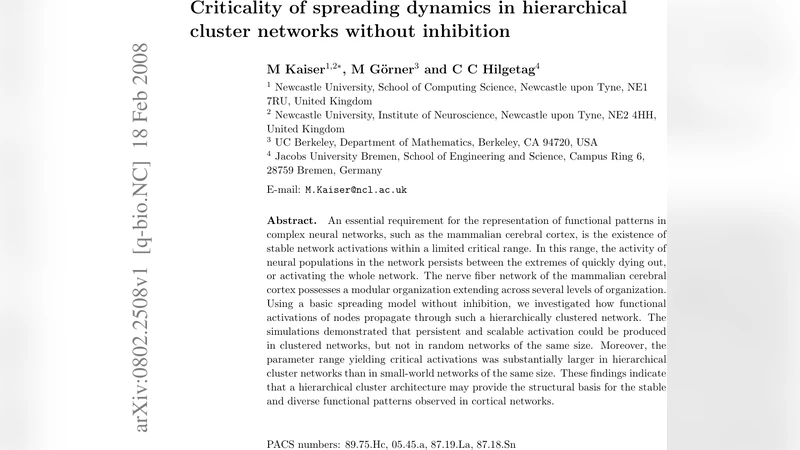
An essential requirement for the representation of functional patterns in complex neural networks, such as the mammalian cerebral cortex, is the existence of stable network activations within a limited critical range. In this range, the activity of neural populations in the network persists between the extremes of quickly dying out, or activating the whole network. The nerve fiber network of the mammalian cerebral cortex possesses a modular organization extending across several levels of organization. Using a basic spreading model without inhibition, we investigated how functional activations of nodes propagate through such a hierarchically clustered network. The simulations demonstrated that persistent and scalable activation could be produced in clustered networks, but not in random networks of the same size. Moreover, the parameter range yielding critical activations was substantially larger in hierarchical cluster networks than in small-world networks of the same size. These findings indicate that a hierarchical cluster architecture may provide the structural basis for the stable and diverse functional patterns observed in cortical networks.
💡 Research Summary
Background and Motivation
The mammalian cerebral cortex exhibits a remarkable ability to sustain functional activity patterns that are neither fleeting nor runaway. This “critical” regime allows neural populations to remain active for extended periods without triggering pathological over‑excitation (e.g., seizures) or rapid extinction. While most computational studies attribute this balance to the interplay of excitatory and inhibitory neurons, the cortical wiring diagram itself is highly modular and hierarchical, spanning micro‑columns, cortical areas, and large‑scale clusters. The authors therefore asked whether such hierarchical clustering alone, even in the absence of explicit inhibition, can generate and maintain critical spreading dynamics.
Model and Network Construction
Three undirected graphs of identical size (N = 1,000 nodes, E = 12,000 edges) were generated: (1) a purely random network, (2) a small‑world network created by rewiring a regular lattice with probability p = 0.5, and (3) a hierarchical cluster network. The hierarchical network was built by partitioning the 1,000 nodes into 10 clusters (100 nodes each) and further dividing each cluster into 10 sub‑clusters (10 nodes each). Exactly 4,000 edges were placed inside sub‑clusters, another 4,000 inside clusters (but between sub‑clusters), and the remaining 4,000 were distributed uniformly across the whole graph. This construction yields three levels of dense connectivity while preserving overall small‑world characteristics (similar clustering coefficient and characteristic path length to the small‑world graph).
The spreading dynamics are binary and deterministic apart from a stochastic de‑activation step. At each discrete time step:
- An inactive node becomes active if it has at least k = 6 active neighbors.
- An active node becomes inactive with probability ν = 0.3 (otherwise it stays active).
Initial activation is controlled by two parameters: i (the total number of nodes that will be initially active) and i₀ (the number of nodes selected from the first i₀ indices, which determines how localized the seed is). For example, i₀ = 10 activates only nodes in the first sub‑cluster, whereas i₀ = 1,000 distributes the seed uniformly.
Simulation Protocol
For each network type, the authors performed thousands of Monte‑Carlo runs, varying i (40–120) and i₀ (10–1,000) while recording:
- Final number of active nodes (categorised as 0, 1–100, 101–200, >200).
- Time required to activate 50 % of the nodes (delay).
- Whether activity persisted, died out, or engulfed the whole network.
Additional experiments systematically varied the spreading parameters k and ν, altered the proportion of edges allocated to each hierarchical level, and imposed a maximum number of consecutive time steps a node could stay active (to mimic resource exhaustion).
Key Findings
-
Random vs. Small‑World vs. Hierarchical
- Random networks displayed an all‑or‑nothing behavior: any seed either quickly percolated through the entire graph or vanished.
- Small‑world networks showed slower spread but ultimately the same binary outcome.
- Hierarchical cluster networks exhibited a rich repertoire: (a) activity confined to a single sub‑cluster, (b) activity spanning two or more clusters without full takeover, and (c) full‑network activation.
-
Critical Range of Initial Activation
- For hierarchical and small‑world graphs, a “critical window” existed where i ≈ 65–105 produced intermediate activation levels (neither extinction nor full percolation). This window was absent in random graphs.
-
Effect of Seed Localization
- When the seed was widely dispersed (large i₀), both small‑world and hierarchical networks often failed to sustain activity.
- Localized seeds (i₀ ≈ i) promoted sustained activation, especially in the hierarchical network, where activation could linger within a few clusters for many time steps before either dying out or expanding.
-
Delay of Propagation
- In random graphs, successful spread occurred within ≤ 10 steps; in small‑world graphs, delays up to ~40 steps were observed only for carefully tuned seeds.
- Hierarchical networks routinely showed delays of 30–45 steps, reflecting the need for activity to traverse multiple modular layers.
-
Parameter Sensitivity (k, ν)
- Across a grid of (k, ν) values, hierarchical networks maintained sustained activity in 60–70 % of trials, whereas small‑world networks achieved this in at most 30 % of trials.
- Lower ν (less de‑activation) naturally increased persistence, but the hierarchical topology remained superior regardless of parameter choice.
-
Influence of Edge Distribution
- Strengthening intra‑sub‑cluster connections boosted persistence; reducing inter‑cluster edges created bottlenecks that prolonged localized activation and prevented runaway spread.
- The default balanced distribution (4,000 edges per level) yielded the most flexible behavior: activation of >2 clusters inevitably led to whole‑network spread, whereas reducing inter‑cluster edges allowed multi‑cluster containment.
-
Resource Exhaustion Constraint
- Imposing a hard cap on consecutive active steps (from 7 down to 1) did not abolish the hierarchical network’s ability to sustain activity; the required ν simply shifted lower. This suggests that structural modularity can compensate for metabolic or inhibitory constraints.
Interpretation and Implications
The study demonstrates that hierarchical clustering alone can generate a broad critical regime without any explicit inhibitory mechanisms. The multi‑scale dense connectivity acts as a “structural filter”: it slows down propagation, creates local reservoirs of activity, and prevents immediate global synchronization. Such properties align with empirical observations of cortical dynamics, where localized bursts can persist without triggering seizures, and where functional connectivity often mirrors anatomical modularity.
Beyond neuroscience, the findings imply that any complex system—social networks, epidemiological contact graphs, or computer networks—could exploit hierarchical modularity to balance robustness (preventing total collapse) and responsiveness (allowing information or contagion to spread when needed).
Limitations
The model abstracts neurons to binary states, ignores synaptic weight heterogeneity, plasticity, and explicit inhibitory neurons. Real cortical circuits also exhibit time‑dependent conductances, adaptation, and neuromodulatory influences that are not captured here. Moreover, the networks are static; developmental or learning‑driven rewiring could further shape criticality.
Future Directions
Incorporating weighted, directed edges, dynamic synaptic plasticity, and realistic inhibitory populations would test the robustness of the hierarchical advantage. Embedding the model in empirically derived connectomes could validate whether the observed critical windows correspond to measured cortical activity patterns.
Conclusion
Hierarchical cluster networks possess a structural capacity to sustain diverse, persistent, and bounded activation patterns across a wide parameter space, outperforming both random and conventional small‑world topologies. This suggests that the brain’s multi‑level modular architecture may be a key substrate for its ability to operate near criticality, ensuring functional flexibility while guarding against pathological over‑excitation. The work highlights topology as a fundamental determinant of dynamical regimes in complex networks, with broad relevance across biological and engineered systems.
Comments & Academic Discussion
Loading comments...
Leave a Comment