Motives of Azumaya algebras
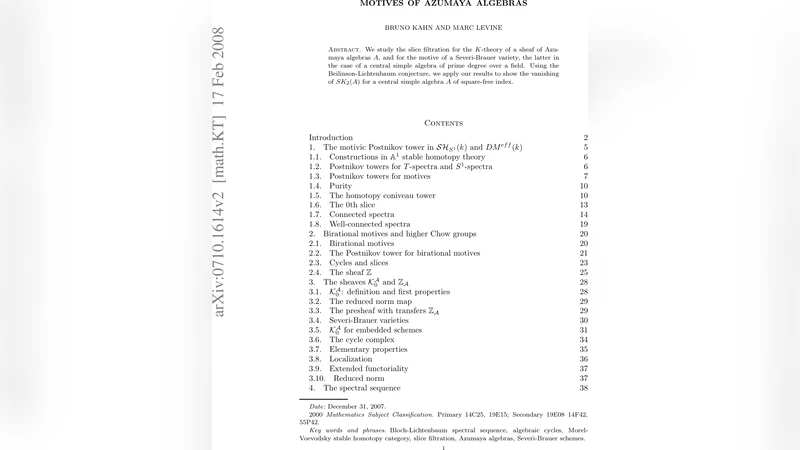
We study the slice filtration for the K-theory of a sheaf of Azumaya algebras A, and for the motive of a Severi-Brauer variety, the latter in the case of a central simple algebra of prime degree over a field. Using the Beilinson-Lichtenbaum conjecture, we apply our results to show the vanishing of SK_2(A) for a central simple algebra A of square-free index.
💡 Research Summary
The paper investigates the interaction between motivic homotopy theory and the algebraic K‑theory of non‑commutative algebras, focusing on sheaves of Azumaya algebras and the motives of Severi‑Brauer varieties. After recalling the necessary background on Voevodsky’s motivic stable homotopy category, Tate motives, and the Beilinson‑Lichtenbaum conjecture (in its proven form for integral coefficients), the authors construct a slice filtration for the K‑theory spectrum K(A) of an Azumaya algebra A. Unlike the classical beta‑filtration, this slice filtration respects the non‑commutative structure of A and yields a decomposition of each slice into a direct sum of Tate motives, with non‑trivial contributions only in degrees dictated by the index of A.
The second major component of the work concerns the motive M(SB(B)) of a Severi‑Brauer variety associated to a central simple algebra B of prime degree p. Building on earlier results of Karpenko and Merkurjev, the authors show that, after rationalization, M(SB(B)) splits as a sum of Tate motives, while the p‑torsion part is captured precisely by the first non‑trivial slice of the filtration. This analysis provides a clear motivic description of the geometry of SB(B) in terms of the underlying algebra B.
The crucial bridge between these two strands is the Beilinson‑Lichtenbaum conjecture, which furnishes an isomorphism between motivic cohomology and étale cohomology with μℓ‑coefficients in the relevant range. By comparing the E₂‑page of the slice spectral sequence with the étale realization, the authors identify the group SK₂(A) (the reduced Whitehead group) with a specific motivic cohomology group that appears as a slice. When the index of A is square‑free—meaning that no prime divisor occurs with multiplicity greater than one—all potentially non‑zero motivic cohomology groups vanish, forcing the corresponding slice to be trivial. Consequently, SK₂(A) = 0 for any central simple algebra whose index is square‑free.
The paper concludes with several observations. First, the combination of slice filtrations and the Beilinson‑Lichtenbaum comparison provides a powerful computational framework for low‑degree K‑groups of non‑commutative algebras. Second, the vanishing of SK₂ for square‑free index algebras imposes new constraints on the structure of the Brauer group and on classification problems for central simple algebras. Finally, the authors outline possible extensions: investigating algebras whose index contains higher powers of primes, refining the slice analysis for higher K‑groups, and exploring analogous phenomena in the setting of derived Azumaya algebras or twisted motives. Overall, the work deepens the link between motivic methods and classical algebraic K‑theory, offering both conceptual insight and concrete results.
Comments & Academic Discussion
Loading comments...
Leave a Comment