More on the Bernoulli and Taylor Formula for Extended Umbral Calculus
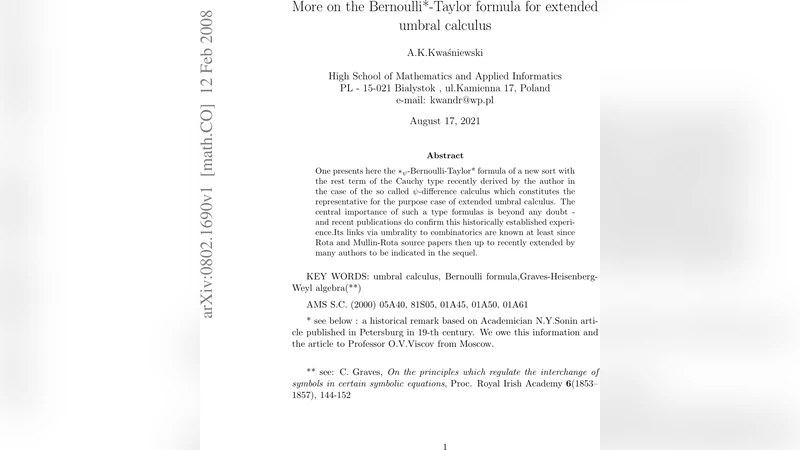
One delivers here the extended Bernoulli and Taylor formula of a new sort with the rest term of the Cauchy type recently derived by the author in the case of the so called $\psi$-difference calculus which constitutes the representative for the purpose case of extended umbral calculus. The central importance of such a type formulas is beyond any doubt. Recent publications do confirm this historically established experience. Its links via umbrality to combinatorics are known at least since Rota and Mullin source papers then up to recently extended by many authors to be indicated in the sequel.
💡 Research Summary
**
The paper by A. K. Kwaśniewski presents a comprehensive development of Bernoulli–Taylor type expansions within the framework of extended umbral calculus, specifically focusing on the ψ‑difference calculus. The central contribution is a new ψ‑Bernoulli–Taylor formula that incorporates a Cauchy‑type remainder term, together with the introduction of a novel non‑commutative product of functions or formal series denoted by ∗ψ.
The author begins by recalling the concept of an admissible ψ‑sequence, which generalises the factorial sequence (n! ) to a wide class of sequences such as Fibonacci‑type, q‑factorial, or any sequence satisfying certain admissibility conditions (as in Markowsky’s work). Using a “up‑side‑down” notation, the ψ‑numbers, ψ‑factorials and ψ‑powers are defined by nψ = ψ(n−1)/ψ(n), nψ! = nψ·(n−1)ψ! , xψ = ψ(x−1)/ψ(x), and the corresponding ψ‑powers x^{k}_{ψ} are obtained by successive ψ‑multiplications.
The paper then revisits Viskov’s operator method for deriving Bernoulli identities. In the classical setting Viskov’s identity reads pⁿ∑_{k=0}^{n}(−q)^{k}p^{k}/k! = (−q)^{n}p^{n+1}/n!, where p and q are operators satisfying
Comments & Academic Discussion
Loading comments...
Leave a Comment