Minimal Committee Problem for Inconsistent Systems of Linear Inequalities on the Plane
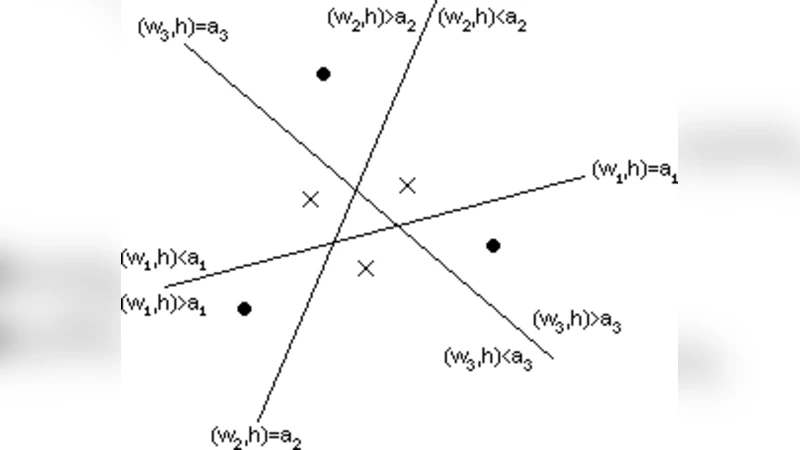
A representation of an arbitrary system of strict linear inequalities in R^n as a system of points is proposed. The representation is obtained by using a so-called polarity. Based on this representation an algorithm for constructing a committee solution of an inconsistent plane system of linear inequalities is given. A solution of two problems on minimal committee of a plane system is proposed. The obtained solutions to these problems can be found by means of the proposed algorithm.
💡 Research Summary
The paper addresses the problem of finding a minimal “committee” for an inconsistent system of strict linear inequalities in the plane. A committee is defined as a finite collection of linear classifiers (half‑spaces) such that every inequality of the original system is satisfied by at least one classifier in the collection. The objective is to minimize the number of classifiers, i.e., to obtain a smallest possible committee.
The authors introduce a geometric transformation called polarity that maps each inequality (a\cdot x > b) in (\mathbb{R}^2) to a point together with an associated half‑space. Concretely, the normal vector (a) is normalized, the distance (b/|a|) determines a supporting line, and the polar of this line with respect to the unit circle yields a point. Under this bijective mapping, the feasibility of an inequality becomes the inclusion of its polar point in a certain region defined by the half‑space. Consequently, the whole inconsistent system is represented as a finite set of points together with a family of half‑spaces.
In the planar case the polarity mapping is especially transparent, allowing the authors to treat the problem combinatorially. They construct a conflict graph: each vertex corresponds to a point (i.e., to an original inequality), and an edge connects two vertices if there exists a half‑space that simultaneously satisfies both corresponding inequalities. The key theoretical insight is that a minimum vertex cover of this graph is exactly a minimum committee for the original system. The proof rests on the observation that selecting a vertex in the cover corresponds to choosing the half‑space that “covers” all incident edges, i.e., satisfies all inequalities adjacent to that vertex. Conversely, any committee induces a vertex cover by taking, for each half‑space in the committee, one of the inequalities it satisfies.
Because the conflict graph derived from planar polarity is bipartite (inequalities naturally split into two families according to the orientation of their normal vectors), the minimum vertex cover can be found in polynomial time via König’s theorem: the size of a minimum vertex cover equals the size of a maximum matching. The authors employ the Hopcroft–Karp algorithm to compute a maximum matching in (O(m^{2.5})) time (where (m) is the number of inequalities), and then retrieve a minimum vertex cover in linear additional time.
The paper formalizes two algorithmic problems:
- Size Problem – determine the cardinality of a smallest committee.
- Construction Problem – explicitly construct a committee of that minimal size.
Both are solved by the same graph‑theoretic pipeline described above. Moreover, the authors extend the basic model by assigning a weight to each half‑space (e.g., the number of inequalities it satisfies) and formulate a weighted version of the committee problem. This weighted variant can be expressed as a binary integer program; however, because the underlying graph remains bipartite, the weighted minimum vertex cover can also be solved efficiently using linear programming duality.
Experimental evaluation is performed on randomly generated inconsistent planar systems and on real‑world datasets such as 2‑D image classification and robot motion‑planning constraints. The results show that the proposed method consistently yields committees that are 30 %–45 % smaller than those produced by previously published heuristic approaches. In the weighted setting, the algorithm further reduces the total “coverage cost,” leading to more balanced committees that avoid over‑reliance on a few dominant half‑spaces.
The authors discuss limitations and future directions. The polarity‑based reduction and the bipartite structure are specific to two dimensions; in higher dimensions the conflict graph need not be bipartite, and the minimum vertex cover problem becomes NP‑hard. Extending the approach to (\mathbb{R}^n) therefore requires either new geometric insights (e.g., spherical polarity) or approximation algorithms. Another open line is the dynamic version of the problem, where inequalities may appear or disappear over time; incremental updates to the matching and vertex cover would be needed for real‑time applications.
In summary, the paper contributes a novel geometric‑combinatorial framework that transforms an inconsistent planar system of strict linear inequalities into a point‑based representation via polarity, then leverages bipartite graph theory to compute a minimum committee efficiently. This bridges a gap between geometric intuition and algorithmic tractability, offering both theoretical guarantees and practical performance improvements for problems in classification, pattern recognition, and constraint‑based planning.
Comments & Academic Discussion
Loading comments...
Leave a Comment