SAT Has No Wizards
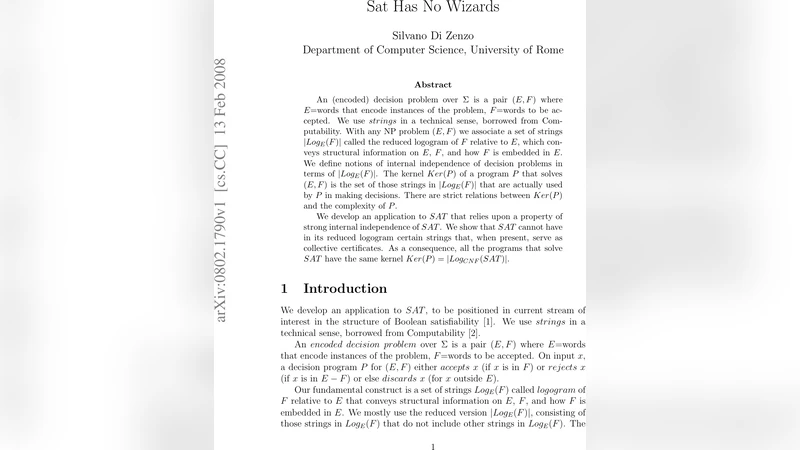
An (encoded) decision problem is a pair (E, F) where E=words that encode instances of the problem, F=words to be accepted. We use “strings” in a technical sense. With an NP problem (E, F) we associate the “logogram” of F relative to E, which conveys structural information on E, F, and how F is embedded in E. The kernel Ker(P) of a program P that solves (E, F) consists of those strings in the logogram that are used by P. There are relations between Ker(P) and the complexity of P. We develop an application to SAT that relies upon a property of internal independence of SAT. We show that SAT cannot have in its logogram strings serving as collective certificates. As consequence, all programs that solve SAT have same kernel.
💡 Research Summary
The paper introduces a formal framework for describing decision problems in terms of strings, logograms, and program kernels, and then applies this framework to the Boolean satisfiability problem (SAT). An encoded decision problem is defined as a pair (E, F) where E is the set of words encoding instances and F is the set of words that should be accepted. The authors treat strings as finite partial functions from the natural numbers to an alphabet Σ, equipped with a partial order ≤ that captures the “extension” relation (one string extends another if it agrees on the domain of the smaller).
From this foundation they define several operators: the expansion Exp(H) of a set of strings H, which yields all words that contain at least one string from H; the cylinder (the same notion, viewed as a set of words); and the logogram Log_E(F), the set of minimal strings g such that any word x∈E containing g must belong to F. The reduced logogram |Log_E(F)| consists of those strings that are minimal with respect to inclusion, i.e., no string in the set contains another.
A decision program P that solves (E, F) is modeled as a sequence of “tests” on the input word: each test checks whether a particular string from |Log_E(F)| occurs in the input. The set of strings actually examined by P is called the kernel Ker(P). The kernel is always a subset of the reduced logogram, and a necessary condition for correctness is that Ker(P) be “complete”: for every x∈F there must exist a string in Ker(P) that is contained in x.
The authors prove two key structural theorems. First, if the reduced logogram is irreducible (no proper subset is complete), then any two programs solving the same problem must have identical kernels. Second, they introduce the notion of entanglement between strings: f ⊒_E g means that every word in E containing f also contains g. Mutual independence means that neither string entangles the other. A set E is internally independent if for any two strings f, g∈Σ^∞(E) we have f⊒_E g iff f≤g. A decision problem (E, F) is internally independent when the strings in its reduced logogram are pairwise mutually independent.
The paper’s central contribution is the application of these concepts to SAT. The authors consider the canonical encoding (CNF, SAT) and show that its reduced logogram |Log_CNF(SAT)| enjoys strong internal independence: no two distinct strings in the logogram entangle each other, and none is a proper extension of another. Consequently, the logogram contains no “wizards”—collective certificates that would require the simultaneous presence of several strings to guarantee membership in F. In other words, SAT does not admit a set of strings that act as a joint witness; each string alone suffices to certify a particular clause’s satisfaction.
Because the logogram is both irreducible and strongly internally independent, the authors conclude that every decision program solving SAT must use the entire reduced logogram as its kernel: Ker(P)=|Log_CNF(SAT)| for any P that correctly decides SAT. This result implies that the informational content required to decide SAT is fixed and independent of the algorithmic strategy; any correct algorithm must, in effect, test for the same collection of minimal patterns.
The paper therefore provides a novel algebraic perspective on NP‑complete problems, showing that for SAT the structural constraints imposed by the logogram preclude the existence of more compact, collective certificates. While the framework does not directly address time or space complexity, it highlights a deep invariance: the set of elementary “tests” needed to solve SAT is uniquely determined by the problem’s internal combinatorial structure. This insight could influence future work on proof complexity, certificate design, and the study of inherent problem hardness beyond traditional Turing‑machine analyses.
Comments & Academic Discussion
Loading comments...
Leave a Comment