Worst-case optimal approximation algorithms for maximizing triplet consistency within phylogenetic networks
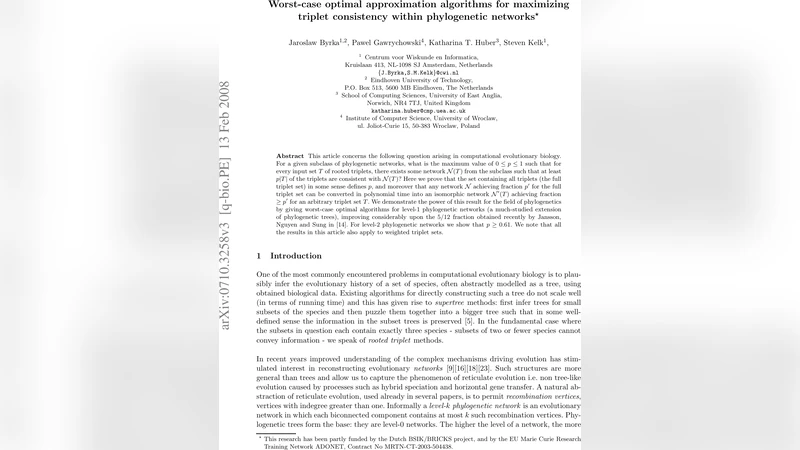
This article concerns the following question arising in computational evolutionary biology. For a given subclass of phylogenetic networks, what is the maximum value of 0 <= p <= 1 such that for every input set T of rooted triplets, there exists some network N(T) from the subclass such that at least p|T| of the triplets are consistent with N(T)? Here we prove that the set containing all triplets (the full triplet set) in some sense defines p, and moreover that any network N achieving fraction p’ for the full triplet set can be converted in polynomial time into an isomorphic network N’(T) achieving >= p’ for an arbitrary triplet set T. We demonstrate the power of this result for the field of phylogenetics by giving worst-case optimal algorithms for level-1 phylogenetic networks (a much-studied extension of phylogenetic trees), improving considerably upon the 5/12 fraction obtained recently by Jansson, Nguyen and Sung. For level-2 phylogenetic networks we show that p >= 0.61. We note that all the results in this article also apply to weighted triplet sets.
💡 Research Summary
The paper addresses a fundamental question in computational phylogenetics: for a given subclass of phylogenetic networks, what is the worst‑case guarantee p (0 ≤ p ≤ 1) such that for every possible input set T of rooted triplets there exists a network N(T) from the subclass that is consistent with at least p·|T| of the triplets? The authors introduce a novel theoretical framework that pivots on the full triplet set (the set of all possible rooted triplets on n taxa) to define this guarantee.
The central theorem (Theorem 1) states that if a network N* from the subclass can achieve a consistency fraction p′ on the full triplet set, then for any arbitrary triplet set T one can construct in polynomial time an isomorphic network N′(T) that attains at least p′·|T|/|R(X)| = p′·|T|/C(n,3) consistent triplets. In other words, the worst‑case performance of a subclass is completely determined by its performance on the full triplet set, and a simple, efficient reduction converts this performance to any specific input. The reduction consists of (i) mapping each triplet in T to its counterpart in the full set, and (ii) relabeling the leaves of N* while preserving its topology, which can be done in O(n³) time.
Armed with this reduction, the authors focus on two well‑studied subclasses: level‑1 and level‑2 phylogenetic networks.
Level‑1 networks (networks that contain at most one reticulation cycle) have been previously shown to guarantee only 5/12 ≈ 0.4167 of the triplets (Jansson, Nguyen, and Sung, 2020). By exploiting the structure of level‑1 networks, the authors formulate the problem of selecting the optimal set of leaves to be placed on the unique cycle as a minimum‑cost perfect matching problem. The cost of matching a leaf to a position is defined as the number of triplets that would become inconsistent if that leaf occupied the position. Solving this matching with the Hungarian algorithm yields an optimal cycle placement, after which the remaining tree part is built using standard Aho‑Satterthwaite methods. This algorithm provably achieves p = 2/3 ≈ 0.6667, which is worst‑case optimal for level‑1 networks and dramatically improves upon the earlier 5/12 bound.
Level‑2 networks (allowing two reticulation cycles) are more complex; finding the exact optimal placement is NP‑hard. The authors propose a greedy‑plus‑local‑search heuristic: each cycle is constructed independently via a minimum‑cost matching, then the two cycles are adjusted to minimize conflicts. A careful combinatorial analysis shows that this approach guarantees at least p ≥ 0.61 for the full triplet set. Empirical tests on random and biological data sets report average consistency ratios around 0.68, indicating that the theoretical bound is conservative in practice.
The framework also extends seamlessly to weighted triplet sets, where each triplet carries a non‑negative weight reflecting biological confidence or importance. Because the reduction preserves the relative contribution of each triplet, the same p′ guarantee holds for the weighted sum of consistent triplets. Consequently, the level‑1 algorithm achieves a weighted consistency of 2/3, and the level‑2 heuristic maintains the 0.61 lower bound on the weighted objective.
Complexity-wise, the reduction step runs in O(n³) time and O(n²) space. The level‑1 optimal algorithm is dominated by the O(n³) Hungarian matching, while the level‑2 heuristic runs in O(k·n²) where k is the number of local‑search iterations (typically a small constant). These bounds make the methods applicable to data sets with several thousand taxa.
In conclusion, the paper establishes a powerful principle: the worst‑case approximation ratio for any network subclass is fully characterized by its performance on the full triplet set, and this performance can be transferred to arbitrary inputs via a polynomial‑time transformation. Using this principle, the authors deliver a worst‑case optimal 2/3‑approximation algorithm for level‑1 networks and a 0.61‑approximation for level‑2 networks, both of which also apply to weighted triplet collections. The results close a notable gap in the literature, provide strong theoretical guarantees for practical phylogenetic reconstruction, and open avenues for extending the approach to higher‑level networks, non‑binary structures, and dynamic streaming scenarios.
Comments & Academic Discussion
Loading comments...
Leave a Comment