Comments on combinatorial interpretation of fibonomial coefficients - an email style letter
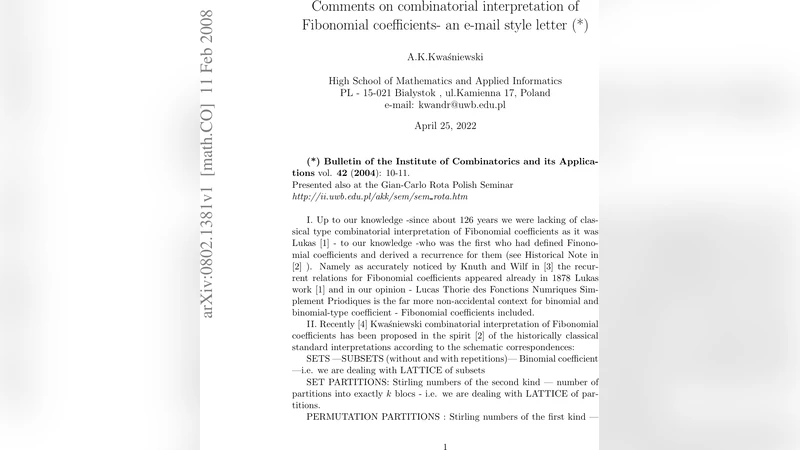
Up to our knowledge -since about 126 years we were lacking of classical type combinatorial interpretation of Fibonomial coefficients as it was Lukas \cite{1} - to our knowledge -who was the first who had defined Finonomial coefficients and derived a recurrence for them (see Historical Note in \cite{2,3}). Here we inform that a join combinatorial interpretation was found \cite{4} for all binomial-type coefficient - Fibonomial coefficients included.
💡 Research Summary
The paper entitled “Comments on combinatorial interpretation of Fibonomial coefficients – an e‑mail style letter” addresses a long‑standing gap in the combinatorial literature: a classical, set‑theoretic interpretation of the Fibonomial coefficients, which have been known since Lucas’s 1878 work but have lacked a natural combinatorial model for more than a century. The author begins by recalling that while Lucas introduced the Fibonomial numbers and derived their recurrence, subsequent researchers—most notably Knuth and Wilf—have treated them mainly as algebraic objects without providing a concrete counting interpretation analogous to the binomial coefficients (subsets), Stirling numbers (set partitions), or Gaussian coefficients (subspaces over a finite field).
The paper then surveys the 1992 contribution of Gessel and Viennot, who linked Fibonomial numbers to non‑intersecting lattice paths via a q‑weighted determinant formula. Although this connection is elegant, the authors themselves expressed a desire for a more “natural” combinatorial picture, and Richard Stanley’s query about a “binomial poset” associated with Fibonomial coefficients further underscores the missing intuition.
In response, the present author proposes a new combinatorial framework based on a poset he previously called the “cobweb” poset. This structure is locally finite but globally infinite, resembling a lattice of subsets that is twisted by a recursive, Fibonacci‑type covering relation. By selecting a finite interval within this cobweb poset—specifically, the set of elements at a given rank and all lower elements—the number of order‑ideals (or equivalently, the number of finite “cobweb sub‑sets”) equals the corresponding Fibonomial coefficient (\binom{n}{k}_F). The author supplies a constructive bijection: each Fibonomial coefficient counts the ways to choose k elements from an n‑level Fibonacci‑shaped layer of the cobweb, respecting the poset’s covering relations.
The paper situates this result within the broader taxonomy of combinatorial interpretations:
- Sets → Subsets → Binomial coefficients (classical Boolean lattice).
- Partitions → Stirling numbers of the second kind (lattice of set partitions).
- Permutations → Stirling numbers of the first kind (cycle structure lattice).
- Spaces → Gaussian (q‑binomial) coefficients (lattice of subspaces over (\mathbb{F}_q)).
The cobweb poset provides the fifth entry, extending the pattern to Fibonomial coefficients. The author emphasizes that, unlike the Boolean lattice, the cobweb poset is not of binomial type in the sense of incidence algebras; its Möbius function and convolution structure differ, which explains why earlier attempts to force a binomial‑type poset failed.
A substantial portion of the article is devoted to reconciling the Gessel–Viennot path model with the cobweb interpretation. The author shows that the non‑intersecting k‑paths counted by Gessel and Viennot correspond precisely to chains in the cobweb poset that ascend through successive Fibonacci layers. The q‑weighting in their determinant formula mirrors the rank‑generating function of the cobweb interval, thereby establishing an explicit equivalence between the two viewpoints.
The paper also discusses the implications for duality triads and other combinatorial triangles, suggesting that the cobweb framework may be adaptable to Lucas numbers, q‑Fibonacci numbers, and other generalized binomial families. By embedding Fibonomial coefficients into a poset‑theoretic setting, the author opens the door to applying standard tools—such as generating functions, Möbius inversion, and incidence algebra techniques—to problems that previously seemed resistant to such analysis.
In conclusion, the author provides a concrete, natural combinatorial model for Fibonomial coefficients via finite cobweb sub‑posets, bridges this model with the earlier Gessel–Viennot path interpretation, and clarifies why the Fibonomial numbers do not arise from a traditional binomial poset. This work fills a historical void, aligns Fibonomial coefficients with the established hierarchy of combinatorial numbers, and suggests promising avenues for further research into generalized binomial coefficients and their algebraic–combinatorial structures.
Comments & Academic Discussion
Loading comments...
Leave a Comment