Quasi-stationary regime of a branching random walk in presence of an absorbing wall
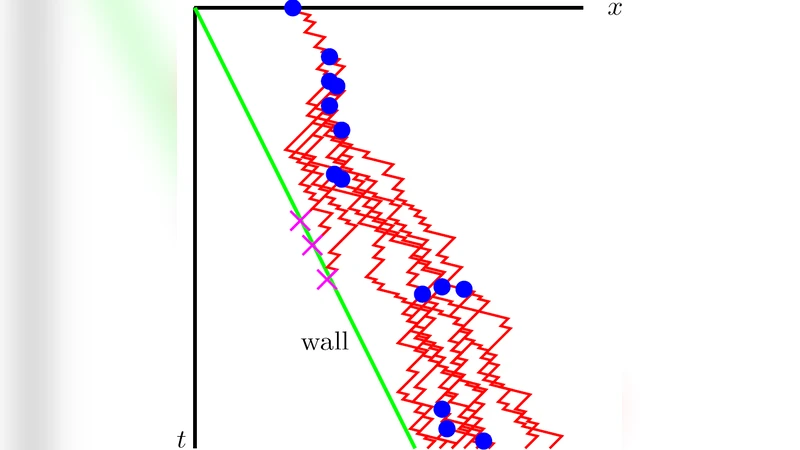
A branching random walk in presence of an absorbing wall moving at a constant velocity $v$ undergoes a phase transition as the velocity $v$ of the wall varies. Below the critical velocity $v_c$, the population has a non-zero survival probability and when the population survives its size grows exponentially. We investigate the histories of the population conditioned on having a single survivor at some final time $T$. We study the quasi-stationary regime for $v<v_c$ when $T$ is large. To do so, one can construct a modified stochastic process which is equivalent to the original process conditioned on having a single survivor at final time $T$. We then use this construction to show that the properties of the quasi-stationary regime are universal when $v\to v_c$. We also solve exactly a simple version of the problem, the exponential model, for which the study of the quasi-stationary regime can be reduced to the analysis of a single one-dimensional map.
💡 Research Summary
The paper investigates a branching random walk (BRW) in the presence of an absorbing wall that moves at a constant velocity v. It is known that such a system undergoes a phase transition: for wall velocities below a critical value v_c the population has a non‑zero probability of survival, and conditioned on survival the number of individuals grows exponentially in time. The authors focus on a more restrictive conditioning: they consider only those histories that end at a prescribed final time T with exactly one surviving particle. By conditioning on this rare event they construct a modified stochastic process that is equivalent to the original BRW under the single‑survivor constraint.
The construction relies on a Doob h‑transform. The function h(x,t) represents the probability that a particle located at position x at time t will be the unique survivor at time T. Re‑weighting the transition probabilities by h produces a new Markov process that preserves the branching structure while enforcing the single‑survivor condition. This “conditioned BRW” can be interpreted as a BRW with an intrinsic selection mechanism that eliminates all but one lineage as time progresses.
A central result is that, as the wall velocity approaches the critical value from below (ε = v_c − v → 0⁺), the statistical properties of the conditioned process become universal. Quantities such as the mean population size, the spatial density of particles, and the distribution of the final survivor’s position all diverge like ε⁻¹, but after appropriate rescaling they collapse onto a single limiting distribution. In other words, a quasi‑stationary regime emerges near the transition: the system spends a long time in a metastable state whose characteristics are independent of the microscopic details of the BRW, depending only on the distance to criticality.
To make the analysis tractable, the authors introduce a simplified “exponential model”. In this model each particle splits with a fixed probability and the offspring are displaced by a deterministic exponential factor. Because both branching and displacement are exponential, the whole system can be reduced to the iteration of a one‑dimensional map x_{n+1}=f(x_n). The map captures the evolution of a suitably defined collective coordinate (essentially the logarithm of the population front). By studying the fixed points, linear stability, and possible periodic orbits of this map, the authors obtain exact expressions for the quasi‑stationary observables. The linearization around the fixed point reproduces the ε⁻¹ scaling found in the full BRW, confirming that the map faithfully represents the critical dynamics.
The paper also discusses the broader relevance of these findings. Similar “absorbing wall + branching” scenarios appear in population genetics (e.g., the spread of a beneficial mutation limited by a moving fitness front), epidemiology (infection fronts halted by quarantine measures), and reaction‑diffusion systems with catalytic surfaces. In all these contexts, conditioning on a single surviving lineage is natural when one is interested in the fate of a rare mutant or a single infection seed. The universality of the quasi‑stationary regime near the critical wall speed suggests that experimental measurements of survival times, front positions, or lineage statistics should exhibit the same scaling laws across disparate systems.
In summary, the authors (1) formulate a rigorous conditioned BRW using an h‑transform, (2) demonstrate that near the critical wall speed the conditioned process enters a universal quasi‑stationary state, and (3) solve a tractable exponential version exactly by mapping it onto a one‑dimensional iterative map. Their work provides a powerful analytical framework for studying conditioned diffusion‑branching processes and highlights the robustness of quasi‑stationary behavior in systems poised at a dynamical phase transition.
Comments & Academic Discussion
Loading comments...
Leave a Comment