On the Equivalent Theory of the Generalized tau^{(2)}-model and the Chiral Potts Model with two Alternating Vertical Rapidities
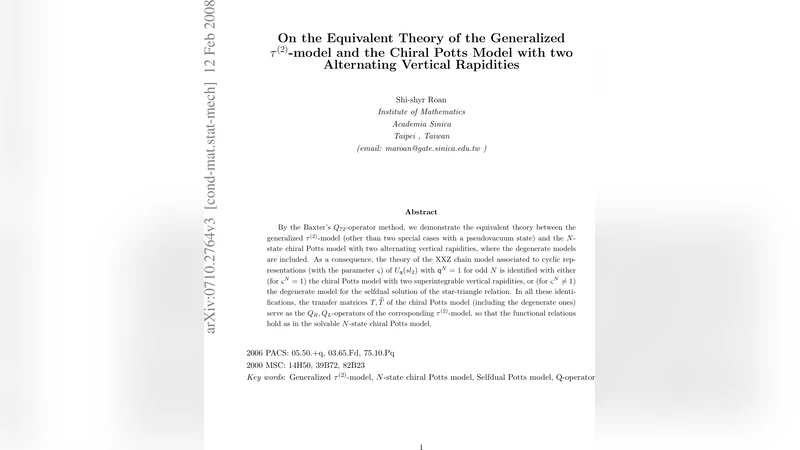
By the Baxter’s $Q_{72}$-operator method, we demonstrate the equivalent theory between the generalized $\tau^{(2)}$-model (other than two special cases with a pseudovacuum state) and the $N$-state chiral Potts model with two alternating vertical rapidities, where the degenerate models are included. As a consequence, the theory of the XXZ chain model associated to cyclic representations (with the parameter $\varsigma$) of $U_{\sf q}(sl_2)$ with ${\sf q}^N=1$ for odd $N$ is identified with either (for $\varsigma^N=1$) the chiral Potts model with two superintegrable vertical rapidities, or (for $\varsigma^N \neq 1$) the degenerate model for the selfdual solution of the star-triangle relation. In all these identifications, the transfer matrices $T, \hat{T}$ of the chiral Potts model (including the degenerate ones) serve as the $Q_R, Q_L$-operators of the corresponding $\tau^{(2)}$-model, so that the functional relations hold as in the solvable $N$-state chiral Potts model.
💡 Research Summary
The paper establishes a rigorous equivalence between the generalized τ^{(2)}‑model (excluding the two special cases that possess a pseudovacuum) and the N‑state chiral Potts model (CPM) with two alternating vertical rapidities, using Baxter’s Q_{72}‑operator construction. The authors first review the τ^{(2)}‑model, whose L‑operator depends on four complex parameters (a, b, c, d). When these parameters are generic, the model lacks a reference (pseudovacuum) state, preventing a conventional Bethe‑Ansatz solution. By employing Baxter’s Q_{72} method, they construct right and left Q‑operators, Q_R and Q_L, and identify them with the transfer matrices T and \hat T of the CPM that has two alternating vertical rapidities (v_1, v_2).
A central technical step is the embedding of the τ^{(2)}‑model into a cyclic representation of the quantum group U_q(sl_2) with q^N = 1 (N odd). The representation is characterized by a parameter ς (varsigma). Two distinct regimes arise: (i) ς^N = 1, where the rapidity curve of the CPM collapses to the well‑known super‑integrable point; (ii) ς^N ≠ 1, where the rapidity curve degenerates to a self‑dual solution of the star‑triangle relation. In both regimes the star‑triangle relation holds, guaranteeing that the CPM transfer matrices satisfy the same functional relations (TQ‑equation, QQ‑equation, fusion hierarchy) as the τ^{(2)}‑model. Consequently, the functional equations derived for the solvable CPM are automatically inherited by the generalized τ^{(2)}‑model.
The paper further connects these results to the XXZ spin‑½ chain built on the same cyclic representation of U_q(sl_2). When ς^N = 1 the XXZ chain is identified with the CPM having two super‑integrable vertical rapidities; when ς^N ≠ 1 it corresponds to the degenerate CPM associated with the self‑dual star‑triangle solution. In both cases the XXZ Hamiltonian’s spectrum can be obtained from the eigenvalues of T and \hat T, which now play the role of Q_R and Q_L. This identification clarifies how the non‑trivial boundary conditions and the cyclic nature of the representation manifest as alternating rapidities in the CPM.
The authors verify the equivalence by explicitly constructing the Q‑operators, demonstrating that the T‑Q functional relation for τ^{(2)} (T(λ)Q_R(λ) = φ(λ)Q_R(λq) + ψ(λ)Q_R(λq^{-1})) matches the known CPM relation, and similarly for the left Q‑operator. They also discuss the fusion hierarchy, showing that higher‑spin transfer matrices of the τ^{(2)}‑model correspond to fused CPM transfer matrices.
In summary, the work provides a comprehensive bridge between three seemingly distinct integrable structures: the generalized τ^{(2)}‑model, the chiral Potts model with alternating vertical rapidities (including its degenerate self‑dual version), and the XXZ chain with cyclic U_q(sl_2) representations at roots of unity. By proving that the CPM transfer matrices serve as Q‑operators for τ^{(2)}, the paper guarantees that all functional relations, analyticity properties, and spectral results known for the CPM are directly applicable to the generalized τ^{(2)}‑model and its associated XXZ chain. This unification not only resolves longstanding questions about the solvability of τ^{(2)} models lacking a pseudovacuum but also opens avenues for exploring other root‑of‑unity quantum group representations within the framework of exactly solvable lattice models.
Comments & Academic Discussion
Loading comments...
Leave a Comment