On the Accuracy of Galileos Observations
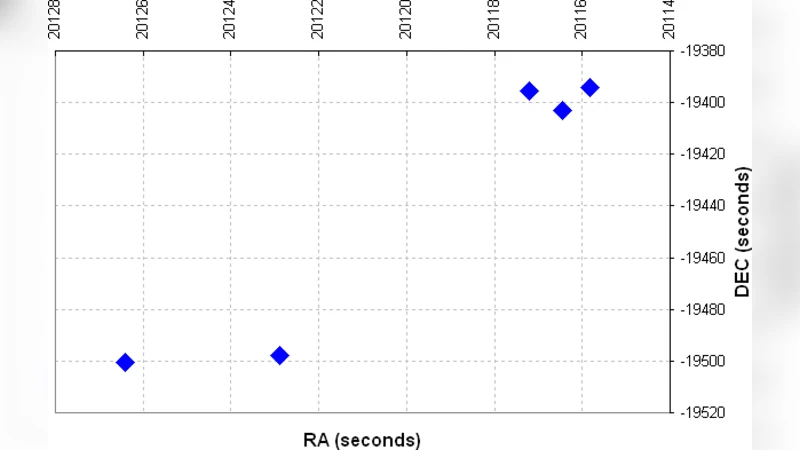
Galileo Galilei had sufficient skill as an observer and instrument builder to be able to measure the positions and apparent sizes of objects seen through his telescopes to an accuracy of 2" or better. However, Galileo had no knowledge of wave optics, so when he was measuring stellar apparent sizes he was producing very accurate measurements of diffraction artifacts and not physical bodies.
💡 Research Summary
The paper by Christopher M. Graney reassesses the precision of Galileo Galilei’s telescopic observations, arguing that while Galileo could measure positions and apparent sizes of celestial objects to an accuracy of about two arc‑seconds, his measurements of stellar diameters were in fact precise recordings of diffraction artifacts rather than true physical sizes.
The introduction reviews earlier work by Standish and Nobili (1997), which demonstrated that Galileo’s drawings of the Jovian system improved dramatically between 1610 and 1613, eventually reaching a positional accuracy of roughly 0.1 Jovian radii (≈2″). Graney emphasizes that Galileo achieved this without a focal plane or measuring reticle, relying solely on his eye and a simple “Galilean” telescope.
Section 2 documents Galileo’s own statements from 1612 that he had refined his ability to measure to the arc‑second level. The author compares Galileo’s sketches of Jupiter and its moons with modern simulated views from the Stellarium software, showing close agreement despite inevitable timing uncertainties.
Section 3 focuses on double stars and tight clusters. In January 1617 Galileo measured the separation of the double star Mizar in Ursa Major as 15″, a value that is within half an arc‑second of modern measurements (14.4″). He also sketched five stars in the Orion Trapezium region; when the sketch is over‑laid on modern SIMBAD coordinates, the relative positions match to within the claimed 15″ precision.
Section 4 addresses Galileo’s measurements of stellar apparent diameters. He recorded Sirius as just over 5″ across and the two components of Mizar as 6″ and 4″ respectively. In a 1624 letter to Ingoli he noted that no star subtends more than 5″ and many are smaller than 2″, implying he believed he could reliably measure to at least 2″.
Section 5 introduces the physics of diffraction. Using the Airy‑disk formula r_A = 1.22 λ/D with λ = 550 nm and telescope apertures of 26 mm and 38 mm (the sizes attributed to Galileo), the theoretical diffraction radius is about 4.5″. Graney explains that the human eye has an intensity threshold; brighter stars exceed this threshold farther from the Airy centre, producing larger apparent disks, while fainter stars fall below the threshold sooner, yielding smaller disks. Plots of intensity versus radius for various magnitudes show a roughly linear relationship between magnitude and apparent radius over the range of stars Galileo could see, matching his reported linear scaling of diameter with magnitude.
Section 6 applies this model to Mizar. Assuming a 26 mm aperture, setting the detection threshold so that component B (mag ≈ 3.95) appears with a 4″ diameter yields an expected diameter for component A (mag ≈ 2.27) of about 7.3″, only 1.3″ larger than Galileo’s 6″ measurement. The same calculation with a 38 mm aperture gives a similarly close result. This quantitative agreement demonstrates that Galileo’s “stellar size” measurements were essentially measurements of the diffraction pattern limited by his telescope’s aperture and his eye’s sensitivity.
The paper also cites modern reconstruction experiments (Tom Pope and Jim Mosher) in which a replica Galilean telescope equipped with a CCD camera reproduces the same diffraction‑limited stellar images, further confirming Graney’s interpretation.
In the conclusions, Graney asserts that Galileo’s positional work consistently achieved ≤2″ accuracy, while his stellar‑size work, though technically precise, reflected a misunderstanding of wave optics. Nonetheless, the ability to obtain such consistent, high‑precision data with a simple instrument and naked eye underscores Galileo’s extraordinary observational skill, instrument craftsmanship, and scientific insight. The paper thus reframes Galileo’s legacy: he was a master of precise measurement, even when the physical meaning of some of his data (stellar diameters) was later clarified by the development of diffraction theory.
Comments & Academic Discussion
Loading comments...
Leave a Comment