Globular realization and cubical underlying homotopy type of time flow of process algebra
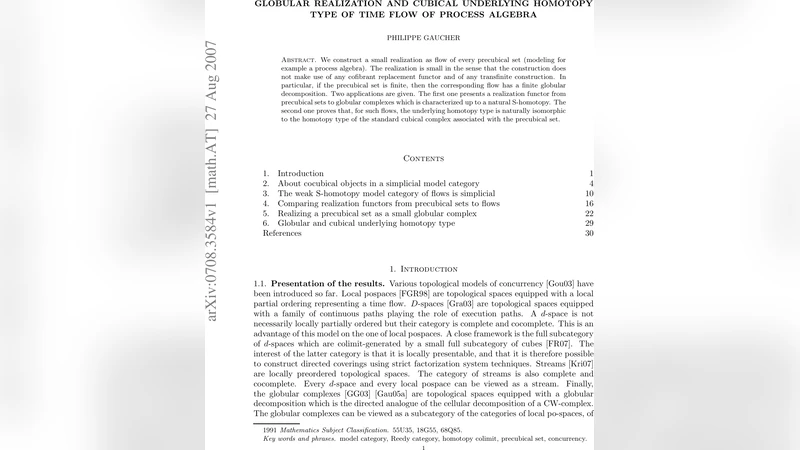
We construct a small realization as flow of every precubical set (modeling for example a process algebra). The realization is small in the sense that the construction does not make use of any cofibrant replacement functor and of any transfinite construction. In particular, if the precubical set is finite, then the corresponding flow has a finite globular decomposition. Two applications are given. The first one presents a realization functor from precubical sets to globular complexes which is characterized up to a natural S-homotopy. The second one proves that, for such flows, the underlying homotopy type is naturally isomorphic to the homotopy type of the standard cubical complex associated with the precubical set.
💡 Research Summary
The paper addresses the long‑standing problem of constructing a concrete, “small” realization of any precubical set as a flow, a model of directed concurrency. Traditional approaches to such realizations rely on cofibrant replacement functors and transfinite constructions, which introduce an uncontrolled proliferation of cells even when the original precubical set is finite. The authors propose a new construction that avoids these heavy categorical tools. Their method maps each n‑cube of a precubical set directly to a globular cell (a “globule”) and interprets the face maps as execution paths in a flow. By using the intrinsic transition preorder of the precubical set, they assemble the execution paths without invoking any cofibrant replacement. Consequently, if the precubical set is finite, the resulting flow admits a finite globular decomposition, making the construction computationally tractable and conceptually transparent.
The second major contribution is a precise comparison between the homotopy type underlying the constructed flow and the homotopy type of the standard cubical complex associated with the same precubical set. The authors define the “underlying homotopy type” of a flow and prove that it is naturally isomorphic to the homotopy type of the cubical complex. The proof hinges on the notion of S‑homotopy, a directed homotopy relation that respects the flow structure while allowing continuous deformation. Moreover, they exhibit a realization functor from precubical sets to globular complexes that is characterized uniquely up to S‑homotopy, establishing a robust bridge between cubical and globular models of concurrency.
To illustrate the practical relevance, the paper applies the construction to classic process algebras such as CCS and CSP. By encoding process algebra operators as precubical sets, the authors obtain flows whose globular decomposition directly reflects the concurrent behavior of the original specifications. The resulting flows retain the full directed topological information, enabling analyses of deadlock, livelock, and higher‑dimensional execution paths that go beyond traditional labeled transition system (LTS) techniques. This enriched topological perspective opens new avenues for formal verification, model checking, and the synthesis of concurrent systems.
Finally, the authors emphasize the categorical elegance of their approach. The realization functor is shown to be a genuine functor between the category of precubical sets and the category of globular complexes, and the natural isomorphism between underlying homotopy types is expressed as a natural transformation. This positions the work at the intersection of directed homotopy theory, higher‑dimensional category theory, and concurrency theory, providing a solid foundation for future research that seeks to unify algebraic, topological, and computational models of concurrent processes.
Comments & Academic Discussion
Loading comments...
Leave a Comment