📝 Original Info
- Title: Small Is Not Always Beautiful
- ArXiv ID: 0802.1015
- Date: 2008-02-08
- Authors: Researchers from original ArXiv paper
📝 Abstract
Peer-to-peer content distribution systems have been enjoying great popularity, and are now gaining momentum as a means of disseminating video streams over the Internet. In many of these protocols, including the popular BitTorrent, content is split into mostly fixed-size pieces, allowing a client to download data from many peers simultaneously. This makes piece size potentially critical for performance. However, previous research efforts have largely overlooked this parameter, opting to focus on others instead. This paper presents the results of real experiments with varying piece sizes on a controlled BitTorrent testbed. We demonstrate that this parameter is indeed critical, as it determines the degree of parallelism in the system, and we investigate optimal piece sizes for distributing small and large content. We also pinpoint a related design trade-off, and explain how BitTorrent's choice of dividing pieces into subpieces attempts to address it.
💡 Deep Analysis
Deep Dive into Small Is Not Always Beautiful.
Peer-to-peer content distribution systems have been enjoying great popularity, and are now gaining momentum as a means of disseminating video streams over the Internet. In many of these protocols, including the popular BitTorrent, content is split into mostly fixed-size pieces, allowing a client to download data from many peers simultaneously. This makes piece size potentially critical for performance. However, previous research efforts have largely overlooked this parameter, opting to focus on others instead. This paper presents the results of real experiments with varying piece sizes on a controlled BitTorrent testbed. We demonstrate that this parameter is indeed critical, as it determines the degree of parallelism in the system, and we investigate optimal piece sizes for distributing small and large content. We also pinpoint a related design trade-off, and explain how BitTorrent’s choice of dividing pieces into subpieces attempts to address it.
📄 Full Content
arXiv:0802.1015v1 [cs.NI] 7 Feb 2008
Small Is Not Always Beautiful∗
Paweł Marciniak†
Poznan University of
Technology, Poland
pawel.marciniak@gmail.com
Nikitas Liogkas
UCLA
Los Angeles, CA
nikitas@cs.ucla.edu
Arnaud Legout
I.N.R.I.A.
Sophia Antipolis, France
arnaud.legout@sophia.inria.fr
Eddie Kohler
UCLA
Los Angeles, CA
kohler@cs.ucla.edu
Abstract
Peer-to-peer content distribution systems have
been enjoying great popularity, and are now gain-
ing momentum as a means of disseminating video
streams over the Internet. In many of these proto-
cols, including the popular BitTorrent, content is
split into mostly fixed-size pieces, allowing a client
to download data from many peers simultaneously.
This makes piece size potentially critical for per-
formance. However, previous research efforts have
largely overlooked this parameter, opting to focus
on others instead.
This paper presents the results of real experi-
ments with varying piece sizes on a controlled Bit-
Torrent testbed. We demonstrate that this parame-
ter is indeed critical, as it determines the degree of
parallelism in the system, and we investigate op-
timal piece sizes for distributing small and large
content. We also pinpoint a related design trade-
off, and explain how BitTorrent’s choice of dividing
pieces into subpieces attempts to address it.
1
Introduction
Implementation variations and parameter settings
can severely affect the service observed by the
clients of a peer-to-peer system. A better under-
standing of protocol parameters is needed to im-
prove and stabilize service, a particularly impor-
tant goal for emerging peer-to-peer applications
such as streaming video.
BitTorrent is widely regarded as one of the most
successful swarming protocols, which divide the
content to be distributed into distinct pieces and
enable peers to share these pieces efficiently. Pre-
vious research efforts have focused on the algo-
rithms believed to be the major factors behind Bit-
Torrent’s good performance, such as the piece and
peer selection strategies. However, to the best of
our knowledge, no studies have looked into the op-
∗Appeared in IPTPS’2008, Tampa Bay, Florida, USA.
†Work done while an intern at INRIA Sophia Antipolis.
timal size of content pieces being exchanged among
peers. This paper investigates this parameter by
running real experiments with varying piece sizes
on a controlled testbed, and demonstrates that
piece size is critical for performance, as it deter-
mines the degree of parallelism available in the sys-
tem. Our results also show that, for small-sized con-
tent, smaller pieces enable shorter download times,
and as a result, BitTorrent’s design choice of fur-
ther dividing content pieces into subpieces is un-
necessary for such content. We evaluate the over-
head that small pieces incur as content size grows
and demonstrate a trade-offbetween piece size
and available parallelism. We also explain how this
trade-offmotivates the use of both pieces and sub-
pieces for distributing large content, the common
case in BitTorrent swarms.
The rest of this paper is organized as follows.
Section 2 provides a brief description of the Bit-
Torrent protocol, and describes our experimental
methodology. Section 3 then presents the results of
our experiments with varying piece sizes, while Sec-
tion 4 discusses potential reasons behind the poor
performance of small pieces when distributing large
content. Lastly, Section 5 describes related work
and Section 6 concludes.
2
Background and Methodology
BitTorrent Overview
BitTorrent is a popular
peer-to-peer content distribution protocol that has
been shown to scale well with the number of par-
ticipating clients. Prior to distribution, the content
is divided into multiple pieces, while each piece is
further divided into multiple subpieces. A metainfo
file containing information necessary for initiat-
ing the download process is then created by the
content provider. This information includes each
piece’s SHA-1 hash (used to verify received data)
and the address of the tracker, a centralized com-
ponent that facilitates peer discovery.
In order to join a torrent—the collection of
peers participating in the download of a particular
content—a client retrieves the metainfo file out of
band, usually from a Web site. It then contacts the
tracker, which responds with a peer set of randomly
selected peers. These might include both seeds, who
already have the entire content and are sharing it
with others, and leechers, who are still in the pro-
cess of downloading. The new client can then start
contacting peers in this set and request data. Most
clients nowadays implement a rarest-first policy for
piece requests: they first ask for the pieces that ex-
ist at the smallest number of peers in their peer
set. Although peers always exchange just subpieces
with each other, they only make data available in
the form of complete pieces: after downloading all
subpieces of a piece, a peer notifies all peers in its
peer set with a have
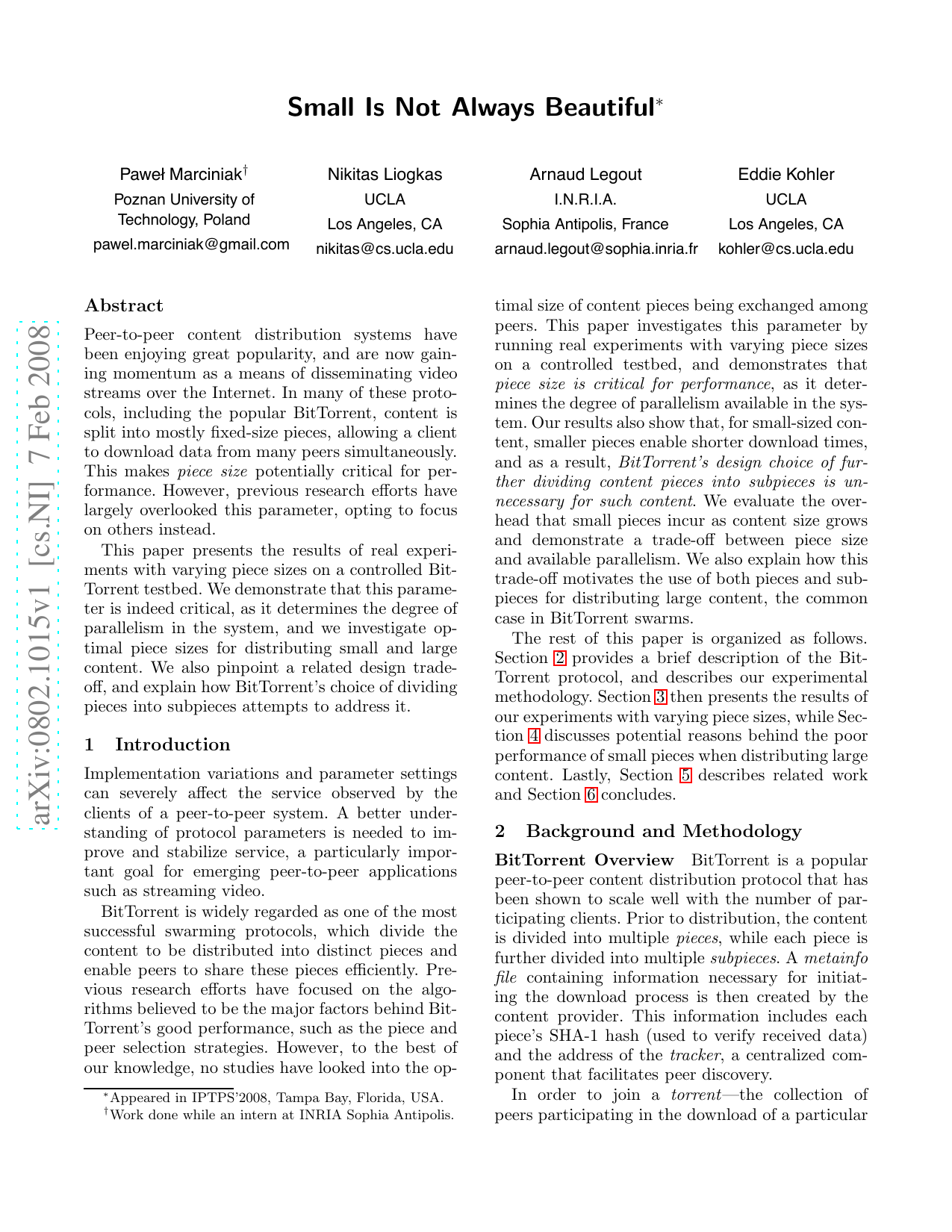
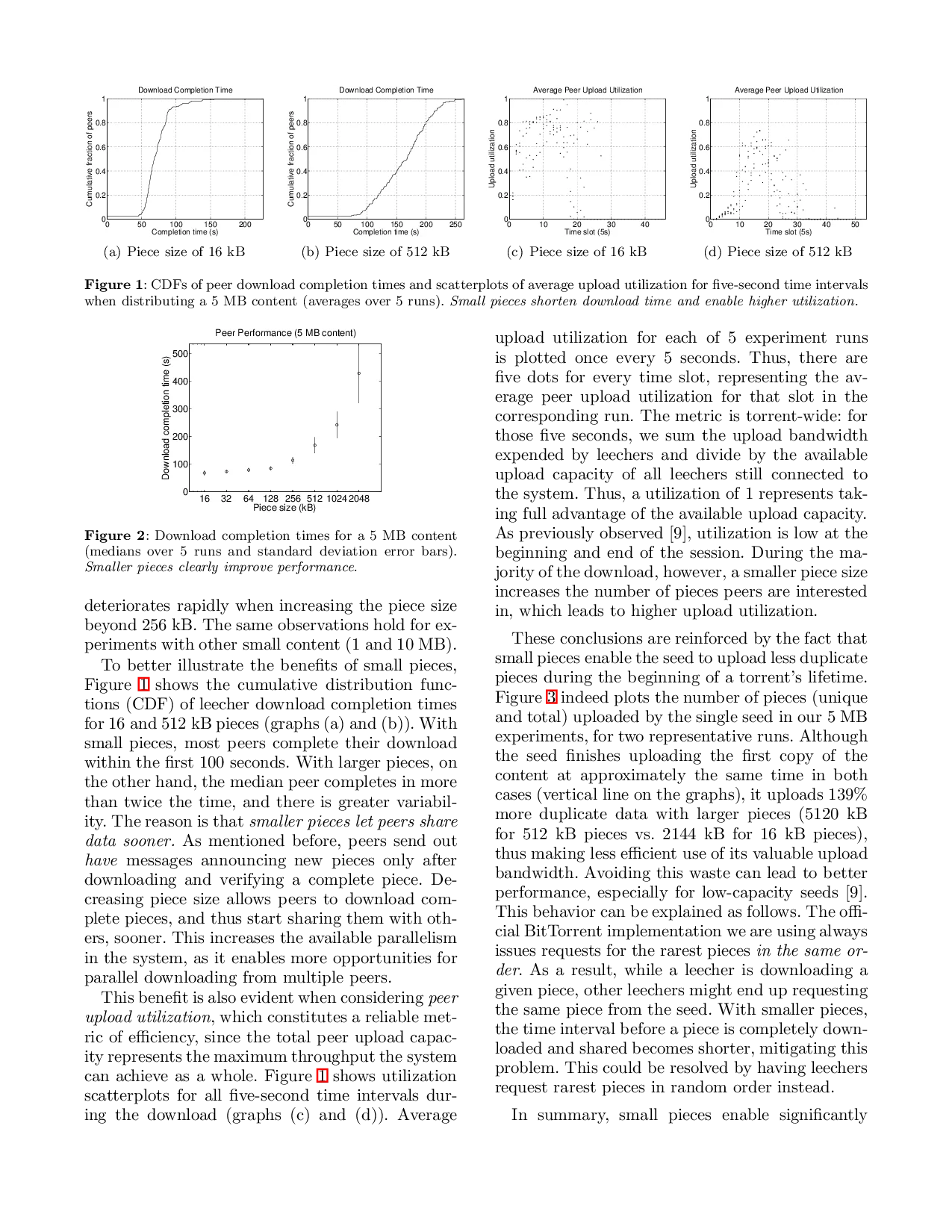
…(Full text truncated)…
📸 Image Gallery
Reference
This content is AI-processed based on ArXiv data.