Covering Homology
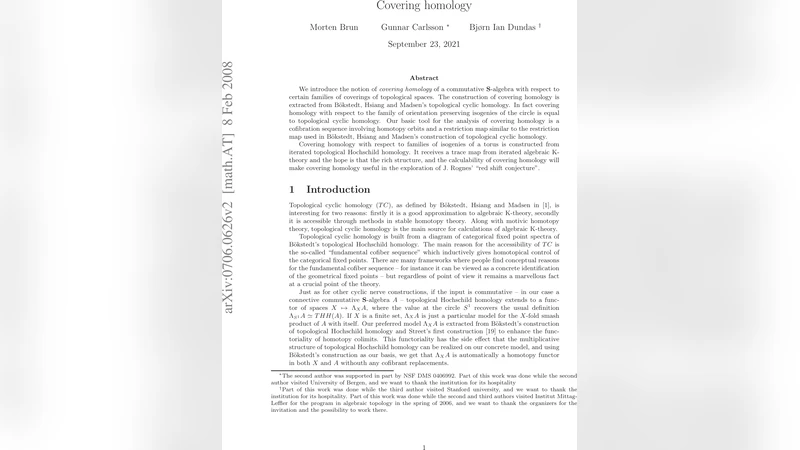
We introduce the notion of “covering homology” of a commutative ring spectrum with respect to certain families of coverings of topological spaces. The construction of covering homology is extracted from Bokstedt, Hsiang and Madsen’s topological cyclic homology. In fact covering homology with respect to the family of orientation preserving isogenies of the circle is equal to topological cyclic homology. Our basic tool for the analysis of covering homology is a cofibration sequence involving homotopy orbits and a restriction map similar to the restriction map used in Bokstedt, Hsiang and Madsen’s construction of topological cyclic homology. Covering homology with respect to families of isogenies of a torus is constructed from iterated topological Hochschild homology. It receives a trace map from iterated algebraic K-theory and the hope is that the rich structure, and the calculability of covering homology will make covering homology useful in the exploration of J. Rognes’ ``red shift conjecture’'.
💡 Research Summary
The paper introduces a new homology theory called “covering homology” (CH) for a commutative ring spectrum R, built from families of coverings of topological spaces. The construction is motivated by, and extracted from, the definition of topological cyclic homology (TC) by Bökstedt, Hsiang, and Madsen. The central idea is to replace the classical cyclotomic structure (restriction, Frobenius, Verschiebung) used in TC with a more flexible “covering” structure: given a family 𝔉 of covering maps f : X → X (typically isogenies of a compact Lie group), one forms the topological Hochschild homology THH(R;X) and assembles a cofibration sequence
THH(R;X)_{hG_f} → THH(R;X) → THH(R;X)^{hG_f},
where G_f is the group of deck transformations of the covering f. The first map is the homotopy‑orbit map, the second is a restriction map induced by f. This mirrors the R‑F‑V sequence in TC, and the resulting spectrum is defined to be the covering homology of R with respect to 𝔉.
Two principal families are studied. First, the family of orientation‑preserving isogenies of the circle S¹, i.e. the maps z ↦ zⁿ for n ≥ 1. In this case the cofibration sequence reproduces exactly the cyclotomic structure of TC, and the authors prove that CH_{S¹} ≅ TC. Hence covering homology genuinely generalises TC.
Second, the authors consider families of isogenies of an n‑torus Tⁿ. Each coordinate circle contributes its own Frobenius and Verschiebung operators, and the resulting CH is built from iterated topological Hochschild homology THH^{(n)}(R). The construction yields a multi‑dimensional cyclotomic diagram: for each prime p and each integer k there are restriction maps
THH^{(n)}(R){hC{p^k}} → THH^{(n)}(R) → THH^{(n)}(R)^{hC_{p^k}},
compatible across the different coordinates. By taking homotopy limits over all such maps one obtains the covering homology of R with respect to the torus isogeny family. This provides a calculable model: the homotopy fixed points and orbits of iterated THH are often accessible via spectral sequences, and the authors illustrate the method on several examples.
A crucial feature of covering homology is the existence of a natural trace map from iterated algebraic K‑theory to CH. The authors construct a map
K^{(n)}(R) → THH^{(n)}(R) → CH,
generalising the classical cyclotomic trace K(R) → TC(R). This trace is expected to respect the “red‑shift” phenomenon conjectured by Rognes: the chromatic height of the image should increase by one when passing from K‑theory to CH, just as it does from K‑theory to TC. By providing a higher‑dimensional version of this trace, covering homology opens a new avenue for testing the red‑shift conjecture in settings beyond the circle.
The paper concludes with a discussion of future directions. The authors suggest extending the covering families to more general compact Lie groups, exploring equivariant refinements, and investigating the interaction of CH with trace methods, motivic filtrations, and Galois descent. They also point out that the cofibration framework makes CH amenable to computational tools such as the Tate spectral sequence and the homotopy fixed‑point spectral sequence, promising concrete calculations in cases where TC is presently out of reach.
In summary, covering homology unifies and extends the cyclotomic machinery of TC, provides a flexible homotopical framework based on covering maps, and establishes a bridge to iterated algebraic K‑theory via a generalized trace. Its calculability and compatibility with chromatic phenomena make it a promising tool for advancing our understanding of the red‑shift conjecture and related problems in algebraic topology.
Comments & Academic Discussion
Loading comments...
Leave a Comment