Fluctuating semiflexible polymer ribbon constrained to a ring
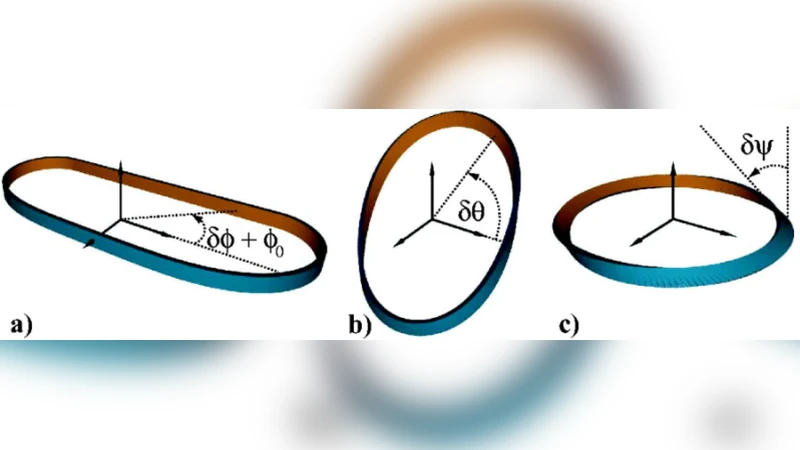
Twist stiffness and an asymmetric bending stiffness of a polymer or a polymer bundle is captured by the elastic ribbon model. We investigate the effects a ring geometry induces to a thermally fluctuating ribbon, finding bend-bend coupling in addition to twist-bend coupling. Furthermore, due to the geometric constraint the polymer’s effective bending stiffness increases. A new parameter for experimental investigations of polymer bundles is proposed: the mean square diameter of a ribbonlike ring, which is determined analytically in the semiflexible limit. Monte Carlo simulations are performed which affirm the model’s prediction up to high flexibility.
💡 Research Summary
The paper investigates the statistical mechanics of a semiflexible polymer ribbon that is constrained to form a closed ring. Building on the elastic ribbon model, which incorporates an asymmetric bending stiffness (different bending moduli for the two principal axes) and a twist stiffness, the authors explore how the geometric constraint of a ring modifies the thermal fluctuations and mechanical response of the filament. By expanding the ribbon’s elastic energy to second order in small deviations from a perfectly circular ground state, they uncover two coupling terms that are absent in the usual straight‑chain description. The first is a bend‑bend coupling term, proportional to the product of the two orthogonal curvature modes, which arises because the constant curvature of the ring forces the two bending directions to interact. The second is a twist‑bend coupling term, linking the twist density to the difference between the two bending modes; this term scales with the ring curvature (1/R) and therefore becomes more pronounced for small rings.
A key consequence of the ring geometry is an increase in the effective bending rigidity. In a free filament the restoring torque is set by the bare bending modulus A, but the closed‑loop constraint adds a curvature‑dependent contribution ΔA ∼ kBT /R², leading to an effective modulus A_eff = A + ΔA. This stiffening effect is strongest for tight rings (small R) and for low temperatures, and it directly influences observable quantities such as the mean‑square diameter of the loop.
The authors introduce the mean‑square diameter ⟨D²⟩ as a new experimentally accessible parameter for polymer bundles. In the semiflexible limit (persistence length L_p ≫ R) they derive an analytical expression:
⟨D²⟩ = 4R²
Comments & Academic Discussion
Loading comments...
Leave a Comment