Balanced category theory
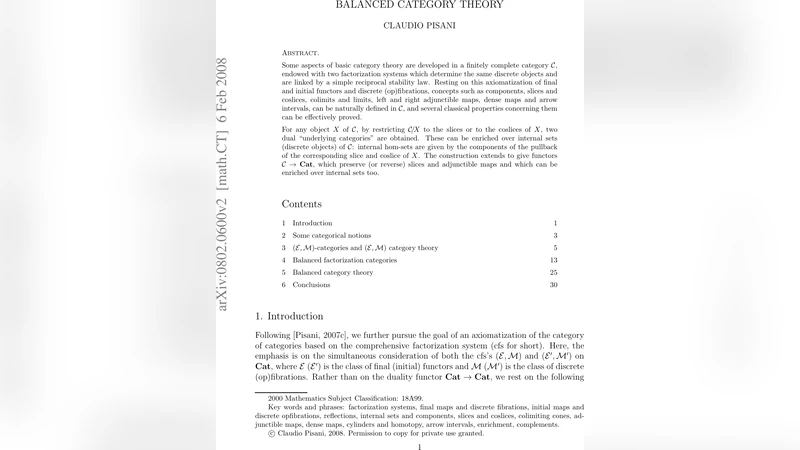
Some aspects of basic category theory are developed in a finitely complete category $\C$, endowed with two factorization systems which determine the same discrete objects and are linked by a simple reciprocal stability law. Resting on this axiomatization of final and initial functors and discrete (op)fibrations, concepts such as components, slices and coslices, colimits and limits, left and right adjunctible maps, dense maps and arrow intervals, can be naturally defined in $\C$, and several classical properties concerning them can be effectively proved. For any object $X$ of $\C$, by restricting $\C/X$ to the slices or to the coslices of $X$, two dual “underlying categories” are obtained. These can be enriched over internal sets (discrete objects) of $\C$: internal hom-sets are given by the components of the pullback of the corresponding slice and coslice of $X$. The construction extends to give functors $\C\to\Cat$, which preserve (or reverse) slices and adjunctible maps and which can be enriched over internal sets too.
💡 Research Summary
The paper develops a self‑contained version of elementary category theory inside any finitely complete category 𝒞 that is equipped with two factorisation systems (E, M) and (E′, M′). The two systems are required to determine the same class of discrete objects—internal sets—so that notions such as components, slices, and coslices can be expressed purely in terms of these factorisations. A central technical condition, the reciprocal stability law, asserts that pullbacks of E‑maps along M′‑maps and pullbacks of E′‑maps along M‑maps exist and remain in the same classes. This law guarantees that the usual stability properties of final and initial functors survive in the internal setting.
Using these tools the authors define internal analogues of final and initial functors, discrete (op)fibrations, limits, colimits, left‑ and right‑adjunctible maps, dense maps, and arrow intervals. For each object X, restricting the slice category 𝒞/X to the slices (or to the coslices) of X yields two dual “underlying categories”. These underlying categories can be enriched over the internal sets: the internal hom‑set between two objects is obtained as the component set of the pullback of the corresponding slice and coslice of X.
The construction extends to functors 𝒞 → Cat that either preserve slices or reverse coslices. These functors inherit the enrichment over internal sets and preserve (or reverse) adjunctible and dense maps. Consequently, many classical results—such as the preservation of limits and colimits, the existence criteria for adjoints, and the characterisation of dense functors—are proved in this balanced framework with concise arguments. In summary, by imposing two compatible factorisation systems and the reciprocal stability law, the paper provides a unified internal language for category theory, allowing standard concepts to be re‑derived and enriched inside any finitely complete category.
Comments & Academic Discussion
Loading comments...
Leave a Comment