Approximability Distance in the Space of H-Colourability Problems
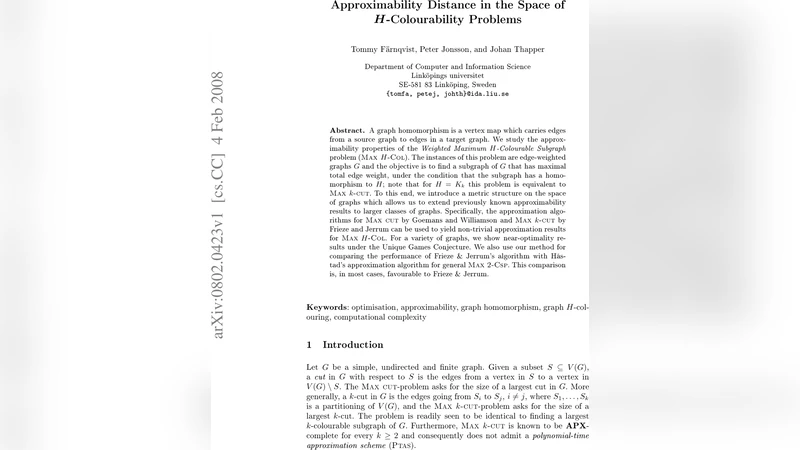
A graph homomorphism is a vertex map which carries edges from a source graph to edges in a target graph. We study the approximability properties of the Weighted Maximum H-Colourable Subgraph problem (MAX H-COL). The instances of this problem are edge-weighted graphs G and the objective is to find a subgraph of G that has maximal total edge weight, under the condition that the subgraph has a homomorphism to H; note that for H=K_k this problem is equivalent to MAX k-CUT. To this end, we introduce a metric structure on the space of graphs which allows us to extend previously known approximability results to larger classes of graphs. Specifically, the approximation algorithms for MAX CUT by Goemans and Williamson and MAX k-CUT by Frieze and Jerrum can be used to yield non-trivial approximation results for MAX H-COL. For a variety of graphs, we show near-optimality results under the Unique Games Conjecture. We also use our method for comparing the performance of Frieze & Jerrum’s algorithm with Hastad’s approximation algorithm for general MAX 2-CSP. This comparison is, in most cases, favourable to Frieze & Jerrum.
💡 Research Summary
The paper investigates the approximability of the Weighted Maximum H‑Colourable Subgraph problem (MAX H‑COL), a generalization of MAX k‑CUT where the target graph H can be any undirected simple graph. The authors introduce a novel metric d on the space of graphs modulo homomorphic equivalence (denoted G≡). For two graphs M and N, they define s(M,N) as the infimum over all weighted host graphs (G,w) of the ratio mc_M(G,w)/mc_N(G,w), where mc_X(G,w) denotes the optimal weight of an X‑colourable subgraph of G. The distance is then d(M,N)=1−s(M,N)·s(N,M). They prove that d is a genuine metric: it is non‑negative, symmetric, satisfies the triangle inequality, and d(M,N)=0 iff M and N are homomorphically equivalent. Moreover, for edge‑transitive graphs N, s(M,N) simplifies to mc_M(N,1/e(N)), linking d(K₂,H) directly to the bipartite density b(H)=1−d(K₂,H).
A central technical contribution is Lemma 5, which shows how approximation ratios transfer across the metric: if MAX M‑COL can be approximated within factor α, then MAX N‑COL can be approximated within (1−d(M,N))·α; conversely, hardness of approximation for MAX K‑COL yields hardness for MAX N‑COL scaled by 1/(1−d(N,K)). This “distance‑based reduction” allows the authors to import known approximation algorithms for MAX CUT (Goemans–Williamson) and MAX k‑CUT (Frieze–Jerrum) to a wide variety of H‑colourability problems.
The paper provides concrete applications. By applying the Goemans–Williamson SDP algorithm to MAX C₁₁‑COL they obtain a 0.79869‑approximation, and by using Frieze–Jerrum’s SDP for MAX k‑CUT they derive approximation guarantees for any H with small d(K_k,H). For edge‑transitive H, the metric reduces to the bipartite density, so the approximation factor equals the known bound for MAX CUT multiplied by (1−d(K₂,H)). The authors also show how to compute d(M,N) via a linear program that exploits the automorphism group of N; when N is edge‑transitive the LP collapses to a single variable.
A substantial portion of the work is devoted to analyzing specific graph families. For dense graphs (including random G(n,p) with constant p) the distance to K₂ is tiny, yielding approximation ratios arbitrarily close to 1. For graphs with large girth or small minimum cycle length, the distance can be bounded using known extremal results, leading to explicit approximation guarantees. The authors prove that for many of these families the obtained ratios are essentially optimal under the Unique Games Conjecture (UGC). In particular, they demonstrate that no polynomial‑time algorithm can beat the derived ratios unless UGC fails.
Finally, the paper compares the performance of Frieze–Jerrum’s algorithm with Håstad’s general MAX 2‑CSP SDP algorithm. Using the metric framework, they show that for most H the Frieze–Jerrum approach yields a strictly better approximation factor, confirming the practical superiority of the former in the context of H‑colourability.
In summary, the authors present a unifying metric‑based methodology that translates approximation results and hardness bounds across the landscape of H‑colourability problems. The metric d captures how “close” a target graph H is to a well‑understood benchmark (such as K₂ or K_k), and this closeness directly determines both achievable approximation ratios and conditional hardness. The work not only extends existing algorithms to a broader class of problems but also provides a systematic tool for evaluating the approximability of any new H‑colourability instance, with near‑optimal guarantees under standard complexity assumptions.
Comments & Academic Discussion
Loading comments...
Leave a Comment