Avalanches of Activation and Spikes in Neuronal Complex Networks
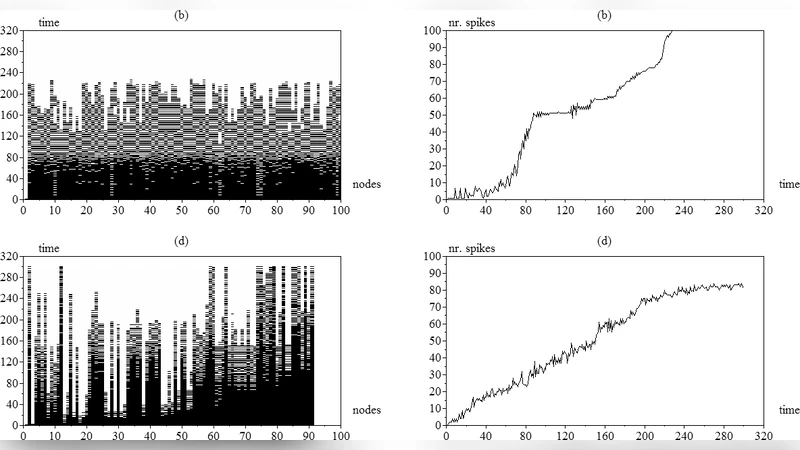
As shown recently (arXiv:0801.3056), several types of neuronal complex networks involving non-linear integration-and-fire dynamics exhibit an abrupt activation along their transient regime. Interestingly, such an avalanche of activation has also been found to depend strongly on the topology of the networks: while the Erd\H{o}s-R'eny, Barab'asi-Albert, path-regular and path-transformed BA models exhibit well-defined avalanches; Watts-Strogatz and geographical structures present instead a gradual dispersion of activation amongst their nodes. The current work investigates such phenomena by considering a mean-field equivalent model of a network which is strongly founded on the concepts of concentric neighborhoods and degrees. It is shown that the hierarchical number of nodes and hierarchical degrees define the intensity and timing of the avalanches. This approach also allowed the identification of the beginning activation times during the transient dynamics, which is particularly important for community identification (arXiv:0801.4269, arXiv:0801.4684). The main concepts and results in this work are illustrated with respect to theoretical and real-world (\emph{C. elegans}) networks. Several results are reported, including the identification of secondary avalanches, the validation of the equivalent model, the identification of the possible universality of the avalanches for most networks (depending only on the network size), as well as the identification of the fact that different avalanches can be obtained by locating the activation source at different neurons of the \emph{C. elegans} network.
💡 Research Summary
**
This paper investigates the transient dynamics of integrate‑and‑fire neuronal networks placed on a variety of complex graph topologies, focusing on the abrupt “avalanche” of activation and the associated burst of spikes that can occur during the early stages of stimulation. Earlier work (arXiv:0801.3056) had shown that such avalanches appear in Erdős‑Rényi (ER), Barabási‑Albert (BA), path‑regular (PN) and path‑transformed BA (PA) networks, while Watts‑Strogatz (WS) and geographically embedded (GG) graphs display a much smoother, gradual spread of activity. The present study seeks a mechanistic explanation by introducing a mean‑field equivalent model based on concentric (hierarchical) neighborhoods around the source neuron.
The authors first define, for any reference node, the h‑neighbourhood (all nodes at shortest‑path distance h), the hierarchical node count n_h, the hierarchical degree k_h (edges linking level h to level h+1) and the intra‑ring degree a_h (edges among nodes within the same level). These quantities capture the local “layered” structure of the graph and serve as the parameters of the equivalent model, which collapses the original network into a linear chain of layers. In this reduced description, the activation received by layer h at time t is simply the sum of the contributions from the previous layer, divided by the number of outgoing edges. Because each neuron fires when its internal state reaches a fixed threshold T, the time at which a whole layer fires can be estimated analytically as
t_h ≈ Σ_{j=0}^{h‑1} n_j / k_j .
When the hierarchical node count n_h grows rapidly with h (as in scale‑free or highly heterogeneous graphs), the cumulative time to reach the threshold becomes short, and many layers fire almost simultaneously, producing a sharp avalanche of spikes. Conversely, when n_h varies slowly (as in WS or GG graphs), the activation propagates layer by layer, yielding a smooth increase in the total spike count.
To illustrate the extremes, the paper examines two toy networks: a star‑like hub and a linear chain. In the hub case, a single source node with degree N‑1 continuously injects unit activation; after N‑1 steps all peripheral nodes receive enough input to fire together, generating a single massive avalanche. In the chain, activation flows back and forth, creating “saw‑tooth” oscillations where each node alternates between high and low internal states; the peaks of these oscillations increase almost linearly with time, and the overall spike count grows gradually. The mean‑field model reproduces both behaviors using only the hierarchical degree and node‑count profiles.
The authors then validate the theory on seven synthetic graph families (ER, BA, WS, GG, PN, PA, and a regularized version of PN called PI) and on the real Caenorhabditis elegans neuronal connectome. Simulations confirm that the predicted avalanche times and magnitudes match the observed spike histograms. In PN and PA networks, a secondary avalanche appears later, reflecting the presence of a second large concentric shell. In C. elegans, the location of the stimulus neuron dramatically changes the avalanche pattern: stimulating a neuron inside a densely connected community triggers an early, localized avalanche, followed by a slower spread to other communities. This confirms earlier findings (arXiv:0801.4269, 0801.4684) that the first‑activation times of nodes are strongly correlated with community structure, suggesting a novel method for community detection based on transient dynamics.
A striking result is the emergence of a scaling law: when avalanche onset times and intensities are normalized by the network size N, data from all examined models collapse onto a universal curve. This “avalanche universality” indicates that, beyond detailed topology, the sheer size of the network largely determines the dynamics of the transient activation burst.
In summary, the paper provides a clear, quantitative link between graph topology (through hierarchical node counts and degrees) and the non‑linear transient behavior of integrate‑and‑fire neuronal networks. The mean‑field concentric model offers a tractable analytical tool to predict when and how avalanches will occur, explains the differences between hub‑dominated and chain‑like structures, validates the predictions on both synthetic and biological networks, and uncovers a universal scaling behavior. These insights have implications for understanding brain dynamics, designing artificial spiking networks, and developing new algorithms for community detection in complex systems.
Comments & Academic Discussion
Loading comments...
Leave a Comment