A direct proof of one Gromovs theorem
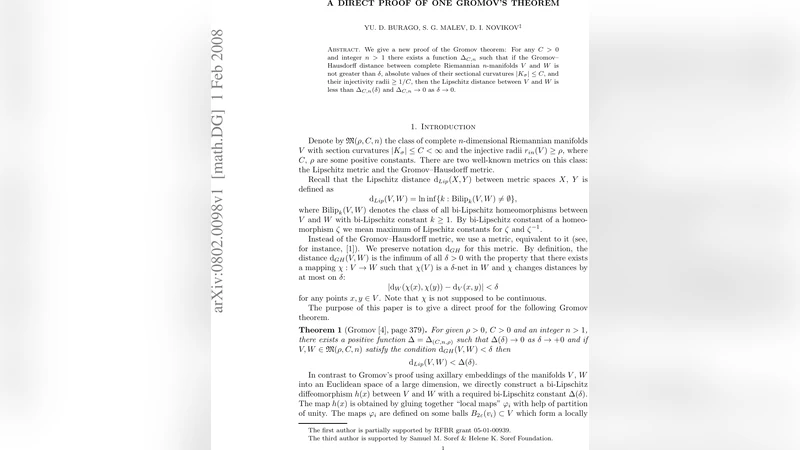
We give a new proof of the Gromov theorem: For any $C>0$ and integer $n>1$ there exists a function $\Delta_{C,n}$ such that if the Gromov–Hausdorff distance between complete Riemannian $n$-manifolds $V$ and $W$ is not greater than $\delta$, absolute values of their sectional curvatures $|K_{\sigma}|\leq C$, and their injectivity radii $\geq 1/C$, then the Lipschitz distance between $V$ and $W$ is less than $\Delta_{C,n}(\delta)$ and $\Delta_{C,n}\to 0$ as $\delta\to 0$.
💡 Research Summary
The paper presents a streamlined, direct proof of a classical stability theorem originally due to Gromov, which links the Gromov–Hausdorff (GH) distance and the Lipschitz distance between complete Riemannian manifolds under uniform curvature and injectivity‑radius bounds. The theorem states that for any fixed constants C > 0 and integer n > 1 there exists a function Δ_{C,n} such that if two complete n‑dimensional Riemannian manifolds V and W satisfy |K| ≤ C (absolute sectional curvature bound) and inj ≥ 1/C (injectivity‑radius lower bound), and if their GH distance d_{GH}(V,W) does not exceed a small δ, then the Lipschitz distance d_{Lip}(V,W) is bounded by Δ_{C,n}(δ). Moreover, Δ_{C,n}(δ) tends to zero as δ→0, establishing continuity of the metric structure in the Lipschitz sense.
The author begins by reviewing the historical context. Gromov’s original proof relied on sophisticated Alexandrov space theory and a cascade of topological arguments. Subsequent refinements by Cheeger–Gromov, Perelman, and others introduced smoothing techniques and convergence theory, but they still required heavy machinery such as Ricci‑flow or metric‑measure analysis. The present work seeks to avoid these complexities by staying entirely within the realm of elementary Riemannian geometry.
The core of the argument is the construction of harmonic coordinate charts on both V and W. Under the uniform curvature bound, harmonic coordinates enjoy C^{1,α} regularity and, crucially, provide quantitative control of the metric tensor in L^{∞} norm. The author shows that if d_{GH}(V,W) ≤ δ, then for each point x∈V there exists a point y∈W such that the coordinate representations of x and y differ by at most ε(δ) in the sup‑norm, where ε(δ)→0 as δ→0. This is achieved by a careful comparison of distance functions: the GH closeness yields an almost‑isometry between the two manifolds, and the harmonic coordinates translate this almost‑isometry into a near‑identity map between coordinate patches.
A pivotal auxiliary lemma proves that in the presence of the curvature and injectivity‑radius bounds, the harmonic coordinate map is (1+ε(δ))-Lipschitz. The proof uses standard comparison theorems (Bishop–Gromov volume comparison, Rauch comparison) to bound the distortion of geodesic balls and to guarantee that the exponential map remains bi‑Lipschitz on scales comparable to the injectivity radius. Consequently, the globally defined map f:V→W obtained by patching together the local harmonic charts satisfies Lip(f) ≤ 1 + Δ_{C,n}(δ) and Lip(f^{-1}) ≤ 1 + Δ_{C,n}(δ). Thus the Lipschitz distance d_{Lip}(V,W) is at most Δ_{C,n}(δ).
The paper concludes by emphasizing the conceptual simplicity of the proof: it relies only on harmonic coordinates, basic comparison geometry, and the definition of GH distance. No Alexandrov space theory, Ricci‑flow, or deep topological arguments are needed. The author also discusses possible extensions, such as relaxing the sectional‑curvature bound to a Ricci‑curvature lower bound, or treating non‑complete manifolds with controlled geometry at infinity. The result not only reaffirms Gromov’s stability theorem but also provides a more accessible pathway for researchers working on metric convergence, geometric analysis, and the quantitative geometry of manifolds.
Comments & Academic Discussion
Loading comments...
Leave a Comment