Computer Simulation of Host and two Parasite Species with Ageing
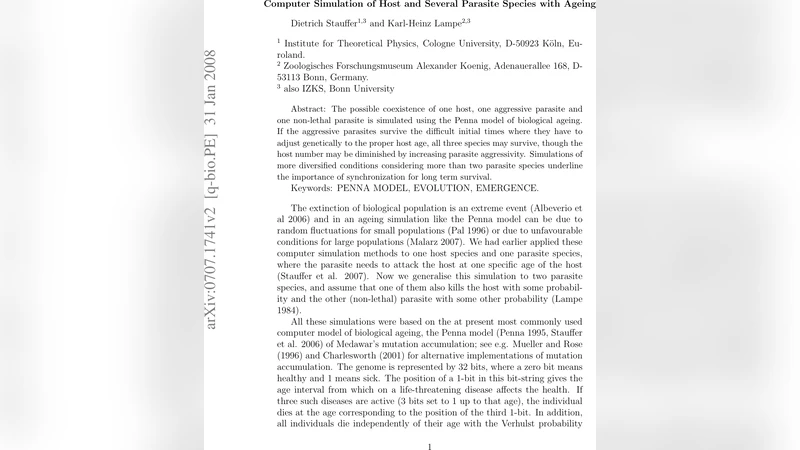
The possible coexistence of one host, one aggressive parasite and one non-lethal parasite is simulated using the Penna model of biological ageing. If the aggressive parasites survive the difficult initial times where they have to adjust genetically to the proper host age, all three species may survive, though the host number may be diminished by increasing parasite aggressivity.
💡 Research Summary
The paper presents a computational study of a host species interacting with two parasite species—one aggressive and lethal, the other benign—using the Penna model of biological ageing. In the Penna framework each individual is represented by a 32‑bit genome; each bit corresponds to a deleterious mutation that becomes active at a specific age. An individual dies when the cumulative number of active mutations exceeds a threshold, and reproduction is limited to individuals that have reached a minimum reproductive age. This construction naturally generates age‑structured mortality and population dynamics without imposing explicit age‑dependent parameters.
To explore multi‑species coexistence, the authors extended the classic host‑parasite Penna implementation by adding two parasite populations. The aggressive parasite (AP) imposes a direct mortality risk on the host: when an AP successfully attaches to a host of the appropriate age, the host’s death probability is increased. The benign parasite (BP) does not cause host death but reduces the host’s reproductive success by a modest factor. Both parasite types are endowed with an “age‑preference” gene that determines the host age class they can attach to. This mimics real‑world parasites that specialize on particular developmental stages of their hosts to evade immune defenses.
Simulations start from random genomes for all three species. A critical early phase is the “adjustment period” for the aggressive parasite: it must evolve its age‑preference gene so that it matches the host’s age distribution. If AP fails to align its preference, it cannot attach, leading to a rapid decline in its population. The authors show that when this adjustment succeeds, all three species can reach a long‑term quasi‑steady state in which the host, AP, and BP coexist.
The authors systematically varied the aggressiveness parameter of AP, which controls the magnitude of the host mortality increase per infection. Higher aggressiveness leads to a pronounced reduction in host abundance. However, when host numbers fall below a critical threshold, the parasites experience a food‑shortage effect: AP’s own population collapses due to insufficient hosts, and BP also declines because its reproductive advantage (exploiting abundant hosts) disappears. This feedback loop resembles classic predator‑prey over‑exploitation dynamics, where excessive predation destabilizes the system.
Genetic diversity analyses reveal distinct patterns. The host and BP maintain relatively stable genotype distributions throughout the simulations, reflecting their lower selective pressure. In contrast, AP exhibits a burst of genetic variability during the early adjustment phase, driven by strong selection for the correct age‑preference. This supports the hypothesis that highly aggressive parasites may evolve higher mutation rates to rapidly adapt to host age structures.
Key insights from the study include:
- Age‑specific parasite attachment can generate a robust mechanism for multi‑species coexistence, even when one parasite is lethal.
- Successful early genetic adaptation of the aggressive parasite is a prerequisite for long‑term stability; failure leads to its extinction and a simple host‑BP system.
- The level of aggressiveness modulates the host population size and, indirectly, the viability of both parasites, highlighting a trade‑off between parasite virulence and sustainability.
- High initial mutation rates in aggressive parasites facilitate rapid alignment with host age windows, but once alignment is achieved, mutation rates can decline, allowing the system to settle into equilibrium.
From an applied perspective, the findings suggest that managing parasite aggressiveness or disrupting the early adaptation phase could be viable strategies in agriculture and public health. For example, altering host age structure (through selective breeding or culling) might prevent aggressive parasites from finding suitable hosts, thereby protecting the host population while allowing benign parasites to persist and possibly outcompete the aggressive strain.
In summary, by integrating age‑dependent host‑parasite interactions into the Penna ageing model, the authors provide a quantitative framework that captures how genetic adaptation, virulence, and age specificity shape the dynamics of a three‑species community. The work advances theoretical ecology by demonstrating that even simple bit‑string models can reproduce complex ecological phenomena such as coexistence, over‑exploitation, and evolutionary trade‑offs, and it offers practical insights for designing parasite control measures that respect the underlying age‑structured biology of host‑parasite systems.
Comments & Academic Discussion
Loading comments...
Leave a Comment