Solving Min-Max Problems with Applications to Games
We refine existing general network optimization techniques, give new characterizations for the class of problems to which they can be applied, and show that they can also be used to solve various two-player games in almost linear time. Among these is…
Authors: Daniel Andersson
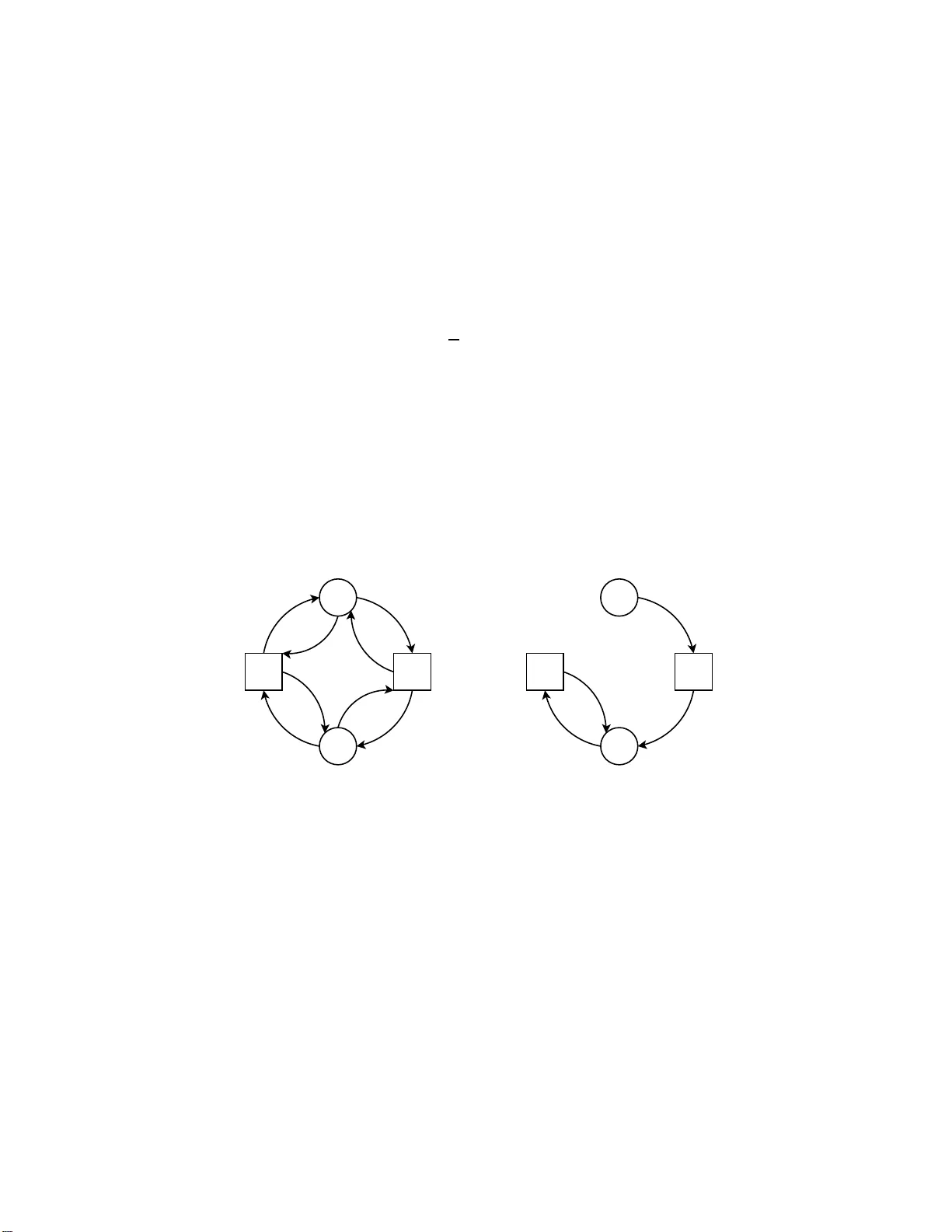
Solving Min-Max Problems with Applications to Games Daniel Andersson ⋆ Department of Computer Science, U niversi ty of Aarhus, Den mark koda@daimi .au.dk Abstract. W e refine existing general netw ork optimization techniques, giv e new characterizations for the class of problems to which they can b e applied, and show that they can also b e used to solve v ari ous tw o- pla yer games in almost linear time. Among these is a new v aria nt of the net w ork interdictio n problem, where the interdictor wa nts to destro y high-capacity paths from the source to th e destination using a vertex- wise li mited budget of arc remo v als. W e also sho w that replacing the limit av erage in mean pay off games by the maxim u m weig ht results in a class of games amenable to these techniques. 1 Min-Max P roblems W e consider problems whose instances hav e t w o parts: a finite discrete part (e.g., a graph), the structur e , and a list of n ob jects from some to- tally ordered set K (e.g., r eal n umber s ), the c omp ar ables . W e adopt the standard ran d om access machine mo del augmen ted w ith the capabilit y of comparing any t w o of the giv en comparables in constan t time. W e will only consider problems wh ere the solution is alwa ys one of the compara- bles in the problem instance (in our mac h ine m o del, this is output in the form of an ind ex b et ween 1 and n ). A min-max pr oblem is suc h a problem w here for an y fixed structure A and num b er of comparables n , the resulting function f A,n : K n → K can b e computed b y a m in-max circuit. The or der e d version of a min -max problem is obtained by alwa ys su pplying as additional input a p ermuta- tion that n on-decreasingly ord ers the list of comparables. Clearly , if the ordered v er s ion can b e solv ed in time ξ ( A, n ), then b y completely sorting the comparables, the original problem can b e solv ed in O ( n log n + ξ ( A, n )) time and O ( n log n ) comparisons. Ho w ever, it turns out that when n log n dominates o v er ξ ( A, n ), it is p ossib le to impro v e b oth of these b ounds sim u ltaneously . In particular, w e ha ve the follo wing results. ⋆ Researc h supported by Center for A lgorithmic Game The ory , funded by The Carl s- b erg F oundation. Theorem 1. If the or der e d version of a min-max pr oblem with structur e A and n c omp ar ables c an b e solve d in time ξ ( A, n ) ≥ n , then the original pr oblem c an b e solve d i n O ( ξ ( A, n ) lo g ∗ n ) time and O ( n ) c omp arisons. Theorem 2. If the or der e d version of a min-max pr oblem with structur e A and n c omp ar ables c an b e solve d in time ξ ( A, n ) ≥ n , then the original pr oblem c an b e solve d in O ( ξ ( A, n )(1 + log ∗ ξ ( A, n ) − log ∗ ( ξ ( A, n ) /n ))) time. The alg orithms are presen ted in Sectio n 2. The b asic tec hnique em- plo yed was used b y Gab ow and T arjan [6] to find a b ottlenec k spanning tree in a digraph with n ve rtices and m edges in O ( m log ∗ n ) time. Pun- nen [12] ga ve a general f ormulation of the tec h nique and used it to s olve the b ottlenec k S teiner ab orescence problem within the s ame b ound . In this pap er, we pro vid e a m ore d etailed analysis, showing that the almost linear r u nning time can b e ac hieve d while still mainta ining the asymptotically optimal linear num b er of comparisons (Theorem 1), and w e main tain the distinction b et wee n the structure and the num b er of com- parables to obtain a b ound that is nev er worse than the sorting m etho d (Theorem 2). Also, recen t w ork b y Litma n et al.[9] sho ws that the functions com- putable by min-max circuits are exact ly the c ontinuous or d er statistics of Rice [13] — con tin u ous 1 functions whose output is alw a ys one of th eir in- puts — b y showing that they are b oth the set of fu nctions that comm ute with every monotone fun ction. This yields tw o additional c h aracteriza- tions of the class of min-max problems. While previous work has b een fo cused on net work optimization prob- lems, we demonstrate in S ection 3 that the metho d s can b e applied to differen t classes of tw o-pla y er games as well. 2 Algorithms W e are giv en an instance of a min-max pr ob lem with structur e A and comparables x 1 , . . . , x n . T o simplify the presenta tion, w e shall assume that all the giv en x i are distin ct. Supp ose that w e hav e an algorithm Or d ( A, ( x ′ 1 , . . . , x ′ n ) , I ) that solve s the instance ( A, ( x ′ 1 , . . . , x ′ n )) in time ξ ( A, n ) ≥ n when x ′ I [1] ≤ · · · ≤ x ′ I [ n ] . The idea is to partition the comparables in to groups to obtain a coarse ordered instance of the p roblem. Due to con tinuit y , s olving the coarse 1 in the order topology for K and the box top ology based on it for K n instance correctly iden tifies the group in whic h the answer to th e original instance can b e foun d, and we can recursive ly cont in u e the searc h within this group. W e fi rst consid er division int o only tw o group s in eac h iteration: 1. I := h 1 , 2 , 3 , . . . , n i 2. l o := 1 3. hi := n 4. While l o < hi (a) m := ⌊ ( hi + l o ) / 2 ⌋ (b) Rearrange I so that max j ∈ I [ l o...m ] x j < min j ∈ I [ m +1 ...hi ] x j . (c) F or j := 1 . . . l o − 1 : x ′ I [ j ] := x I [1] . (d) F or j := l o . . . m : x ′ I [ j ] := x I [ l o ] . (e) F or j := m + 1 . . . hi : x ′ I [ j ] := x I [ hi ] . (f ) F or j := hi + 1 . . . n : x ′ I [ j ] := x I [ n ] . (g) If Or d ( A, ( x ′ 1 , . . . , x ′ n ) , I ) ∈ I [ l o . . . m ], then hi := m . (h) Else l o := m + 1. 5. Return l o . Let n i b e th e v alue of hi − l o + 1 in th e i ’th iteration of the while-loop. Step 4b can b e p erformed in O ( n i ) time and comparisons by a linear time median findin g algorithm[3]. Thus, eac h iteration of the wh ile-loop tak es O ( ξ ( A, n )) time, and since n i is halve d ( ± 1) with eac h iterati on, the total time is O ( ξ ( A, n ) log n ) and the total num b er of comparisons is O ( n ). An easy w a y to imp ro ve this algorithm is to break the w h ile-loop as so on as we can afford to simply sort the comparables in th e remaining in terv al, i.e., when n i log n i ≤ n . This brings the n u m b er of iterations do wn to O (log log n ). T o get ev en closer to linear time, w e need to partition the comparables in to more than tw o groups. Recursiv e p artitioning around the med ians (i.e., a prematurely cancelled p erfect quic ksort) can construct 2 k groups in O ( k n i ) time. The num b er of groups will b e c hosen so as to b alance the w ork sp ent on partitioning and solving. If we allot O ( n/i 2 ) time for partitioning in the i ’th iteratio n, then w e can ensure th at n i +1 ≤ n i 2 − 2 n/ ( n i i 2 ) , and solving this recurr en ce (see App end ix) sho w s that the num b er of iterations drops to O (log ∗ n ). S in ce P ∞ i =1 1 i 2 con verge s, the total num b er of comparisons remains O ( n ). If we are willing to giv e up the O ( n ) b ound on comparisons , we can instead allot O ( ξ ( A, n )) time for p artitioning in eac h iteration and get O (1 + log ∗ ξ ( A, n ) − log ∗ ( ξ ( A, n ) /n )) iteratio ns (see App endix for details). Note that if ξ ( A, n ) = Ω ( n log log lo g · · · log n ) for some fix ed n umber of log’s, then this b ound is actually O (1). 3 Applications to Games 3.1 Simple Rec ursiv e Games Andersson et al.[1] in tro duce the class of simple r e cursive games , whic h are t wo -pla ye r zero-sum p erf ect information extensiv e form games where the game tree is r eplaced by a game gr aph . Infi nite pla y is inte rpreted as a zero pay off. Thus, they are s imilar (but incomparable) to Condon’s simple sto c h astic games [4], but with no mo ves of c h ance and an arbitrary n u m b er of different pay offs. Figure 1 sho ws an example game. P S f r a g r e p l a c e m e n t s Min Min Max Max start s − 1 1 2 3 4 5 6 7 8 9 P S f r a g r e p l a c e m e n t s Min Min Max Max start s − 1 1 2 3 4 5 6 7 8 9 Fig. 1. A simp le recursive game ( left ) and a solution ( right ). In [1], the problem of find in g a wea k solution (v alue and minimax strategies for a sp ecified starting p osition) is reduced to a min-max prob- lem, whic h is solv ed u s ing alg orithms analogous to those presen ted herein. Ho we v er, f or th e case of optimal n u m b er of comparisons, T horem 1 con- stitutes an imp ro vemen t o ver the p revious r esult. 3.2 Maxim um P ay off Games Me an p ayoff games [14] is a class of infin ite duration games pla yed on a w eighte d sink-free digraph ( V , E , w ). S tarting from a sp ecified no de, t wo pla yers tak e tur ns c h o osing outgoing arcs to create an infinite path with arcs e 0 , e 1 , e 2 , . . . , and pla y er Min pa ys to pla yer Max the limit av erage lim n →∞ 1 n X 0 ≤ i ≤ n w ( e i ) . (1) In disc ounte d p ayoff games , (1) is replaced with a discoun ted av erage P 0 ≤ i λ i w ( e i ), w here λ ∈ [0 , 1) is a parameter. Both classes are closely related to model c hec king for the mo dal µ -calculus, a nd they are inter- esting from a complexit y-theoretic p oint of view, since they give rise to problems that are among the few natural ones kno wn to b e in NP ∩ coNP but not kn o wn to b e in P . The b est kno wn upp er boun ds for solving them are randomized sub exp onential time [2]. P S f r a g r e p l a c e m e n t s Min Min Max Max s t a r t s − 1 1 2 3 4 5 6 7 8 9 P S f r a g r e p l a c e m e n t s Min Min Max Max s t a r t s − 1 1 2 3 4 5 6 7 8 9 Fig. 2. A maxim um pa yo ff game ( left ) and a solution ( right ). In terestingly , if w e c hange the ev aluation function for the stream from limit or discounte d a v erage to simply max 0 ≤ i w ( e i ), the complexit y of solving the games plummets. Finding the v alue of a game w ith a sp ecified starting no de s is no w a min -max p roblem, and the ordered v ersion ca n b e solv ed in linear time as follo ws: 1. V alue [ V ] := + ∞ 2. While there is an arc (a) Let e b e a max-w eigh t arc, and let v b e its tail. (b) If v belongs to Min and e is not its only outgoing arc, remo ve e . (c) Else, increase the w eigh t o f v ’s incoming arcs to w ( e ), set V alue [ v ] := w ( e ), remo v e v ’s outgoing arcs except e , and con tract e (its head determining the type of the resulting no d e). 3. Return V alue [ s ] 3.3 Widest P ath In terdiction Motiv at ed by military applica tions, McMasters and Mustin [10] defi n ed and stu died network inter diction pr oblems , where an interdictor w ith lim- ited resources wan ts to inhibit the usefulness of a net work. In particular, shortest p ath inter diction is a we ll-studied v arian t [7,8]. Phillips [11] con- sidered minimizing th e maxim um fl o w. In this pap er w e define and consider a new v ariant : widest p ath in- ter diction . W e are giv en a connected net wo rk ( V , E ) with arc capacities c : E → R + , a s ource s , a destination t , and a budget k ( v ) f or eac h ve rtex v . F rom eac h vertex v the in terdictor remo v es at most k ( v ) outgoing arcs, so that th e wid th of th e wid est path from s to t is minimized (the w idth of a p ath is the m inim u m capacit y along that path). W e could also, as in [8], allo w more general budget constraint s, sp ecified by a certain class of oracles, without affecting the asymptotic ru nning time of our algo rithms. This is a min-max p roblem. The ordered v ersion can b e solv ed in O ( | E | ) time as f ollo ws: 1. Width [ V ] := 0 2. Width [ t ] := + ∞ 3. While inde g ( t ) > 0 (a) Let e b e a max-capacit y incoming arc to t , and let v b e its tail. (b) If v ’s budget allo ws it, remo v e e (this is an optimal remo v al). (c) Else, ensure that arcs to v ha ve capacit y at most Width [ v ] := c ( e ), remo ve all outgoing arcs f rom v , and merge v with t . 4. Return Wi dth [ s ] T o imp lemen t the algorithm, we need a max-priorit y queue for the incoming arcs to t . Ho wev er, th e extracted v alues form a non-increasing sequence, so w e can fi rst replace the capacities with in tegers fr om 1 to | E | (using the gi v en p ermutatio n) and then use an arr ay of | E | buc k ets to sta y within linear time. By Th eorem 1, th e widest path in terdiction problem can b e solv ed in in O ( | E | log ∗ | E | ) time and O ( | E | ) comparisons, w hic h is also , consid er in g b ound s in | E | only , the b est known b oun d for the (uninterdicted) widest path problem in d ir ected graphs [6]. If w e ins tead consider a glob al bu dget, i.e., an y set of at most k arcs ma y b e r emo ve d, then w e can solve the w idest path in terdiction problem b y p erformin g a binary searc h for the smallest capacit y q suc h that remo v- ing all arcs of ca pacit y at most q yields a net w ork w ith arc connectivit y at most k . Using Dinic’s blocking flo w algorithm [5] to compute th e arc con- nectivit y , the total runn ing time b ecomes O ( | E | min ( | E | 1 / 2 , | V | 2 / 3 ) log | E | ). This is in stark co n tr ast to shortest path in terdiction with a global budget [8], w here the maximin path length is NP-hard to app ro ximate within a factor less than 2. Ac kno wledgemen t s. Th e auth or thanks P eter Bro Miltersen and T roels Bjerre Sørensen for helpf ul commen ts and discussions. References 1. Dan iel A ndersson, Kristoffer Arnsfelt Hansen, Peter Bro Miltersen, and T roels Bjerre Sørensen. Simple recursive games. arXiv 0711.1055 , to app ear in Com- putability in Eur op e 2008 . 2. H en rik Bj¨ orklund and Sergei V oroby o v. A com b in atorial strongly subex p onential strategy impro vement algorithm for mean pay off games. Di scr ete Appli e d Mathe- matics , 155(2):210–229 , 2007. 3. M. B lum, R.W. Floyd, V. Pratt, R.L. Rivest, and R.E. T arj an. Linear time b ou n ds for median computations. In Pr o c e e dings of the 4th Annual ACM Symp osium on the The ory of Computing , pages 119–124, 1972. 4. A n ne Co ndon. The complexity of sto chastic games. Information and Computation , 96:203– 224, 1992. 5. S . Even and R.E. T arja n. Net work flow and testing graph conn ectivity . SIAM Journal on Computing , 4:507–518, 1975. 6. H .N . Gabow and R.E. T arjan. Algorithms for tw o b ottleneck optimization prob- lems. J. Algorithms , 9:411–417, 1988. 7. E. Israely a nd K . W ood . Shortest-path net w ork interdiction. Networks , 40:97–111, 2002. 8. L. K hac hiyan, E. Boros, K. Borys, K . Elbassioni, V . Gurvich, G. Rudolf, and J. Zhao. On short paths i nderdiction problems: T otal and no de-wise limited in ter- diction. T ec hn ical R ep ort TR-2007-02, DIMACS, 2007. 9. A m i Litman, Guy Ev en, and T amir Levi. On mappings that co mmute with mono- tone functions. Man uscript, 2007. 10. A.W. McMa sters and T.M. Mustin. Optimal interdiction of a supply netw ork. Naval R ese ar ch Lo gist ics Quarterly , 17:261 –268, 1970. 11. C.A. Philips. The netw ork inhibition problem. In Pr o c e e dings of the 25th Annual ACM Symp osium on the The ory of Computing , pages 776–785, 1993. 12. A.P . Pun n en. A fast alg orithm for a class of b ottleneck problems. Computing , 56:397– 401, 1996. 13. W.D. Rice. Contin uous algorithms. T op olo gy Appl. , 85:299–318, 1998. 14. Uri Zwic k and Mik e S. P aterson. The complexit y of mean pay off games on graphs. The or etic al Computer Scienc e , 158(1–2):343–35 9, 1996. App endix: Tw o Recurrences O ( n/i 2 ) Time for P artitioning First we consider th e r ecur rence n 1 = n n i +1 ≤ n i 2 − 2 n/ ( n i i 2 ) . Letting x i = n/n i w e get x 1 = 1 x i +1 ≥ x i 2 2 x i /i 2 . Lemma 1. F or i ≥ 4 , x i ≥ i 2 log 2 ( i + 1) . Pr o of. By ind uction. ⊓ ⊔ Lemma 2. F or i ≥ 4 , x i +2 ≥ 2 x i . Pr o of. By d efi nition and Lemma 1, we hav e for i ≥ 4, x i +2 ≥ x i +1 2 2 x i +1 ( i +1) 2 ≥ 2 2 ( i +1) 2 x i 2 2 x i /i 2 ≥ 2 x i . ⊓ ⊔ It follo ws from Lemma 2 that m in { i : n i ≤ 1 } = O (log ∗ n ). O ( ξ ( A, n )) Time for P artitioning W e let m = ξ ( A, n ) and consider the r ecurrence n 1 = n n i +1 ≤ n i 2 − m/n i . Letting x i = n/n i w e get x 1 = 1 x i +1 ≥ x i 2 x i m/n ≥ 2 x 1 m/n , and th us min { i : n i ≤ 1 } = O (log ∗ 2 m/n n ) = O (1 + log ∗ m − log ∗ ( m/n )).
Original Paper
Loading high-quality paper...
Comments & Academic Discussion
Loading comments...
Leave a Comment