Multiscale expansion on the lattice and integrability of partial difference equations
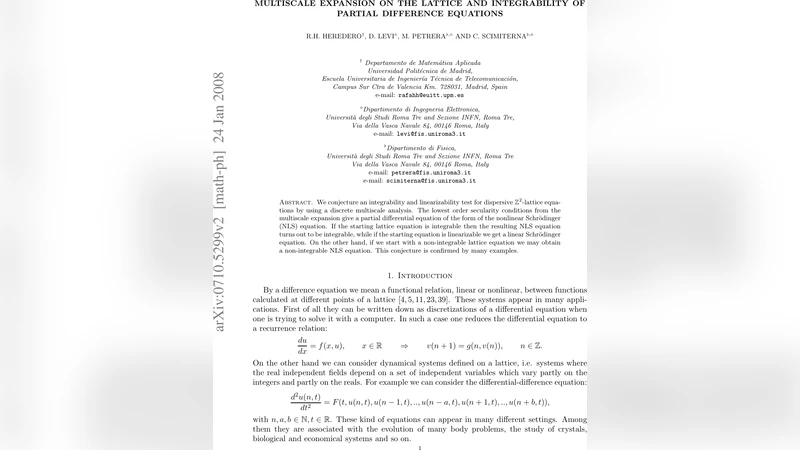
We conjecture an integrability and linearizability test for dispersive Z^2-lattice equations by using a discrete multiscale analysis. The lowest order secularity conditions from the multiscale expansion give a partial differential equation of the form of the nonlinear Schrodinger (NLS) equation. If the starting lattice equation is integrable then the resulting NLS equation turns out to be integrable, while if the starting equation is linearizable we get a linear Schrodinger equation. On the other hand, if we start with a non-integrable lattice equation we may obtain a non-integrable NLS equation. This conjecture is confirmed by many examples.
💡 Research Summary
The paper proposes a novel integrability and linearizability test for two‑dimensional (Z²) lattice equations based on a discrete multiscale expansion. Starting from a generic dispersive difference equation defined on a square lattice, the authors introduce slow continuous variables X = ε n, Y = ε m and a slow time T = ε² t, while retaining the original fast lattice indices. By expanding the dependent variable in powers of a small parameter ε and replacing lattice shifts with Taylor series, the discrete equation is systematically reduced to a hierarchy of equations at successive orders of ε.
At order ε the solution is a linear wave with a prescribed carrier wavenumber and frequency. At order ε² the amplitude modulation appears, and at order ε³ the requirement that secular (resonant) terms vanish yields a compatibility condition for the envelope. This condition is precisely a nonlinear Schrödinger (NLS) equation of the form
i A_T + α A_{XX} + β A_{YY} + γ |A|² A = 0,
where the coefficients α, β and γ are explicit functions of the original lattice parameters. The key observation is that the nature of the resulting NLS reflects the integrability properties of the original lattice model.
If the lattice equation is known to be integrable (e.g., the discrete KdV, Ablowitz–Ladik, or Hirota equations), the derived NLS is itself an integrable NLS (focusing or defocusing depending on the sign of γ). Consequently, the multiscale reduction preserves the infinite hierarchy of conserved quantities and the Lax pair structure. If the original lattice equation can be linearized through a Cole‑Hopf‑type transformation, the coefficient γ vanishes, and the envelope satisfies a linear Schrödinger equation, confirming linearizability. Conversely, for genuinely non‑integrable lattice equations, the reduction produces an NLS with non‑standard nonlinear terms or coefficients that do not correspond to any known integrable NLS; numerical experiments show chaotic dynamics and a limited set of invariants, indicating non‑integrability.
The authors substantiate the conjecture with a broad set of examples. For each case they compute the multiscale expansion, derive the envelope equation, and compare its integrability status with that of the original lattice model. The agreement across all examples—integrable lattices yielding integrable NLS, linearizable lattices yielding linear Schrödinger, and non‑integrable lattices yielding non‑integrable NLS—provides strong empirical support for the proposed test.
Beyond the specific examples, the work highlights the power of discrete multiscale analysis as a bridge between lattice dynamics and continuous field theories. It offers a practical, computationally inexpensive diagnostic tool: instead of searching for a Lax pair or performing a full Painlevé analysis on the lattice equation, one can perform a few orders of expansion and inspect the resulting envelope equation. The method also clarifies how dispersion and nonlinearity on the lattice combine to generate the effective continuous dynamics, shedding light on the algebraic structure underlying discrete integrable systems.
In conclusion, the paper establishes a clear and testable link between the multiscale reduction of Z² lattice equations and the integrability of the emergent NLS envelope. This link provides both a theoretical framework for understanding the continuum limits of discrete models and a practical algorithm for classifying new lattice equations as integrable, linearizable, or non‑integrable.
Comments & Academic Discussion
Loading comments...
Leave a Comment