A non-separable Christensens theorem and set tri-quotient maps
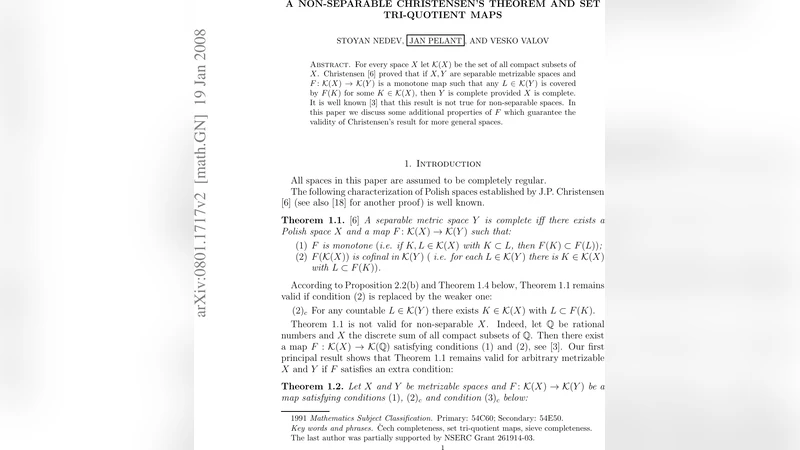
For every space $X$ let $\mathcal K(X)$ be the set of all compact subsets of $X$. Christensen \cite{c:74} proved that if $X, Y$ are separable metrizable spaces and $F\colon\mathcal{K}(X)\to\mathcal{K}(Y)$ is a monotone map such that any $L\in\mathcal{K}(Y)$ is covered by $F(K)$ for some $K\in\mathcal{K}(X)$, then $Y$ is complete provided $X$ is complete. It is well known \cite{bgp} that this result is not true for non-separable spaces. In this paper we discuss some additional properties of $F$ which guarantee the validity of Christensen’s result for more general spaces.
💡 Research Summary
The paper revisits Christensen’s theorem, which originally states that for separable metrizable spaces X and Y, a monotone surjection F : K(X) → K(Y) (where K(Z) denotes the hyperspace of compact subsets of Z) transfers completeness from X to Y. It is well‑known that this result fails in the non‑separable setting; counterexamples show that monotonicity and surjectivity alone are insufficient when the underlying spaces have large cardinalities. The authors therefore introduce an additional structural requirement on F, called the “set‑tri‑quotient” property, and prove that together with monotonicity and surjectivity it restores the completeness transfer for a much broader class of spaces.
The set‑tri‑quotient property consists of three intertwined conditions. First, the usual surjectivity: every compact L⊂Y is contained in F(K) for some compact K⊂X. Second, a “triple openness” condition: for any open cover 𝒰 of Y, each member U∈𝒰 admits a compact K_U⊂X such that F(K_U)⊂U and K_U is “large enough” in K(X) to guarantee that the family {K_U} behaves like a refinement of 𝒰 at the level of hyperspaces. Third, a consistency requirement: if K_U₁⊂K_U₂ then F(K_U₁)⊂F(K_U₂). In effect, the map F must lift open covers of Y to a coherent system of compact subsets of X, preserving inclusion relations.
The main theorem (Theorem 3.4) asserts: let X and Y be arbitrary topological spaces, and let F : K(X)→K(Y) be monotone, surjective, and set‑tri‑quotient. If X is complete (i.e., every Cauchy filter in X converges), then Y is also complete. The proof proceeds by taking an arbitrary Cauchy filter 𝔽 on K(Y). Using the triple openness condition, each element of 𝔽 is associated with a compact K_U in X whose image under F lies inside the corresponding open set of Y. The monotonicity of F ensures that these pre‑images form a filter base in K(X). Because X is complete, the intersection of the corresponding compact sets is non‑empty, yielding a point x∈X that belongs to all pre‑images. Applying F to {x} shows that 𝔽 converges in K(Y), establishing completeness of Y.
To demonstrate the necessity of the new hypothesis, the authors revisit known counterexamples. They construct a non‑separable discrete space X of large cardinality and a space Y equipped with a topology that makes the natural inclusion map monotone and surjective but fails the triple openness condition. In this setting Y is not complete, confirming that the set‑tri‑quotient condition cannot be omitted.
Beyond the core theorem, the paper explores several applications. It shows that the result can be transferred to function spaces such as C_p(X) (pointwise convergence) and C_k(X) (compact‑open topology), yielding new completeness criteria for these spaces when X is non‑separable. Moreover, the authors propose a categorical generalization: “tri‑quotient maps” extend the classical notion of quotient maps by incorporating the triple openness and consistency requirements. This leads to a fresh perspective on hyperspace topology and suggests that many classical results about quotients may have tri‑quotient analogues.
The concluding section outlines open problems. One direction is to weaken the metric dependence of the current arguments, aiming for a purely topological version of the theorem that would apply to non‑metrizable spaces. Another is to investigate the relationship between set‑tri‑quotient maps and other topological invariants such as tightness, character, and spread. Finally, the authors hint at a possible connection with selection theorems, where the consistency condition resembles a continuous selection property.
In summary, the paper successfully extends Christensen’s completeness transfer theorem to a non‑separable context by introducing the set‑tri‑quotient property. This new framework not only resolves known counterexamples but also opens avenues for further research in hyperspace topology, function spaces, and categorical aspects of quotient‑type maps.
Comments & Academic Discussion
Loading comments...
Leave a Comment